Happy Birthday, San Francisco!

Two hundred thirty-six years ago on 28 March 1776, the settlement that would one day become the great city of San Francisco was founded. While the British-dominated eastern shore of North America was in political ferment and rebellion that would result in the world’s first colonial declaration of independence, the Spanish-dominated western shore was being settled to make a reality Spain’s longstanding claim to the potentially valuable territory. Spain had started to settle California with the establishment of a small military garrison and a religious mission on San Diego Bay in 1769.

That same year, the impressive, accommodating, and strategically important San Francisco Bay had been discovered. Though the California coast had been frequently explored in the preceding 250 years, the Spanish despaired of finding a decent natural port. Unlike the East Coast of North America whose many rivers formed navigable tidal estuaries and bays at regular intervals along the coastline, the West Coast of North America was almost completely devoid of natural harbors. Until the discovery of San Francisco Bay, the best harbor that had been found was at the Monterey Peninsula, and that was not a particularly sheltered locale.

Why did it take so long to find San Francisco Bay? Well, those who have been there surely know: it is often foggy there. Very foggy. So foggy, in fact, that the narrow opening of the Bay, the Golden Gate, often disappears from view, either from inside the Bay or from outside. Though many expeditions had sailed very close to the Golden Gate – Sir Francis Drake is thought to have sailed within four miles of it – not a one saw the wonderful gap in the coastline that opened into a splendid natural port. It seems somehow typical of San Francisco – doing the exact opposite of what is usually expected – that the famous Bay was first discovered from the land! Yes, it was Gaspar de Portola’s 1769 overland expedition that made first sighting of the glorious natural harbor that would later become so important.

So it was on this day, 28 March in that fraught and momentous year of 1776, that the first settlers under Juan Bautista de Anza reached the site that was to become San Francisco. It was first established as a military garrison – in Spanish Presidio; it was a military facility for Spain, Mexico, and the United States. The United States Army maintained that Post until the site was incorporated into the Golden Gate national recreation area in 1994, and “The Presidio” proudly bore its founding date, 1776, upon its entrance gates. The very next order of business was the founding of a religious mission. The ancient adobe mission building, dedicated to the patron of the Franciscan friars who built the California missions, San Francisco de Asis, still stands, having withstood nine major earthquakes and five major fires unscathed. And finally established was a small town known, in honor of the healing herb that grew on the site, as Yerba Buena, Good Herb.

The actual city of San Francisco would not exist until the first American governor of California granted a charter to the former Yerba Buena in 1847. This governor, John C. Frémont, was a renowned geographer who had mapped a great deal of the far West for the United States Army – he also coined the name “Golden Gate” for the entrance to San Francisco Bay (in 1846, before gold had been discovered) but his coining did not stick in its original form: drawing on his mastery of Classical Greek, Frémont had dubbed the breathtaking entry Chrysopylae, “Golden Gate.” (I am glad that the English form won out!) Frémont also established a bit of a tradition of Californian unorthodoxy: an Army officer, Colonel Frémont had been appointed governor by Commodore Stockton after the U.S. victory in the Mexican-American War. General Kearny felt this was an unacceptable slight – he outranked Frémont, after all! Kearny therefore arrested Frémont and sent him to Washington, D.C. charged with mutiny!

Frémont was convicted and almost immediately pardoned by President Polk. The whole affair convinced many of the former Mexican citizens who now found themselves under American rule that the Yanquis were as unstable as the Spanish Grandees who had been so intolerable. (All the principals have streets named after them in San Francisco!)

San Francisco, as this brief account illustrates, was unusual and unorthodox from its very founding. And California has often had a rough time with its governors! But in any case, a Happy 236th birthday to one of our nation’s – indeed, one of the world’s – most interesting and delightful cities!

Downtown San Francisco looking eastward from UCSF Medical Center. This is an unorthodox view, most SF cityscapes looking westward. 06SEP08.

Jamie Rawson
Flower Mound, Texas

It is an odd thing, but everyone who disappears is said to be in San Francisco.

— Oscar Wilde

Happy Birthday To The University Of California!

Today, 23 March 2018, is the day upon which the University of California, Berkeley celebrates its 150th anniversary, its annual Charter Day. The University has accomplished many great things in its 15 decade life span; it has seen triumphs and tragedies, upheavals and euphorias. By any measure, it is one of the great institutions of learning and discovery in the world, and it is fitting to pay tribute to its long, eventful, and impactful existence.

It was, in reality, 150 years ago 23 March 1868 that the Organic Act creating the University of California was enacted. The plan to build a state university is as actually even older than the state of California itself. The first constitutional convention for the state-to-be was held at Monterrey in 1849, more than a year before California was admitted to the Union 9 September 1850. At that session, hope was expressed for the establishment of a great university, the only limiting factor being the perennial problem of lack of money. Despite the riches promised by the Gold Rush, the state had no significant tax base. One delegate, undeterred by the sad state of financial affairs, nevertheless observed, “If we have the means here, we can procure the necessary talent; we can bring the president of Oxford here by offering a sufficient salary.”

Though the hopes were high in 1849, it would take almost two decades for the state to finally realize its aspirations for a university. The United States Congress granted the state 46,000 acres of public lands to endow the university in 1853, and with the passage of the Morrill Act in 1862, a further land endowment of 150,000 acres was made available. But still no university was created. During this period, the private College of California had been founded in Oakland, across the bay from San Francisco, and in 1866, the California legislature established an Agriculture, Mining, and Mechanical Arts College. This state college had funding, but no campus; the College of California had a campus but no funds. Seeing an opportunity, Henry Durant, president of the College of California, proposed that the college give its facilities to the state on the condition that a proper university be established, merging the faculties of the College of California and the AM&M College. This proposal was accepted, and on 23 March 1868, the University of California was formally established and chartered.

In addition to a small site in Oakland, the College of California owned a sizable tract of land to the north of Oakland amid some rather marginal farmland. The site had limited water resources, which was something of a drawback, but it had one remarkable asset: it was situated exactly opposite the Golden Gate and possessed an absolutely unique and stunning view. This view through the Golden Gate and out over the vast expanse of the Pacific Ocean was inspiring, and seemed to embody the very aspirations of the state and its new university. When the site was acquired, Durant and others gathered at a rocky outcropping and gazed at the prospect. One of those present quoted the final stanza from the poem On the Prospect of Planting Arts and Learning in America:

Westward the Course of Empire takes its Way;
The four first Acts already past.
A fifth shall close the Drama with the Day;
Time’s noblest Offspring is the last.

The poem’s author was the scholar and philosopher George Berkeley (always pronounced “BARK-lee”) Bishop of Cloyne, Ireland in the early 18th century. Bishop Berkeley felt that America had great potential for furthering education and achievement; his notions resonated with the founders of the College of California, and they decided to name the surrounding town in honor of Bishop Berkeley. The University of California moved to the Berkeley campus in 1873, after two large buildings had been completed.

The first graduation class of the University of California was rather small; they bore the collective nickname “The Twelve Apostles.” From that small class, however, came a future governor of California, two future mayors, a future congressman, and three future Regents of the UC. It was an auspicious start. That first class was all male, but in 1870, the university committed to accepting women as well, and from that time on was a co-educational institution.

During the 1870s, the UC experienced many difficulties as the institution became a “political football,” with opposing factions fighting over the university for political influence, or hurling charges of mismanagement at the school for political aims. In the state’s constitutional convention of 1878, the UC was given an unprecedented degree of independence. The University of California enjoys a unique position among public universities, as it is not merely a function of the state government, but an autonomous, almost equal fourth branch of state government. The idea was that the UC would be dependent upon the legislature for some funds, but otherwise insulated from political infighting. This noble ideal has not always been as successful as the originators had hoped, but it has produced a vigorous, dynamic, and truly independent university.

From the outset, California aimed to build a truly great university. By the 1870s, foreign students began to enroll in the UC. Eastern academics attracted by favorable salaries and a pleasant climate began taking professorships at the university. Professors from universities in the American South left institutions still devastated by the Civil War and came to California. By the turn of the 20th Century, the University of California had built an international reputation.

In 1899, Benjamin Ide Wheeler was appointed president of the University of California. During Wheeler’s twenty-year tenure, the school grew from 2,600 students to over 12,000, and from fewer than 200 faculty to nearly 700. Wheeler was an adept fund raiser, and he attracted many private benefactors to sponsor the growth of the campus, beginning a long tradition of private support for a public university. The Berkeley campus experienced a building boom which gave the campus its stunning “classical core” designed by America’s foremost proponent of Beaux Arts architecture, John Galen Howard. Under Wheeler’s strong leadership, students were given a functional self-government. The University expanded during Wheeler’s time with two “farms” (agricultural research stations) at Davis and at Riverside, a medical school in San Francisco and an oceanographic research facility at San Diego. To better serve the southern region of the state, an extension campus was founded in Los Angeles. All of these facilities later became full campuses in what is today the ten campus system of the University of California. Wheeler assembled a faculty of the very first rate. By 1906, the University of California was accounted one of the “Big Six” universities in the United States, along with Harvard, Yale, Columbia, Chicago, and Michigan.

After Wheeler resigned in 1919, the comptroller of the university, Robert Gordon Sproul, had effective command of the campus for ten years prior to being appointed president in 1930. Sproul served for an unheard of 28 years as president of the University. During Sproul’s time in office, the University grew even larger. The university extension in Los Angeles became UCLA. Additional campuses were added. Enrollment grew dramatically, from about 30,000 statewide in 1930 to almost 80,000 in 1958 when Sproul retired. The university’s reputation grew as well.

In 1929, Ernest O. Lawrence built his cyclotron which revolutionized atomic physics. Lawrence was awarded the Nobel Prize for Physics in 1939, the UC’s first recipient (and, in fact, the first Nobel Laureate at any public university.) Today the UC has more than 100 Nobel Laureates among its faculty, staff, and alumni throughout the various campuses (of these, 65 are affiliated with the Berkeley campus.)

By the 1950s, it was plain that the University of California was much more than its flagship campus in Berkeley. In response to growing demand for access to the University, the Regents restructured the campuses, ultimately leading to the 10-campus system which exists today.

At one time, “The University of California” inevitably described the institution whose campus was in Berkeley. This campus was also called, in the fashion of so many state universities, simply “California,” or “Cal.” The rise of this multi-campus university, or “multiversity,” to use former President Emeritus Clark Kerr’s terminology, led to the use “Berkeley” to specifically describe the Berkeley campus. It is as “Berkeley” that the University of California’s oldest campus is most commonly known today when discussing its academics (or its politics.) Sports fans, however, recognize that “California,” or “Cal” has long been an outstanding name in athletics. Interestingly enough, many people who are well aware of the athletic achievements of “Cal,” have no idea that “Berkeley” has a football team!

California athletics have many notable achievements, including five undefeated seasons of football in the 1920s under Coach Andy Smith. (The outstanding record of 50 straight games without a loss stood for many years and was significantly “bested” – by 5 – in 2003 by Ohio’s Mount Union College.) Cal also has the distinction of playing some of the most famous (or infamous) plays in college football history, notably “Wrong-way” Roy Riegels’ reverse run against Georgia Tech in the 1929 Rose Bowl, and 1982’s “Miracle of Strawberry Canyon,” better known as “The Play,” which featured 5 lateral passes on the final play of the Cal Stanfurd Big Game, resulting in a 25-20 Cal victory. Football is by no means Cal’s only sport, though space does not permit the listing of all of Cal’s sporting accomplishments here.

I would also note that Cal has for more than a half century fostered one of the finest college marching bands in the U.S. Though nearby rival Stanfurd is home to a “wild and crazy” band of the most anti-traditional kind, it is “Berkeley” whose band represents traditional musical and marching discipline. Many who see the Cal Band in performance, such as the huge crowd at 1979’s Garden State Bowl, find it hard to imagine that such a polished group arises from “Berkeley.” Just goes to show what they know …

In the 1960s, the Berkeley campus attracted national attention because of its significant student activism. In the era of the Civil Rights struggle across the country, a large number of students at the University of California felt that their education had to serve a purpose more meaningful than the simple pursuit of a good job. The campus’s conflicts and upheavals in the 1960s merit a discussion of far more detail than this essay permits, but a few key points should be noted: the beginning of the student demonstrations and campus unrest was grounded in the most uncontroversial of motives: Free Speech.

For much of the UC’s history, the University forbade any form of political discourse on UC property. The aim was laudable enough: as a truly independent arm of the state government, the Regents felt that it was wise to forbid any political activity within the University itself. Though this policy was generally unpopular with the campus community, it was acceptable because the campus was situated in the heart of the city. Those who wished to discuss matters political had merely to step to the edge of campus to stand on Berkeley city property where politics could be discussed. In honor of the campus’ main entry way to the city, Sather Gate, this accommodation was known as “The Sather Gate Tradition.”

This tradition meant that the main entrance to campus was typically the gathering place for political expression of every stripe. A cartoon from 1924 shows every sort of cause from the Irish Revolution to “The Jews Harp Club” being promoted at Sather Gate, all, of course, asking for donations. And this tradition acted as a safety valve that permitted students to accept the UCs prohibition of Free Speech on the campus itself. True, there were some rather embarrassingly bizarre results, such as when the presidential candidates of 1952 and 1956 had to address campus crowds from cars parked on city streets, yet it worked.

When the University grew in the late 1950s, however, the border of the campus proper moved a block south of Sather Gate. Territory that had been the scene of free political discourse for more than 50 years suddenly became subject to the prohibition against Free Speech. Yet trouble did not start immediately because “The Sather Gate Tradition,” in a modified form, moved south with the border of the campus.

In the Fall of 1964, “The Sather Gate Tradition” was suddenly revoked without apparent justification. The chancellor of the Berkeley campus and his assistant determined that the new southern border of the campus where political activity had been relocated in the wake of campus expansion was, in fact, technically, UC property. Accordingly, a ban against all political expression was proclaimed.

Nothing will incite resentment and reaction like the revocation of long-held rights. Changes to such rights, and changes to perceptions of such rights, are notoriously contentious and difficult to effect. The University officials, by all accounts, fumbled badly. The result was the first major student demonstration of the 1960s: Berkeley’s Free Speech Movement (FSM) was born.

The Free Speech Movement, it is important to note, was in no way an exclusively “radical” or even “left wing” movement. When one looks at the photos of the students involved in the protest, it is striking that the vast majority of the men are wearing coats and ties and the women are in dresses. The Free Speech Movement appealed to a broad array of students of all political viewpoints. Among the signatories to the statement of aims of the FSM were both the California Young Republicans and the Young Californians For Goldwater! These were young adults who wanted, simply, to be able to talk about the vital issues of the day on the campus where they were preparing for their place in the larger world. That hardly seems subversive.

But with the power and influence of television, the student protests of the FSM became major media events. within a few months, anyone who wanted their cause to be televised discovered that a demonstration on the Berkeley campus virtually guaranteed coverage. By the late 1960s when anti-war protests turned violent and deadly, the streets of Berkeley south of the UC campus were the premiere place for demonstration and agitation. It is notable that reliable estimates for the violent clashes of 1968-1971 account no more than 20% of the protesters as having affiliation with the University (affiliation is imprecise: students who had graduated or dropped out may or may not be accounted as “affiliated,” and so the numbers range between 10 – 20% in most estimates. In any case, it was never near a majority.)

Despite the pain and upheaval of the 1960s, the University continued to grow and to carry on its mission. The later 1970s saw a return to a more peaceful and productive campus atmosphere, though one in which political confrontation was a prominent fixture. In 1980, Cal’s Czeslaw Milosz was honored with the Nobel prize in literature, a first for a campus whose Physicists and Chemists had dominated the honors.

By the 1990s, the Berkeley Campus drew more of its funding from private donations than from state support. As the University continued to grow, the Berkeley campus continued in its flagship role as it does even today. In the past two decades many advances in science and technology have originated at Berkeley. Chemistry, Physics, Biology, Geology, Paelontolgy, Economics, History, and Engineering have all seen major contributions from Berkeley scholars. Computer folks know of advancements such as BSD Unix and RAID storage. A great public university has continued to uphold its public trust.

More than 100 years ago, Benjamin Ide Wheeler addressed the students of the University of California:

“The University shall be a family’s glorious old mother by whose hearth you shall love to sit down. Love her. It does a man good to love noble things … it is good to be loyal to the University, which stands in life for the purest things, and the cleanest, loftiest ideals. Cheer for her; it will do your lungs good. Love her; it will do your heart and life good.”
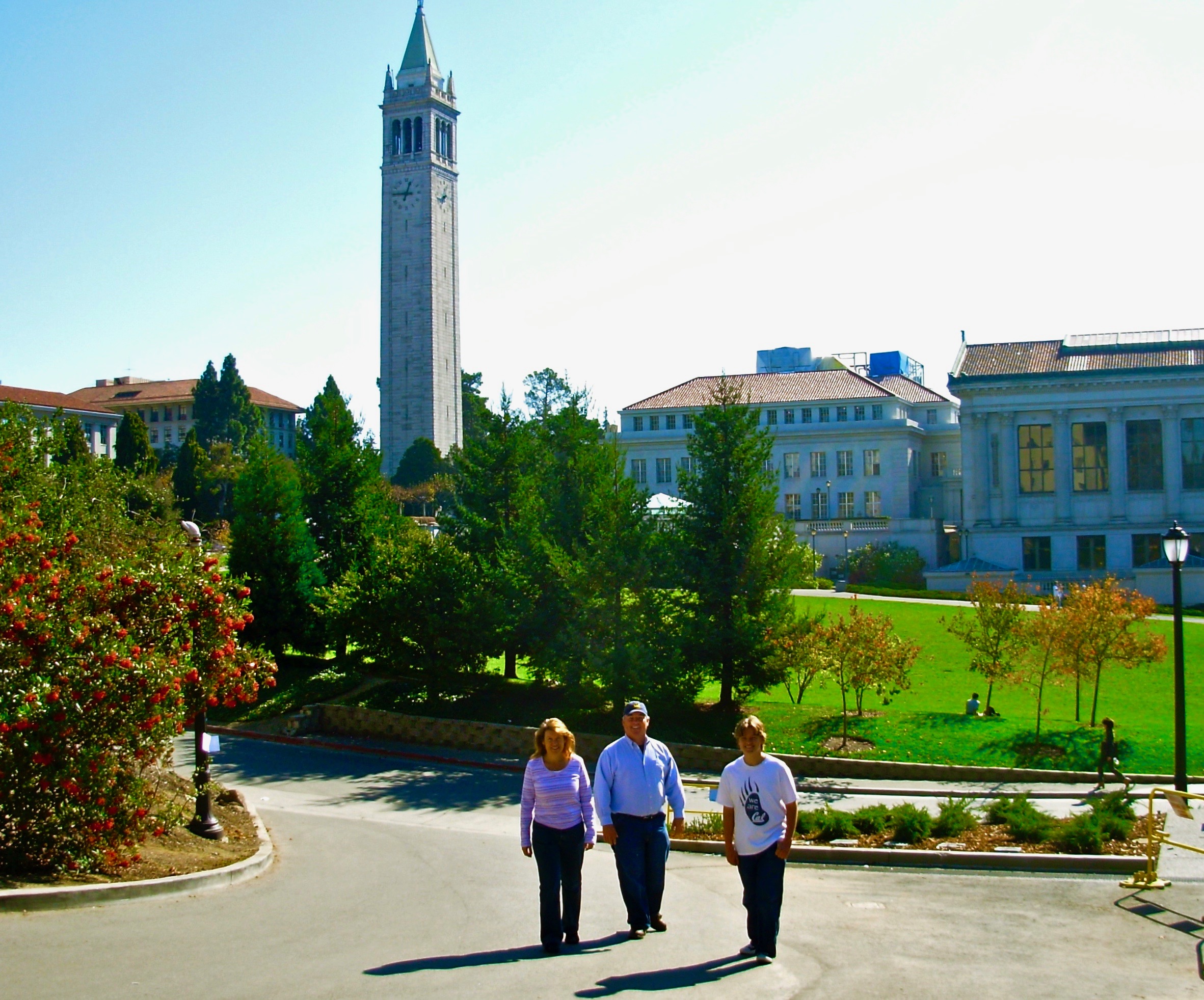
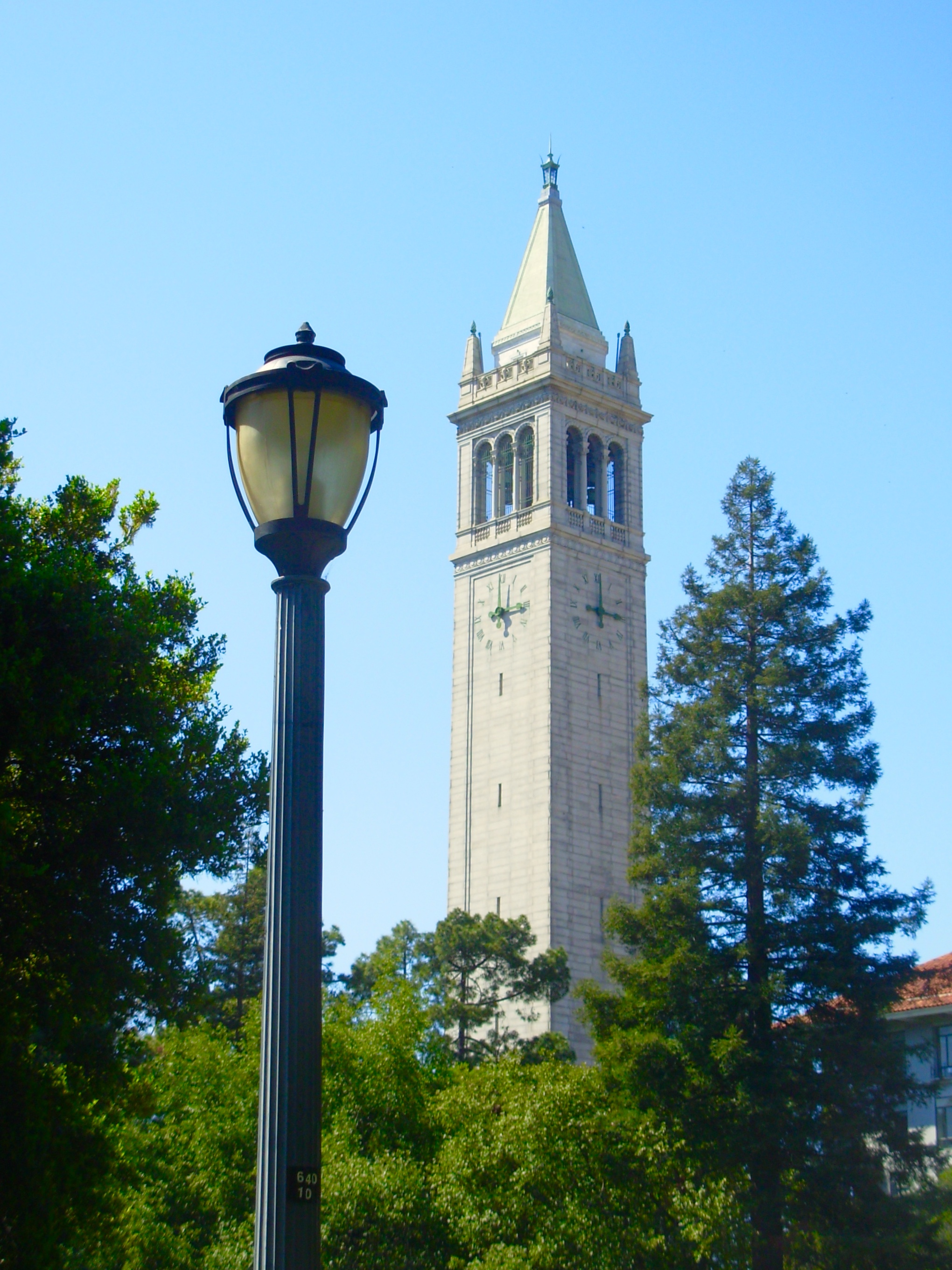
Happy Birthday to the University of California!!!

Jamie Rawson
Flower Mound, Texas

It is a good thing in general to avoid doing what you couldn’t explain to your mother.

— Benjamin Ide Wheeler,
President of the University of California,
Remarks to the new Freshman class, 1920
20 March 1852: A Book That Changed The World

It was on this day in 1852 that Harriet Beecher Stowe’s landmark novel Uncle Tom’s Cabin; or, Life Among The Lowly was first published. The book unquestionably ranks as one of the most important novels in world history: it was the best seller of the entire Nineteenth Century throughout the world, second only to the perennial leader, The Bible, and it was significantly responsible for creating a profound change in attitudes toward slavery throughout the United States of America, but mainly, of course, in the Northeast and Midwest. Pro-slavery and Abolitionist sentiments had been at odds from the very earliest days of the founding of our republic, but in the wake of the publication of Uncle Tom’s Cabin, abolitionist sentiment grew immensely. Tolerence for the manifest hypocrisy of the evil of slavery flourishing in “The Land of the Free” grew less and less. As absolutists on each side clashed, war became inevitable. Upon being introduced to Mrs. Stowe at the Whitehouse, Abraham Lincoln is reported to have said, “So this is the little lady who made this great big war!”

The book sold out its first run almost immediately. Before the end of 1852, more than 300,000 copies had been printed in the United States, an unprecendented success at that time. Another 200,000 copies were printed elsewhere in the English-speaking world, and translations began to appear in other languages before the year was out. These figures do not include unauthorized and “bootleg” copies that flooded the market as well, nor the many unauthorized abridgements and digests of the book. Additionally dramatic interpretations ranging from public readings to many hundreds of theatrical versions brought the tale to millions of people. It was a phenomenon unlike any which the world had seen. And, as noted above, its impact was immense and immediate.

For today’s tastes, Uncle Tom’s Cabin is overwrought, melodramatic, and verbose in the extreme. Stowe’s prose styling makes one think of Charles Dickens as being spare and concise by comparison. The novel’s major appeal today lies in its historical importance. It is today much more often read about than read; indeed, some recommend against actually reading the unabridged original novel because it contains characterizations of its enslaved protagonists that are distinctly stereotypic and often unflattering (though no one decries the portrayal of the wicked and greedy Simon LeGree, whose name is still an epitome for nastiness and evil.) This seems to me to be a perfectly fine state of affairs, as the book really is a labor to slog through; it is enough to know what it was about and to know its impact.

Uncle Tom’s Cabin did not start the dialogue on slavery in the United States, and it certainly did not conclude it. It did, however, hugely influence the development and direction of that dialogue. The book did not really do much to advance the understanding and communication between blacks and whites in the United States either. The book was written for a white audience, and while it is sympathetic and sentimental about the condition of the slaves, it does not portray a realistic view of the slave experience, and in fact did much to promote limiting, negative stereotypes. More than a century after the publication of Uncle Tom’s Cabin, the book was at the center of controversy in the height of the Civil Rights movement.

So, Uncle Tom’s Cabin was not genuinely timeless literature, nor did it promote real understanding among diverse and conflicting populations. But it did enkindle an outrage against centuries of slavery that brought about the end of that “Peculiar Institution,” as it was euphemistically known, within less than fifteen years. The end of slavery was a most necessary starting point to permit our nation to begin addressing the resultant issues of inequality and race in America. That process is ongoing still, and as is plain from then Senator Obama’s much remarked upon speech in early 2008, that process is a work in progress, a work that has not yet, even after more than 150 years, reached its goal. The past is not dead; it is not even past: it is with us in the present. But knowing the past and frankly facing it with all its glories and all of its shames, is necessary to living today and building a better future for all of us.

-+-+-+-+-+-+-+-+-+-+-+-+-+-+-+-+-+-+-+-+-+-+-+-
Jamie Rawson
Flower Mound, Texas

Fable is more historical than fact, because fact tells us
about one man and fable tells us about a million men.

— G. K. Chesterson

Happy Saint Patrick’s Day!

Saint Patrick was the man
Who, through piety and stealth,
Drove the snakes from Ireland!
Here’s drinking to his health!!!

Happy Saint Patrick’s Day!

Whatever one’s ethnic heritage, one can wear the green and raise a glass in celebration. It is a particular genius of our American melting pot that we can be Irish on Saint Patrick’s Day, Mexican on Cinco De Mayo, Lovers (which is to say: Citizens of the World) on Valentine’s Day, and anything at all at Christmastime, while being Americans all year ’round.

Contrary to a common assumption, St. Patrick was indeed an actual historical person about whose life we have much documentation. He wrote a Confessions which, while not rivaling St. Augustine’s similar work, is nevertheless a an important piece of post-classical Latin, and a valuable reference for fifth century Church history.

Patrick was born in Roman Briton, near modern-day Bristol. When he was a young man, he was kidnapped by a band of Irish pirates and enslaved. During his period of slavery, he became fervently devoted to the Christian faith in which he had been raised, and he determined to Christianize the pagan Irish. He also, unsurprisingly, developed a life-long hatred for slavery.

Patrick was finally rescued from slavery after several years, and he returned to Briton where he took holy orders and became a priest. He returned to Ireland unaccompanied to begin his mission of converting the Irish. Patrick preached the Gospel to the heathen Celts throughout Ireland’s four provinces (Ulster, Munster, Linster, Connaught, and Meath*) and he found a remarkably receptive audience. Though the Irish were fiercely attached to such classic Celtic pastimes as violence and sexual license, they nevertheless accepted the message of the Gospel and Patrick became attached to the court of the Ard-Rí (high king,) ultimately becoming Ireland’s first bishop.

It is not known if the legend of Patrick using a seamróg – or shamrock – to illustrate the concept of the Trinity has a basis in fact — he certainly makes no mention of it in his writings; it is even more doubtful that he drove the serpents from the island, but, one supposes, it could be true … His aversion to slavery became influential in Christian thinking and is significantly responsible for the fact that for nearly a millennium Western Europe did not practise slavery (per se.) The Irish aversion to slavery was also manifest in the massive migrations of Irish who flocked to the free states of the U.S. and the trickle into the slave states. Southern politicos railed against Irish immigration, and the Irish became strong abolitionists, mainly, Gerald O’Hara notwithstanding.

What is known for sure is that Patrick was responsible for an absolutely unique occurence in Western history: the completely peaceful conversion of an entire people. Alone in European history, Ireland experienced no violence nor strife in the conversion to Christianity, yet the complete conversion was effected in a generation. Well, just how complete is complete? As recently as 1992 I was invited to visit a “holy well” on the outskirts of Sligo, being assured that its waters were healing and beneficial (one elderly lady even told my traveling companion that if she would wet her feet in the well, she’d bear a child within the year! Which Michelle, being then single, really didn’t wish to happen …) Such holy wells — and groves, and mountains, and fields, and such — were a feature of Druidic religion, and festivals such Lughnasa and Halloween and Michaelmas all tie to Druidic feasts: in many ways the Irish simply fitted Christianity over the old, pagan ways. Yet they embraced Christianity with a passion, and with Christianity they also embraced the necessary literacy and in so doing became master scribes and authors.

The Irish, as Thomas Cahill’s book title claims, “Saved Civilization.” When the whole of Western Europe was being marauded by barbarians and Vikings, the Irish at the far West of the world, copied classical literature and religious texts, and added their own works to the cannon. By the ninth century, there were Irish monasteries from Scotland to Kiev and from Sicily to Upsala. It was from these resources that Charles the Great, king of the Franks and Emperor of the newly formed Holy Roman Empire, was able to launch the Carolingian renaissance.

Of course the Irish still retained a love of fighting and a sense of fierce independence that prevented the political unification of the country (except briefly in the 1000’s under Brian Boru) and the difficulties of that legacy are still vexing the Irish today. Easily divided and defeated seriatim, the Irish became subjected under the Vikings (who founded virtually all of Ireland’s great cities: Dublin, Derry, Wexford, Waterford, Cork, but not Galway) and later the Normans in England. In the late 1100’s, the pope was so frustrated with the political instability in the most Christian see of the Church that he permitted England’s Henry II to take the title of King of Ireland, and for the next 750 years the Irish were subjects of the king of England. Periodic revolts — some 70 major risings in that time period — were to no avail because even the most successful revolt would end with the fragmentation and ultimate suppression of the participants.

Finally, in the 1920’s, England relinquished Ireland (after some incredible brutality on the parts of The Crown and the IRA) but retained control of six of the nine counties of historic Ulster. The painful results of that compromise are well-known down to our own day.

The internal trials in Ireland led to massive waves of emigration throughout the 18th and 19th centuries. “Unhappy Ireland, whose chiefest export is her children,” a 19th Century commentator observed. America, Canada, and Australia are heavily populated by the descendants of these emigres, but to a lesser extent the Irish also settled in Latin America; one of the heroes of Latin American liberation is Bernardo O’Higgins. Interestingly, though the best census figures estimate that possibly one in four Americans has Irish heritage, and some 40% of U.S. presidents have had Irish heritage, (including Mr. Obama) surveys repeatedly find that nearly 60% of the U.S. population claim Irish descent!

Happy Saint Patrick’s Day!!!

-+-+-+-+-+-+-+-+-+-+-+-+-+-+-+-+-+-
Jamie Rawson
Flower Mound, Texas

It is said that God created whiskey
so that the Irish wouldn’t conquer the world.

— Irish Folk Wisdom

* Yes, that’s FIVE provinces … precision is not a particularly Celtic concern 😉

BEWARE THE IDES OF MARCH

It was about 2,056 years ago this day, (give or take a few calendrical corrections in the interval) on 15 March, 44 BC, known in the Roman calendar as “The Ides” (“IDVS” meaning, most likely, “mid-month”) that the last leader of the Roman Republic, the dictator Gaius Julius Caesar, was murdered by a group of well‐meaning, if arguably incompetent conspirators as the Senate gathered to conduct business in Pompey’s theater in Rome.

These men styled themselves saviors of the Roman Republic and had coins minted which featured the phrase IDVS MARTIVS (The Ides of March) and depicted a “Liberty Cap”, the emblem of a freed slave, hoping to convince the people of Rome that Caesar’s murder had freed them from tyranny. Unfortunately, and quite oppositely, in the wake of the assassination of Caesar, civil strife and chaotic uncertainty dominated the political landscape for years, ending only when Julius Caesar’s adopted son, his nephew Octavius, took control of Rome as the first true Emperor of Rome, Caesar Augustus.

Under Augustus, Rome’s political situation stabilized and the economy regained its former vigor. Materially, Rome prospered, but her cherished heritage of more than 500 years of civil liberty and republican government had vanished, killed more by decades of short‐sighted petty politics among Rome’s competing factions, coupled with the indifference of the electorate, than by the daggers of Caesar’s assassins.

Whether one admires Caesar or detests him, it nevertheless remains that he’s still a pretty big part of our lives: our calendar is the one he promulgated (with one amendment by Pope Gregory XIII in the 16th century) and we have the month “July” to honor him (and “August” to honor his heir, Augustus.) Many of the checks and balances in the U.S. Constitution were emplaced by our founders specifically to prevent a modern‐day Caesar from arising here.

Because the name Caesar became so inextricably associated with imperial power, it came to mean “emperor.” The German term Kaiser and the Russian term Царь, “Czar” (or “Tsar”) both derive from Caesar. From early 44 BC when the Senate conferred the status of Dictator Perpetuo upon Caesar, (dictator without a fixed term) until the forced abdication of Simeon II, last Tsar of Bulgaria, in 1946 — nearly 2,000 years — the world was never without a ruler somewhere whose title derived from Caesar’s name!

“Caesar salad”, however, is not named for Julius at all, or at least not very directly: it was created at Caesar’s Hotel in Tiajuana, Mexico during the prohibition era when the Hollywood elite would drive to Mexico for cocktails and dinner. A “Caesar” salad was named for Caesare Cardini, the hotel’s Italian-born proprietor.

-+-+-+-+-+-+-+-+-+-+-+-+-+-+-+-+-+-+-+-+-+-+-+
Jamie Rawson
Flower Mound, Texas

The strangest poison ever known
Came from Caesar’s laurel crown.

— William Blake

A Revolution In Naval Warfare

History so often vitally depends upon which side wins a battle. A key victory at the right moment can alter all that follows. Of course, some glorious victories, such as that of Henry V’s English longbowmen over the flower of French Chivalry at Aigincourt, or John Churchill’s “famous victory” at Blenheim apparently accomplish nothing more, in the long run, than ending the lives of countless soldiers. But, oddly enough, sometimes a great contest can culminate without a clear winner at all, yet radically alter the course of history all the same.

On 9 March 1862, what is arguably the single most important naval battle of the American Civil War ended in a draw at Hampton Roads, Virginia. The Confederate ironclad warship CSS Virginia and the Union ironclad USS Monitor had engaged one another for more than 3 hours without result. CSS Virginia is better known as Merrimac, confusingly, because Virginia had been built on the reclaimed hull of a Union ship. Thus, this battle is generally referred to as the battle between the Monitor and the Merrimac.

The two ironclads used steam power alone. Previous steam-powered warships retained traditional sails, as did the very first ironclad, France’s La Gloire of 1859, but the radical designs of Virginia and Monitor precluded such a scheme. Both vessels were heavily armed with powerful guns. Virginia was fitted with traditional broadside ranks, but Monitor had a remarkable, revolutionary revolving turret. Both were heavily armored with iron plates that rendered the most powerful shots harmless. With neither ship able to inflict meaningful damage upon the other in the course of their contest, both withdrew to regroup and repair after the grueling fight.

Both sides claimed victory at the time, but the action has long been considered a draw. The meeting of the two untested, state-of-the-art warships was the truly crucial aspect of the engagement, and the result was undeniably a tie. It is certainly true that on the morning of March 8 the Confederates inflicted great damage to the Union blockade fleet which was bottling up the state of Virginia’s trade. CSS Virginia sank two traditional wooden Union warships and forced a third to run aground. Virginia was initially able to attack at will and with impunity, so the Union losses were about 261 killed to 7 Confederates. This would ordinarily count as a significant tactical victory for Virginia, except that she failed utterly in her mission to lift the Union blockade. The timely arrival of USS Monitor prevented Virginia from inflicting any more damage upon the Union blockade fleet and turned the battle into a contest between the ironclads.

Though the epic clash of the ironclads was inconclusive from a tactical and strategic point of view, it was nevertheless a dramatic turning point in the history of naval warfare. Until 9 March 1862, ironclad warships were an untried experiment, and most tradition-minded naval brass around the world viewed them as novelties. Though France and England had built a small number of ironclads between 1859 and 1862, both navies relied upon and were still bulding traditional wooden-hulled ships. But the news of the battle at Hampton Roads changed everything immediately and irrevocably.

The United States Navy commenced commissioning an entire fleet based upon the design of USS Monitor. The Confederacy could not match the Union’s industrial might, and never again seriously challenged the Union navy. Within days of news of the battle reaching England and France, both country’s navies put an immediate halt to all construction of wooden ships. Other major navies followed suit. Russia ordered the construction of ten “monitors” and newly formed Kingdom of Italy a like number. By year’s end of 1862, ironclads had been added to every major fleet in the Western world, or were under construction. By 1866, in the largest fleet action the world had witnessed in almost 40 years, the Italians and Austrians fought at the battle of Lissa where 7 Austrian ironclads decisively defeated 12 Italian ironclads. The age of sail had effectively ended for naval warfare.

The new iron and steel navies which ran on coal-burning steam engines changed the very nature of global geo-politics. In the age of sail, ships needed little more than periodic replenishment of food and water for the crew, even on extended voyages. And these needs could be met at most any port of call, or even in wilderness. But steam ships required coal, and lots of it. A coal burning ship was limited by her supply line. Suddenly, small and otherwise uninteresting islands became potential strategic resources as coal depots. A scramble for island empires began, and by the end of the century, the majority of oceanic islands across the globe had been claimed by one of the Western powers. Even islands that had previously been independent nations were caught up in this race for coaling stations. In a very real way, the independence of the Kingdom of Hawaii was doomed on 9 March 1862.

The inconclusive battle between CSS Virginia and USS Monitor seemed to have accomplished nothing very meaningful at the time, yet everything that followed was changed by the very fact that it was fought. That no clear victor emerged was, ultimately, unimportant. Wooden ships and sails had been a mainstay of navies for more than 2,500 years; quite literally overnight, they were rendered obsolete. It is perhaps fitting, that the United States Navy christened its first ironclad “Monitor,” which is Latin for “One Who Warns.”

-+-+-+-+-+-+-+-+-+-+-+-+-+-+-+-+-+-+-+-
Jamie Rawson
Flower Mound, Texas

There was never a good war, or a bad peace. — Franklin

A Revolution In information Technology

On or about this date – some sources cite February 24, others February 23 – in 1455, a watershed event in human history occurred. There was no upheaval, no violent conflict, nor even much note taken of the event at the time, yet it arguably changed the world more profoundly than any other single event of the last millennium. In the town of Mainz, Germany, the workshop of goldsmith Johannes Gutenberg began the production of the renowned Gutenberg Bible (also known as the 42-line Bible to distinguish it from a later Gutenberg production, the 36-line Bible.) This edition produced a rather small run of copies by later standards – perhaps some 200 copies, of which 180 survive – over the course of about a year. But that represented an unimaginable advance in information technology. From the very dawn of the written word until Gutenberg’s invention of the movable type printing press, all written words were produced laboriously by hand. The cliche of scribes laboring for years to produce a single volume are quite authentic. A well-staffed scriptorium might produce one copy of The Bible in a year’s time. Gutenberg started a revolution!

Gutenberg’s Bible was not the first printed item his workshop produced, but it was the first full book. Very quickly the news of Gutenberg’s invention spread across Europe, and within twenty years every major urban center had printing presses operating. The impact of this revolution is literally incalculable. Books suddenly became affordable to private citizens, where previously only large corporate entities such as monasteries and universities could afford them. The situation is rather analogous to the more rapid evolution of computers: originally only big businesses, governments, and universities could afford the immense investment in early computers. When microcomputers hit the market, they were still very much a luxury item. (Today, of course, it seems that everyone has a computer!)

Within a generation a profound cultural change swept across Europe. The printed word meant that consistent, accurate copies of information could be widely disseminated across Europe, and the effect was to vastly increase the rate of learning and development within Europe. By the year 1500, virtually every piece of literature from classical antiquity had been produced in a printed book. More profoundly, new works were being printed. In the days of hand-written texts, there was not a notable demand for newly written books; teachers simply passed along their knowledge to their students through the spoken word, scientists communicated personally through letters. But with printing, the demand for recognizable expertise rose, and with it the notion of the value of authorship. The printing press is responsible in a real and direct way for the Renaissance and the Scientific Revolution which followed. It also contributed enormously to the Protestant Reformation of the 16th century. (Ironically, among the very first printed texts produced by Gutenberg’s press were Papal Indulgences, which Martin Luther specifically condemned in his famous 95 theses. Luther’s 95 theses were widely distributed in printed broadsheets, forerunner to modern newspapers.)

Gutenberg certainly did not invent the press itself, for screw presses to produce wine and olive oil had been used since the days of antiquity. That basic design required little modification to serve as a printing press. It is thought that some sort of printing press had been employed to produce copper plate or woodblock prints of single sheet documents well before Gutenberg’s time. Gutenberg is also not the first individual in history to conceive of movable type, an honor which, as seems so often to be the case, apparently belongs to the Chinese, inventor Bi Sheng creating clay type stamps about 450 years before Gutenberg.) But Gutenberg’s uniquely valuable contribution was to combine the press with practical movable type. His knowledge of metallurgy led him to create cast metal type, using lead, tin, and antimony, which remained the essential “typemetal” until modern offset printing replaced handset type in the 19th century. It is not known if Gutenberg invented the punch-cut method of producing type, as was long supposed, but it is certain that he used metal type. He also developed more suitable oil-based inks, also a long-standing standard in the industry.

Gutenberg did not profit from his invention, however: his financial backers sued and won control of his workshop (I am always fascinated about how much of the documentation from medieval days is from court cases!) In later life he was awarded a small pension by the Archbishop of Mainz. It was not until many years after his death that the impact of his invention was truly recognized, and his gravesite was forgotten and lost. Today there are many monuments and statues commemorating Gutenberg and his contribution to the advance of human society.

The most enduring monument to Gutenberg must, of course, be the printed book. It is fitting that Gutenberg’s first great project was to print The Bible. A very widely quoted fact is that The Bible is the best-seller of all time, which it is, hands-down. Less well known is that it remains the best-seller year after year even today. Last year about 25 million Bibles were sold in the United States, in a huge variety of different editions and translations. (By comparison, the latest Harry Potter book has sold some 10 million copies.) Annual expenditure on Bibles in the United States is estimated at more than half a billion dollars. Spreading The Good News is good business! Forty-seven percent of Americans claim to read The Bible daily, and ninety-one percent of U.S. households have at least one copy on hand, with the astonishing average of four copies for each household! Gutenberg would be pleased with the trend he started, I would guess. But as it was for Gutenberg, Bible publishing remains an often unprofitable enterprise, for the production is expensive and the retail margins are low. Gutenberg might take some small satisfaction in that fact as well.

Jamie Rawson
Flower Mound, Texas

You don’t have to burn books to destroy a culture. Just get people to stop reading them. — Ray Bradbury

Happy Birthday, George!

It was on this day in 1732 that the first President and Chief Executive of The United States of America, George Washington, was born. Often referred to by the ancient Roman honorific title “the Father of his Country,” George Washington actually deserves the honor. As “Light Horse” Harry Lee wrote at Washington’s death, he was “First in war, first in peace, first in the hearts of his countrymen.”

In the late 1960s and early 1970s, it became the fashion to call into question any received wisdom about historical figures in American History, and the more revered a figure, the more downgraded it seemed they had to become. Now, I am all for a healthy skepticism when it comes to history – it is, after all, as Napoleon observed, usually written by the winners – yet I do balk when the known facts are ignored. My 11th grade U.S. History teacher asserted that Washington was a bad general, a poor politician, and a wanna-be king. These “facts” were, of course, at least incorrect, and perhaps even outright lies. (Tom Maeder was possibly trying to spur people to read on their own and form their own opinions; equally likely he just delighted in shattering icons, and didn’t let a few facts get in his way.)

As a general, Washington was no Napoleon nor Alexander; he did not have to be. He won a few pivotal battles, but it is true he lost about as many. Yet war is not a tennis tournament: it really does matter which battles you win. You can lose many minor frays if you win the important ones. Then, too, Washington’s main brilliance was in devising a very modern understanding of the realities of warfare: War is damnably expensive, and Washington shrewdly calculated that his greatest chance for success was to keep several British armies in the field for as long as possible while denying them a chance at a conclusive victory. Knowing that the fledgling United States could neither outgun nor outspend the British Empire, he nevertheless knew he could make the war more expensive than the Empire could tolerate. Washington had studied his Roman history quite thoroughly, and modeled his strategy upon Quintus Fabius Cunctator’s successful war of attrition against Hannibal. And, as we know now, Washington’s “Fabian Strategy” worked.

As a politician, George Washington ably presided over the Constitutional Convention, managing to guide a contentious and divided gathering of representatives of the several states to a successful conclusion of their mission. No other citizen of the United States commanded the necessary respect and personal affection to undertake so politically risky a post; without his leadership and the legitimacy it imposed upon the proceedings, the entire enterprise might have failed aborning.

As the first President under the Constitution, Washington established many precedents which – far from being Royal in character – showed that Washington was sincerely committed to the republic and the democratic, republican ideals upon which the nation had been founded. It was Washington, for example, who decided that The President of the United States of America would be addressed simply as “Mr. President.” Many have noted that Washington was frequently addressed as “His Excellency” during his term of office, but the address was not preferred by Washington; it was a holdover from officials and functionaries who had grown up in the British Empire, and who found old habits of titular deference hard to abandon.

Washington also established the profoundly important precedent that a president should serve no more than two terms. It is hardly a kingly ambition to voluntarily step down from power. And it is quite notable that in his will, Washington identified himself plainly as “Citizen of the United States.” Not “Former President,” not “General of the Army,” but “Citizen.” It is hard to find regal pretension in that.

In his own time, Washington was well respected in Europe, and he enjoyed an excellent reputation in Great Britain after the Revolution. In France, Napoleon himself proclaimed a period of national mourning when the news of Washington’s death reached Paris.

Much much more could be said of Washington – and of course hundreds volumes have been written – but it is enough to say that George Washington truly was a towering figure in American history, and remains truly deserving of our genuine respect and gratitude (he’d not have wanted our awe.)

Oh, and one other thing: I started by noting that many of the old facts about George Washington had been called into question in the iconoclastic 1960s and 1970s, and I noted that the facts genuinely were correct. BUT, I am quite wrong when I say the George Washington was born on this day in 1732, for he most definitely was NOT. Despite what we used to celebrate every year before it was subsumed into the rather bland and uninspiring “President’s Day,” February 22 is not George Washington’s Birthday. Old George was born on the 11th of February 1731! True.

George Washington was actually born on February 11, 1731 as reckoned by the Old Style, Julian Calendar which was then still in use in Great Britain and its colonies at the time. The old Julian Calendar, however, was flawed in its imposition of one leap-day every four years, making the average Julian year exactly 365.25 days. The physical solar year is not quite so neatly precise, being 365.2424 days long; the difference seems small, but trivial values add up over time. The Julian scheme made the calendar gain somewhat on the physical solar year. By the 1500s, the calendar was off by a full ten days and Pope Gregory the XIII decreed in early 1582 that a two-fold correction should be made: the short-term fix was to delete ten days from the year 1582. The calendar that year jumped from October 5 to October 15. The other correction was to eliminate 3 leap-years from every 100 so that only century years evenly divisible by 400 would be leap years (thus 1600 and 2000 were leap years, but 1700, 1800, and 1900 were not.) In this scheme, the average year works out to be 365.2425 days, an error that would add up to about a day around the year 10000. However, because the actual solar year is increasing very slightly, astronomers these days periodically add a “leap second” to the calendar, which should keep things aligned satisfactorily.

The adoption of this new calendrical scheme was uneven, but by 1587 the Catholic countries of Europe had put it in place. On continental Europe, other countries soon fell in line, the utility of the new calendar and the desirability of a uniform dating system being obvious. But insular England stubbornly refused to implement the new, Popish calendar, and held on to the old, inaccurate Julian Calendar for another 180 years. The English also calculated the beginning of the legal year as late March rather than January 1st, and so 1731 ran from April to March, thereby including George Washington’s birth.

At length, bowing to the demands of commercial trading interests, Parliament decided to adopt the Gregorian Calendar. Thus the month of September 1752 lost eleven days – the number required for the correction at that point.

George Washington was a 20 year old surveyor when this change took place. Being a punctilious gentleman, George was uncomfortable with celebrating his birthday 11 day early in 1753, so he himself decided that from 1753 forward he would celebrate his birthday on February 22nd. And so it is that George Washington was born on February 11, 1731, but he and we have come to celebrate February 22 as his birthday, and we now reckon his natal year as 1732.

It’s all so simple, eh? 😉

-+-+-+-+-+-+-+-+-+-+-+-+-+-+-+-+-+-+-+-+-+-+-+-+-+-+-+-+-
Jamie Rawson
Flower Mound, Texas

Labor to keep alive in your breast that little spark
of celestial fire, called conscience.

— Washington

Executive Order 9066

In the aftermath of Imperial Japan’s surprise attack upon the U.S. Military at Pearl harbor, fear and uncertainty gripped the United States. Americans of Japanese heritage were suspected of divided loyalties or worse. On February 19, 1942, President Franklin Roosevelt issued Executive Order 9066 enabling the Secretary of War to declare “Military Zones” and ultimately authorizing the internment of more than 100,000 Japanese-Americans in “War Relocation Centers.”

The internment of Japanese Americans potentially applied to anyone who had a Japanese great grandparent or closer heritage, so that citizens of Chinese-Japanese heritage were affected; Koreans were affected as well, since Japan had governed Korea for almost 40 years by the time of Pearl harbor. (It is notable that almost none of the more than half-million Chinese-Americans in the US during the war years were affected by this “relocation” effort. China was a U.S. ally in the war with Japan.) Was this internment order inspired by racism and bigotry? In large part, no doubt. Simple greed was a major factor as well, profiteering knowing no limits of race. Many of the Japanese-Americans who were subject to internment had to sell their homes and possession on very short notice and at greatly undervalued prices. As noted, the action was not applied to people simply because they were from East Asia. The Japanese were specifically targeted.

Of the ten internment camps that were established in 1942 and 1943 in support of the relocation effort, Manzanar in California’s Owens Valley is the most well-known. This is due to three factors: it was the first of the “War Relocation Centers” (WRCs) to be opened, in March of 1942; it was the largest, and it has been preserved as a National Historic Park.

One of the aspects of these camps that is worth calling to mind is that while they were truly “Concentration Camps” in the original sense of the word, they were not in the same category as the concentration camps in Nazi-occupied Europe which gave that term such an especially evil and murderous reputation. In fact, the American Jewish Committee at one time strenuously objected to the use of the term “Concentration Camp” to refer to the WRCs, as the WRCs were demonstrably far different from Nazi camps. The WRCs featured stores, schools, hospitals, recreation facilities of sorts, and libraries. These were not comfortable facilities, and no one would wish to be imprisoned even in a palace, but they were not intentionally physically brutalizing.

These camps were Spartan, to say the least. The accommodations were meager and only just barely adequate, being built of boards and tarpaper, and having minimal heating, no cooling. At a place such as Manzanar, in the high desert, the cold could be fierce and the heat intense. The facilities, though, were basically the same as the barracks used by members of the armed forced at the time, and so were not intentionally harsh. There were no “permanent” buildings at these camps. Some structures were placed upon concrete slabs, and a few had masonry foundations, but none were of brick. The guard towers were wood-frame construction in all the camps. Costs were kept low.

I had the moving experience of meeting a former inmate of Manzanar a few years ago in California when I attended a memorial service for Ruth Colburn, the mother of a College classmate. She had served as head librarian at Manzanar from 1942 through 1945. In that capacity, she made many deep and lasting friendships, and she earned the respect and affection of many of the camp’s inmates, as reflected in the fact that one of the “alumni” of Manzanar, a gentleman in his early 80s, remembered that she had been a gracious and kind presence in a difficult and stressful circumstance. He had been a teenager at Manzanar, and had evidently taken full advantage of the library that was provided.

Growing up in California, I had the chance to know a few people of Japanese heritage who had been sent to these “War Relocation Centers.” Frank Kamada, a nurseryman, had been interned at Camp Jerome in Arkansas. Frank recalled such things as being “deloused” by being showered in Malathion insecticide, and having to play baseball with ball of string wrapped in medical adhesive tape copped from first aid kits. Frank also remembered being allowed outside the camp to work for and with local farmers, and teaching the Arkansan farmers techniques of soil conservation and improvement which originated in Japan. Frank spoke of this time without apparent bitterness or regret. “We were at war,” he once observed. Note that use of “we.” Frank was Nisei, a 2nd generation Japanese descendant. He identified as American, as did his parents. But they were all interned.

When my folks owned a flower shop in the early 1970s, we did a great deal of business with vendors in the “Japanese Market.” Los Angeles’ wholesale flower market – in those days second only to Amsterdam’s – occupied two city blocks on either side of Wall Street in downtown LA. On the south side was the American Exchange, on the north was the Japanese Market. Many of the folks who owned concessions or worked in the market were Nisei or Sansei (3rd generation) who had been in the camps or had family who had been interned. Sada Miyahara (who anually on 17 March donned vibrant green and wore a green plaid tam on his head, would proclaim, “I’m Irish: Me O’Hara!”) had been at Tule Lake WRC. He recalled his time there frankly, but, again, without any grudge.

I was then and remain to this day struck by how little resentment or bitterness was expressed by these people to whom so great an injustice had been done. No doubt some small number of those imprisoned were loyal to the Emperor, but even these could hardly have constituted a meaningful threat to the U.S. But one must bear in mind that the shock of war was profound and dramatic, and that the suddenness of the surprise attack that brought us into it alarmed people in a way that even the 9/11 terrorist attacks did not. This does not excuse the internments, but it does help to explain them.

I would not aim to lessen the grim and oppressive aspect of these camps. Their very existence is a proof enough of oppression and discrimination. But as my brother observed, “I was appalled then (and am now) to think that US citizens could be treated that way but I was also struck by the complete lack of rancor evident when these folks told about their wartime experiences. I doubt I would be as calm in retelling such a tale. All the same, it seems, in a small way, more humane and civilized to know that those camps were provided with libraries and trained librarians. Somebody was thinking. How nice to know that Ruth Colburn was one of the people who made our internment camps something far less odious than what the Germans and Japanese had to offer the world at the time.”

Executive Order 9066 was officially rescinded by President Gerald Ford on 19 February 1976. Under President Jimmy Carter, a commission was established to fully investigate and evaluate the motive and the impact of Executive Order 9066. Eventually, reparation payments were made to living internees and the Federal Government formally apologized for the internment. While money and conciliatory words cannot truly redress an old wrong, remembering and reflecting may help us to avoid repeating the episode in some future time of fright and trepidation. Executive Order 9066 remains a part of our American past that must not be forgotten.

+-=-+-=-+-=-+-=-+-=-+-=-+-=-+-=-+-=-+-=-+-=-+-=-+-=-+-=-
Jamie Rawson
Flower Mound, Texas

To do injustice is more disgraceful than to suffer it. — Plato

Sook Ching: Defeat And Horror

On 18 February 1942, in the wake of the surrender of the British miltary and subsequent collapse of British authority, the victorious Imperial Japanese forces began the imposition of Sook Ching, or a “cleansing purge” upon the Chinese population of Singapore.

Because the Singaporean Chinese community had given strong financial support to Chiang Kai-shek and the Kuomintang in the war against Japan, (there is a memorial to China’s first president, Sun Yat-sen, in Singapore) the Japanese occupation government determined that this support had to be eliminated forcefully. Accordingly, they began a screening process, rounding up any and all suspected of anti-Japanese sympathies. The number of people who were caught up in this purge are much disputed. The Japanese acknowledge that perhaps 6,000 people were killed; the Chinese community in Singapore believes it was 100,000. Most sources state a figure between 25,000 and 50,000. No matter the numbers, it was a huge devastation upon the Singapore Chinese, and it also resulted in many deaths among other ethnic groups as well, for anyone who had served in the colonial administration was suspect.

In addition, during the occupation, food was rationed in starvation portions. An adult could only purchase about 8 pounds of rice per month, and that at exorbitant prices. An unknown number of people died of malnutrition or starvation during the occupation. It is regarded as the darkest period in Singapore’s history, and many in Singapore consider that the movement for independence was born of the lessons learned during that time.

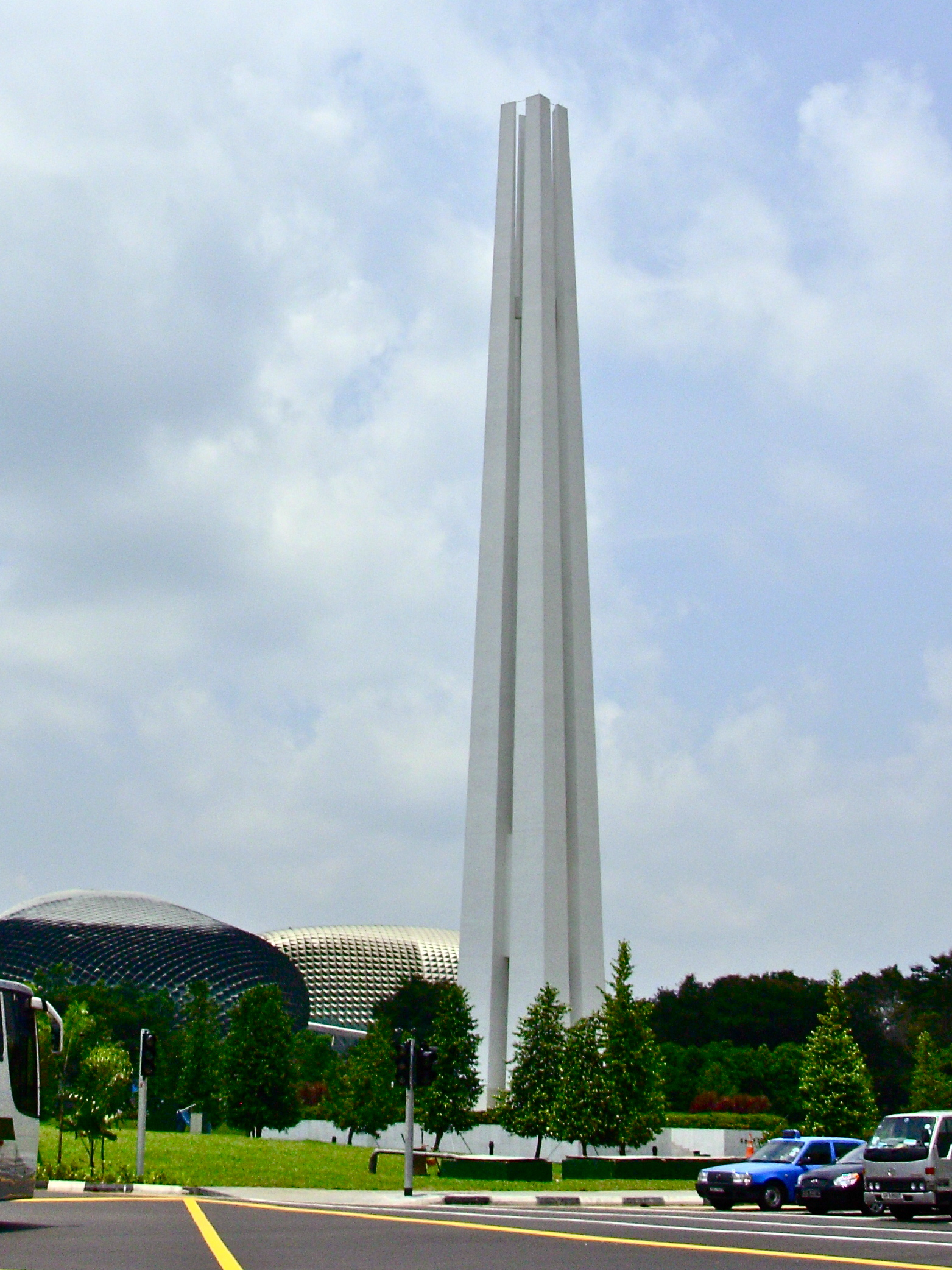
When the Japanese surrendered in 1945, Singapore was a shell of its former self, and its economy seemed permanently ruined. It would be years before it returned to pre-war levels. But in the 48years since Singapore’s independence, it has been one of “The Asian Tigers” with a vigorous, fast-growing, highly modernized economy, and one of the highest standards of living in Asia. But the war years are not forgotten: there is a striking monument to the victims of the occupation in downtown Singapore, and annual memorials are held on February 18 each year.

Monument Commemorating The Japanese Occupation of Singapore

Monument Commemorating The Japanese Occupation of Singapore

+–+–+–+–+–+–+–+–+–+–+–+–+
Jamie Rawson
Flower Mound, Texas