The Boar War?

It was on 15 June 1859 that Lyman Cutlar shot and killed a male pig belonging Charles Griffin on San Juan Island, and started a chain of events that nearly ignited a third war between the United States of America and Great Britain. The locals around San Juan Island, located in the waterway between what is now Washington State and British Columbia, know the event as “The Pig War.” Though it started off as a rather touchy and fraught situation, cool heads prevailed and war was avoided through diplomacy and negotiation.

Both the United States and Great Britains claimed sovereignty over San Juan Island in the wake of the 1846 Anglo-American treaty which settled most of the questions about the Oregon Territory (which included Oregon, Washington, and part of Idaho.) The Hudson’s Bay Company started to move in settlers in the early 1850’s. Considering the island to belong to the U.S., American pioneers began staking claims on the island about the same time. Tensions grew.

Charles Griffin, originally from Yorkshire, England, claimed land for sheep pasturage; Lyman Cutlar, who hailed from Kentucky, planted a potato patch there. When Griffith’s boar uprooted Cutlar’s potatoes, Cutlar killed the hapless swine with a single shot. But the incident caused festering resentments to flare into open dispute. Griffin called upon Hudson’s Bay Company officials to arrest Cutlar. The British officials did confront Cutlar, however they decided that to effect an arrest would be too provocative and left empty handed.

The matter might have ended in a stalemate then and there but for the fact that American General William Harney, commander of the U.S. Army’s Department of Oregon, shortly thereafter paid a courtesy call upon the British Territorial Governor and noted an American flag flying over San Juan Island. Upon investigating, he learned of the American settlers there, and of their grievances against the British. Griffin’s pig was prominently discussed. It is likely that most military men would have deferred the matter as an issue for courts of law, but Harney had an almost irrational hatred of the British. And he clearly enjoyed the prospect of a fight or even a war. The British Governor, it should be noted, was also pleased with the prospect of finally settling the matter of the disputed territory, even by force of arms.

Harney ordered Captain George Pickett — who would later have his name irrevocably linked with Lee’s disastrous charge on the third day of the battle of Gettysburg — to take a detachment of 66 troops from Fort Bellingham up to San Juan Island. Upon landing, Pickett issued a proclamation that the island was U.S. territory, which distressed the British residents, understandably. The British responded by sending a 21-gun warship to train its cannon on Pickett’s small encampment. By the end of August, there were nearly 500 U.S. troops on San Juan Island, and there were almost 2,000 British troops in a small flotilla of warships surrounding the Island. The Americans were outmanned and outgunned, but the British could not readily obtain more troops, while the Americans could draw several thousand from California if needed. Thus the situation remained a stalemate.

After several months of this tense and uncomfortable state of affairs, aging General Winfield Scott, hero of the War of 1812 and of the Mexican War, was sent to negotiate a resolution to the matter. Scott eventually agreed to a joint military occupation of the island with roughly 100 U.S. and 100 British troops remaining on the island. This was how things stayed for the next dozen years or so until at last, in 1872, Kaiser Wilhelm arbitrated the dispute, deciding in favor of the United States. The British quietly withdrew from San Juan Island, thus ending “The Pig War.”

It is nearly amazing, considering the men, the firepower, and the tensions at the start of the affair, that hot war never broke out. Negotiations were allowed to succeed, in part because the senior military men then involved – Scott for the United States and Admiral Baynes for Great Britain – both knew the horrors of battle first-hand, and were unwilling to enter into war lightly. And, unlike the fiery Pickett or the hostile Harney, General Winfield Scott did not feel willingness to negotiate to be a sign of weakness.

Today the United States National Park Service maintains the sites of the British and American camps on the island. The American camp was constructed and fortified by Liuetentant Henry Martyn Robert, later famous as the author of Robert’s Rules of Order. The rangers tell visitors of the amiable joint occupation years, when both British and American troops would jointly celebrate the holidays of their respective nations. And indeed, the rangers note, during that period, the greatest threat to peace and stability was whiskey! To this day the rangers hoist a period Stars and Stripes over the American Camp, and, unusually, these U.S. Government employees also hoist the flag of a foreign power every day when they raise the “Union Jack” over the British Camp.

So cooler heads prevailed, war with Great Britain was averted, Germany’s Kaiser — jealous of Great Britain’s Empire — gave The United States what it wanted after all, and no one died. (Except the pig.)


Jamie Rawson
Flower Mound, Texas

There was never a good war, or a bad peace. — Franklin

Further Reading:

Smithsonian Magazine, June 2005: “The Boar War” by Deborah Franklin.

The Pig War: Standoff at Griffin Bay, Michael Vouri; Griffin Bay, 1999: ISBN: 0963456253

The Flag Of The United States of America at 240

Two Hundred forty years ago this day, June 14, 1777, the Congress of the United States of America took action to standardize and unify the multitude of flag designs that had been in use up to that time. In an admirably brief if unsuitably vague resolution, Congress decreed:

“RESOLVED, that the flag of the 13 United States be thirteen stripes, alternate red and white: That the union be thirteen stars, white in a blue field, representing a new constellation.”

Before the Declaration of Independence had been adopted, the revolutionary forces in the various thirteen colonies had used flags of whatever design appealed to the local troops. All that mattered was that the participants in a particular engagement could recognize the flags of their own units. Thus, from the start of the revolution in April of 1775 until the adoption of the Flag Resolution, there were dozens of flags identified as United States flags.

The resolution of Congress limited the essentials of the flag’s design from June 14, 1777 until the present. Yet the resolution makes no specification as to how the stars are to be arranged nor whether red or white is to be the first color in the alternate stripes. As a result, variations persisted for the next century.

The “Star Spangled Banner” flag which flew during the bombardment of Fort McHenry in Baltimore September 14, 1815 had fifteen stars and fifteen stripes to represent the enlarged United States. It was quickly realized that a growing Union would soon render the number of stripes unmanageable, so thereafter the stripes would remain at thirteen and only the number of stars would be increased to reflect the states.

During the Civil War, many U.S. flag designs were present at every major battle. All featured thirteen stripes, but the constellation of stars was often a uniquely local pattern. In the latter days of that great conflict, many flags were made with golden stars rather than the specified white stars. This was due to the fact that many military flags used silver thread to embroider the stars on their regimental colors; it turned out that the silver thread quickly tarnished black in the sulphur-laden gunpowder smoke of the battlefield.

It was not until 1912 that a full and formal specification of the U.S. flag — sizes, color shades, arrangement of the stars, and order of the stripes — was enacted by Congress. This was the familiar 48 star flag, until 2008 the longest lived of all the flag designs. The design of this flag was officially adopted on July 4, 1912, after the admission of Arizona, the last of the continental states, into the Union. This is the flag which flew over the American Expeditionary Forces in Europe 1917 – 1918, and over United States forces throughout the world from the attack on Pearl Harbor December 7, 1941 until the final surrender on September 2, 1945.

The current standard U.S. flag, of course, has fifty stars representing each state of the Union. The design of this flag was officially adopted July 4, 1960, following the admissions in 1958 of Alaska, and in 1959 of Hawaii. This has now been the official flag of the United States for almost fifty-two years. This is the flag which was raised on the surface of the moon July, 24 1969 and which has flown over United States military forces throughout the Vietnam War and the Gulf Wars and Afghanistan. And this is the flag that flew on 11 September 2001:
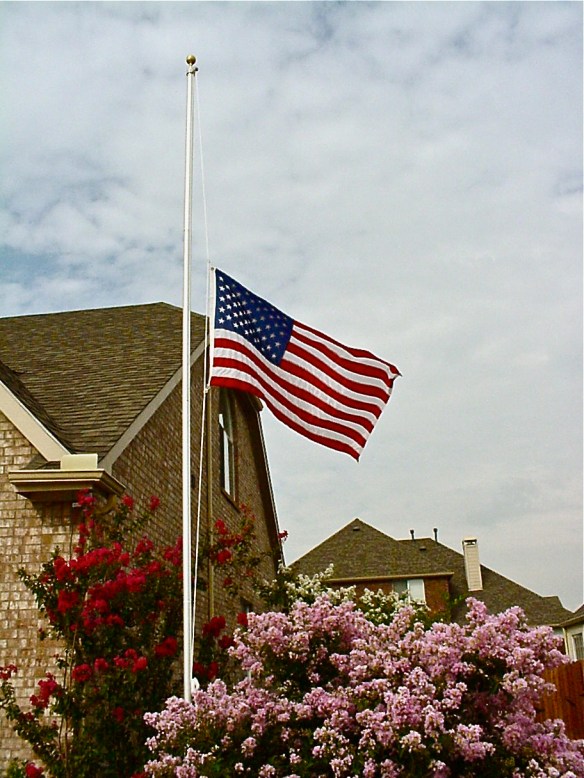
11 September 2001

11 September 2001: When I arrived home that evening, my brother and I lowered my flag with proper ceremony, and then raised it again before taking it to half-mast.

President Woodrow Wilson proclaimed the first nation-wide Flag Day in 1916, but there had been many observances by state and local entities for at least thirty years before. In 1949, Congress formally enacted the Federal Flag Day observance. Flag Day is a day not only for flying the flag, but to reflect on what it stands for and upon the history and the sacrifices it represents.

There have been many hymns, patriotic songs, stories, and poems written about the flag of the United States of America, and a very famous pledge. Especially popular with grade school children is George M. Cohan’s spirited song You’re A Grand Old Flag.

Francis Scott Key, inspired by the sight of the nation’s flag still flying above Baltimore’s Fort McHenry after a night of savage bombardment, started writing the poem which became The Star Spangled Banner while he was still aboard a British warship in Baltimore Harbor. Key’s poem was published in a Baltimore paper later that month. A music hall balladeer performed the poem as a song using the tune of a popular drinking song, To Anacreon in Heaven, and retitling it The Star Spangled Banner. This is the song that Congress officially declared the United States National Anthem in 1931.

Among the scores of poems that have been inspired by the U.S. flag, my personal favorite is Barbara Frietchie by John Greenleaf Whittier. Written in 1863, when the outcome of the Civil War was far from certain, this poem celebrates the legendary courage of Barbara Frietchie, a resident of Frederick, Maryland, in the face of Rebel troops. In September of 1862, Confederate forces invaded Maryland. One column approached the fateful meeting at Antietam Creek by marching through Frederick. The battle of Antietam, the bloodiest day in U.S. history, resulted in a Confederate withdrawal.

Barbara Frietchie is an idealized retelling of an idealized event; it is not at all what one might call truly historical. Whittier always stated that he wrote the poem in good faith based upon the best information he could obtain, but shortly after the poem was published, its accuracy was called into question.

Old Barbara Frietchie really did exist. She was ninety-five years old in September of 1862 when the poem takes place. She was something of a local celebrity in Frederick, because when she was a young woman, her family had hosted George Washington when he visited the town. She apparently met with General Reno of the Union Army two days after the great battle of Antietam. Barbara possessed a small U.S. flag made of silk which she so treasured that she stored it inside her family Bible. That flag is preserved to this day, and though it is slightly torn, it is not rent “seam and gash.”

Apparently it is true that Old Barbara did wave her flag cheerfully as Union soldiers marched through Frederick after the battle of Antietam, and there were many Union Army veterans who in later years affirmed that they indeed recalled the ancient granny who cheered and waved her flag when they retook Frederick. While this was a fine and patriotic thing, no one clearly recalled “Dame Barbara” confronting Stonewall Jackson as the poem tells it.

What seems to have happened is a conflation of two separate events: when Jackson’s troops marched through the town on that September morning, another woman of Frederick, Mrs. Mary Quantrell (or Quantrill) did indeed fly her U.S. flag while the Confederate troops passed by. Because Old Barbara was already well-known in Frederick, and because she had warmly cheered the Union troops who gratefully received her support after the battle, the deeds of Mary Quantrell quickly became associated with Barbara. And while Stonewall Jackson cannot be conclusively proven to have been in Frederick at all during the march, it was natural for the story to include the most famous of the Confederates in that vicinity. And so, as commonly happens, a couple of good stories — Mary Quantrell’s stubborn loyalty to the Union and Barbara Frietchie’s warm welcome of the Union troops — folded into one, and were further embellished to make a right wonderful tale.

It was this rather embellished version that caught John Greenleaf Whittier’s attention in late 1863 as he was in Washington. Upon hearing the story from sources “respectable and trustworthy”, Whittier felt compelled to immortalize it in verse. He later acknowledged that his poem was possibly based upon “… a blending of the two incidents.” But he always asserted that it was valid nevertheless.

I must agree with the poet. It is immaterial if the poem tells a precise, historical, and documented event; the poem does tell a truth that is greater and more enduring than any single genuine event. In Barbara Frietchie we see that courage is not limited by age nor by gender, and we see that people of honor will respect courage, even if they do not agree with the cause.

Old Barbara Frietchie passed away in December of 1862 just days after reaching the age of 96. Stonewall Jackson died the following May after being wounded by his own troops at Chancellorsville. Jackson’s enduring fame was ensured well before the poem was published, but Barbara was truly immortalized by these 30 couplets. In 1866 a Nantucket schooner was christened Barbara Frietchie. Generations of Maryland school students were required to memorize the poem. My mom and dad told me about an unremarkable brand of candy that one could buy in Frederick in the 1930’s which was named after her.

Today, unfortunately, such “sappy” and “saccharine” poetry is out of fashion, and even its praise for patriotism is considered rather antiquated. And so fewer and fewer people recall the poem, its fairly fictionalized heroine, or the simple concepts of loyalty to a cause, and bravery in the face of overwhelming force. Yet, as I observed above, if the events of the poem are not literally true, nevertheless the poem tells us truth.

Jamie Rawson
Flower Mound, Texas

BARBARA FRIETCHIE

John Greenleaf Whittier

Up from the meadows rich with corn,
Clear in the cool September morn,

The clustered spires of Frederick stand
Green-walled by the hills of Maryland.

Round about them orchards sweep,
Apple and peach tree fruited deep,

Fair as the garden of the Lord
To the eyes of the famished rebel horde,

On that pleasant morn of early fall
When Lee marched over the mountain wall;

Over the mountains winding down,
Horse and foot, into Frederick town.

Forty flags with their silver stars
Forty flag with their crimson bars,

Flapped in the morning wind; the sun
Of noon looked down, and saw not one.

Up rose old Barbara Frietchie then,
Bowed with her fourscore years and ten;

Bravest of all in Frederick town,
She took up the flag the men hauled down;

In her attic window the staff she set,
To show that one heart was loyal yet.

Up the street came the rebel tread,
Stonewall Jackson riding ahead.

Under his slouched hat left and right
He glanced; the old flag met his sight.

“Halt!” – the dust-brown ranks stood fast.
“Fire!” – out blazed the rifle-blast.

It shivered the window, pane and sash;
It rent the banner with seam and gash.

Quick, as it fell, from the broken staff
Dame Barbara snatched the silken scarf.

She leaned far out on the window-sill,
And shook it forth with a royal will.

“Shoot, if you must, this old gray head,
But spare your country’s flag,” she said.

A shade of sadness, a blush of shame,
Over the face of the leader came;

The nobler nature within him stirred
To life at that woman’s deed and word;

“Who touches a hair of yon gray head
Dies like a dog! March on!” he said.

All day long through Frederick street
Sounded the tread of marching feet;

All day long that free flag tost
Over the heads of the rebel host.

Ever its torn folds rose and fell
On the loyal winds that loved it well;

And through the hill-gaps sunset light
Shone over it with a warm good-night.

Barbara Frietchie’s work is o’er,
And the Rebel rides on his raids no more.

Honor to her! and let a tear
Fall, for her sake, on Stonewall’s bier.

Over Barbara Frietchie’s grave,
Flag of Freedom and Union, wave!

Peace and order and beauty draw
Round thy symbol of light and law;

And ever the stars above look down
On thy stars below in Frederick town!
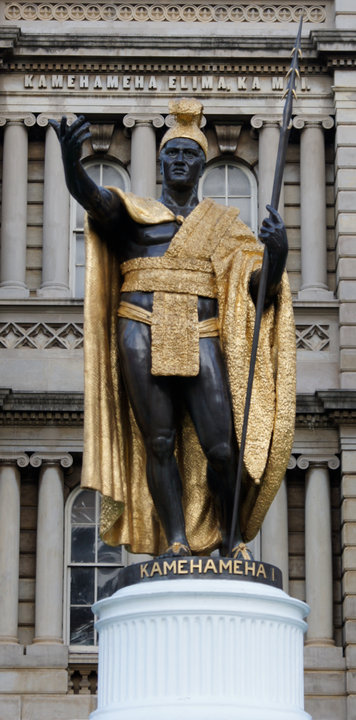
A Royal Holiday In The United States

Kamehameha

Bronze and gilt statue of Kamehameha I across from the Iolani Palace in Honolulu, 7 April 2010.

Today, 11 June, is celebrated as King Kamehameha Day in the state of Hawaii. It is one of two officially recognized holidays in honor a royal person in all of the United States of America (the other is Hawaii’s Prince Kuhio Day.) Indeed, when one travels in Hawaii, it is striking to see the great number of monuments, memorials, and statues which are dedictated to various kings, queens, princesses, and princes; nowhere else in the United States is there such homage to royalty. The reason for all of this homage to monarchs lies in Hawaii’s history.

When Captain Cook made the first European contact with Hawaii in 1778, the islands were each ruled by a hereditary nobility of chiefs and lords and each island had its own Ali, a high chief or king. There was occasional fierce and bloody warefare among the clans of each island, and even between the islands. There was no central, unifying authority. European contact changed the Hawaiian islands radically and immediately. Before Cook arrived, the Hawaiians had no metals; within ten years trade with Europeans had become essential. In return for European manufactured goods, Hawaiians traded precious sandalwood and sealskins. In addition to iron pots and steel tools, the European traders brought firearms to the islands.

On the big island of Hawaii, a local member of the chiefly class, Paiea (“crab”) who had been among the first Hawaiians to treat with Captain Cook, realized that a fragmented and fractious Hawaii could not endure in the face of European contact. He also knew that European technology would be a decisive advantage to a warrior king who might take advantage of it. By making favorable deals with European traders to secure tools and weapons and training for his troops, and by political alliance and by military conquest, Paiea, better known by the name “The Loner,” Kamehameha, began to consolidate the island of Hawaii under his single rule. By 1791, with the whole of the island of Hawaii under his rule, Kamehameha set his sights on uniting all of the islands.

Kamehameha contracted with European ship captains to transport his men and materials to Maui and Oahu, and in at least one case, hired ship’s cannon to provide artillery support for his troops. Through a series of successful, hard-fought campaigns, by 1795 Kamehameha became Ali’nui, or Great High King over Hawaii, Maui, Molokai, Lanai, Kahoolawe, and Oahu. Only Kauai and tiny Niihau remained independent. In 1810, through successful diplomatic negotiations, the Ali of Kauai formally recognized Kamehameha as sole sovereign over all of the Hawaiian islands. Kamehameha at last ruled a unified Hawaiian nation.

As king, Kamehameha, styled “The Great,” was known as a firm and fair ruler. He promulgated uniform laws for all Hawaiians, and is most famous for his celebrated 1797 proclamation of Kanawai Mamalahoe, the “Law of the Splintered Paddle.” This law declared that non-combatants were to be protected during military action, and by extension that no one should be in fear of being attacked or molested. This law still exists as a part of Hawaii’s state constutution, and it has had a far-reaching impact upon the development of the theory of humanitarian laws of warfare.

As king of a united Hawaii, Kamehameha worked to promote trade with the outside world, but he also regulated and limited the influence that foreigners could have in Hawaii’s affairs. Kamehameha recognized that the traditional life in hawaii needed to be actively preserved in the face of Western culture.

Kamehameha ruled the kingdom of Hawaii until his death in 1819. He had made preparations to ensure that his achievements would be perpetuated, and he was succeeded by his sons Kamehameha II and Kamehameha III. The House of Kamehameha would last until 1872 with the death of Kamehameha V. The Hawaiian monarchy would continue until its overthrow 1893.

It is worth making especial note that Hawaii is one of the very few places which ever experienced the armed overthrow of a monarchy yet which still honors and respects its monarchical past. It would be odd in the extreme for France to have a King Louis XIV Day, or for the U.S. to have a King James I Day. Yet Hawaii enthusiastically embraces King Kamehameha Day and has done so since the day was first decreed by Kamehameha V in 1871. This holiday continued through the end of the monarchy and was revived in 1901 when Hawaii formally became a territory of the United States. When Hawaii was granted statheood in 1959, Kamehameha Day was among the first holidays established by the new state legislature. So why has this royal holiday persisted in Hawaii?

At the time that Sanford B. Dole’s “Committee of Safety” with the aid of United States Marines dispatched by U.S. Consul John L. Stevens, imprisoned Queen Liliuokalani and declared the monarchy abolished in 1893, the majority of Hawaiians had no desire to see the monarchy ended. In fact, majority sentiment favored a re-empowered monarchy, the possibility of which led to Dole’s coup.

In 1887, European-American Hawaiian business interests backed by the paramilitary Honolulu Rifles, had forced King David Kalakua to acceed to the “Bayonet Constitution,” which essentially stripped the king of all power and disenfranchised all but the wealthiest land owners. The rolls of eligible voters were reduced to a fraction of what they had been under the 1864 constitution. In 1893, Queen Liliuokalani determined that it was necessary to restore the 1864 constitution, a proposal which was, not surprisingly, met with approval among the majority of Hawaii’s people. It is also not surprising that the proposal was absolutely repugnant to the business interests who had forced the 1887 constitution to be adopted. The coup which imprisoned Queen Liliuokalani was not only not supported by the population, it was deeply unpopular.

Dole and his oligarchy hoped to have the United States annex Hawaii immediately after the overthrow, confident that expansionist president Benjamin Harrison would favor such a step. However, Harrison lost his bid for reelection and president Grover Cleveland would not even consider such an annexation. The U.S. House of Representatives issued a resolution deploring the use of U.S. troops to overthrow a legitimate government, and Congress would not take any steps toward taking control of Hawaii.

The Committee of Safety therefore declared the Republic of Hawaii on 4 July 1894 with Sanford B. Dole as president. (Hawaii is one of only four states to have been an independent republic.) The republic bided its time until the United States elections of 1896 returned the Republican Party to power, and after the inauguration of William McKinley in March 1897, Dole commenced negotiations for annexation. Hawaii was formally annexed in 1898 and became a U.S. territory in 1901. Dole served as the first territorial governor.

Because the monarchy had never been unpopular with the people of Hawaii, the kings, queens, princesses, and princes remained popular figures. Queen Liliuokalani remained especially popular, long after the overthrow, and her repeated efforts to receive justice from the United States government were widely supported in Hawaii. Prince Kuhio, mentioned above, eventually served in the United States Congress as a territorial representative, making him the only royal ever to have served in that body. In what may well have been intended as a bit of a show of defiance, Hawaii’s territorial legislature reestablished the observation of Kamehahmeha Day in 1901.

Thus it is we have a state in the Union which overthrew its monarchy, but which remains powerfully attached to it to this day.

Happy Kamehameha Day!!!

Jamie Rawson
Flower Mound, Texas

Kanawai Mamalahoe E na kanaka,
E malama ‘oukou i ke akua
A e malama ho’i ke kanaka nui a me kanaka iki;
E hele ka ‘elemakule, ka luahine, a me ke kama
A moe i ke ala ‘A’ohe mea nana e ho’opilikia. Hewa no, make.

— Kamehameha The Great

(The Law Of The Splintered Paddle:
Oh, my people, honor your god;
respect equally men great and humble;
ensure that our elderly, our women, and our children
lie down to sleep by the roadside without fear of harm.
To disobey is to die.)

A Hideous Reprisal

It was on this day, 9 June 1942, that Adolph Hitler ordered bloody reprisals against the Czechs as a response to the Czech anti-Nazi resistance. The very next day, 10 June 1942, Nazi troops utterly erased the 630 year old Czech village of Lidice from the face of the earth. Every man, woman, and child in the village was either killed, sent to a labor camp, or – for the very young children who were ajudged to have the right traits – sent to be “Arayanized” and incorporated into the Nazi’s “New World Order.” The entire village was looted and plundered, and burned to the ground or razed with heavy machinery. The task being undertaken with Nazi fervor, there was soon barely a trace of the village. Later the terrain was graded level and overplanted with grain. Lidice had truly been erased completely.

With a Teutonic obsession for record-keeping, the action was documented in detailed reports and expense ledgers. Additionally, and perhaps most astonishingly, a documentary film was made of the atrocity. It seems that the Nazis had not yet envisioned the possibility that they might someday be held accountable.

Lidice (pronounced LEE-dee-tseh in Czech and most commonly LIH-dih-chee in English) and its 340 inhabitants were obliterated in reprisal for the assassination of the Nazi administrator of the German-occupied Czech region, Reinhard Heydrich, a few day before. Czech resistance fighters – “terrorists,” according to the Nazi point of view – had ambushed Heydrich’s car and gravely wounded him. He died of an infection a few days later. The death of Heydrich so enraged Hitler that he demanded that Kurt Daluege, Heydrich’s successor, “wade through blood” to find the assassins. Daluege proceeded to do precisely that.

Though there were many reprisals throughout the Czech region, Lidice was singled out for complete destruction because it was known to be especially hostile to the German occupation, and it was thought to harbor resistance fighters. The Nazi High Command felt that such a total obliteration of a village would set an example and act as insurance for the good behavior of other Czech towns and villages. So confident were they in this strategy that they proudly and widely broadcast the news of the horrendous slaughter and inhuman enormity in the assurance that such a dreadful object lesson would deter future resistance activity. This calculation and conclusion are just the sort that tyrants routinely make.

Tyrants are rarely correct in such a judgment, though. Far from quelling resistance, horrors such as that perpetrated at Lidice often fire resolve among the complacent and spur more determined resistance.

Because the Nazis broadcast their atrocity, it was quickly known throughout the world. The allied powers immediately recognized the propaganda value of the destruction of Lidice: no one could now deny that Hitler’s Germany was brutal, barbaric, and beastly. Within days of the crime, Lidice became a household word throughout the world. Almost immediately towns and neighborhoods across the globe adopted the name of Lidice as their own: Lidice, Illinois; Lidice, Panama; Lidice, Brazil; the barrio of Lidice, Caracas, Venezuela; the barrio of Geronimo-Lidice, Mexico City; barrios in Lima, Peru; Regla, Cuba. Dozens of monuments and memorials were also created throughout the Americas, and, later, across Europe. Thousands of newborn girls were christened Lidice as well. Far from serving as a means of stifling resistance, the destruction of Lidice served to rally opponents of brutal totalitarianism around the globe.

Yet the Nazi grip on Europe would endure almost three more years after Lidice’s demise. Despite the world’s reaction to what happened at Lidice, and despite the fact that there was still a resistance movement in Czech region, the Nazi High Command still favored the tactic of disproportionate reprisal to try to intimidate resistance. Thus it was that an even greater carnage occurred exactly two years to the day after the eradication of Lidice.

On 10 June 1944, the French village of Oradour-sur-Glane was subjected to the same fate as Lidice. The men were rounded up into some large barns just outside the village and machine-gunned through the legs. Once so debilitated, the gravely wounded were covered with kindling and the barns set afire. The women and children had been gathered in the village church where explosives had been laid. After detonation, the few survivors were machine-gunned. In all, more than 640 people were slaughtered, and, as with Lidice, the town was razed.

These were not the only cases of such horror being perpetrated upon entire towns during the Nazi grip on Europe. Poland, Russia, the Ukraine, and elsewhere in Eastern Europe saw many others. But Lidice and Oradour are perhaps the most widely known. And, tragically, incomprehensibly, such atrocities are not a unique property of the Nazis. Other wars and other nations have seen recent examples of the same gruesome strategy, the same diabolical tactics, even though such actions not only fail to achieve the desired goal of halting resistance, they often increase resistance.

Much as one might wish that such uncivilized violence belong to past ages, it has not yet disappeared. Nations and cultures which surely should know better still yield to the urge to win by force that which they cannot win by persuasion. It is a melancholy reflection to note that while humans can wipe a Lidice or an Oradour from the face of the earth, humanity has not yet grown to a point where we can erase barbarity from the face of mankind.

Jamie Rawson
Flower Mound, Texas

Man’s inhumanity to man Makes countless thousands mourn.

— Burns

Salem’s “Witches”

Take an unseasonably long and cold winter after a poor harvest, a minor epidemic, (probably flu) and an unsuccessful military campaign against restive local tribes, then add a few unprovable accusations from unlikely sources, a populace wary and uneasy, fearing attacks by unseen foes, and authorities inclined to presume the worst, and you have a witches’ brew of explosive and lethal ingredients. In Salem, Massachsuetts, in 1692, such a mixture produced deadly results that resonate yet today. Three hundred twenty years ago, on 10 June 1692, Bridget Bishop, the first victim of the infamous Salem Witch Trials, was hanged.

The madness started four months earlier when two young girls became sick with “fits” which were diagnosed as the results of a bewitching. In the course of their seizures, these girls identified several local women as possible witches. The hunt was on.

Local authorities arrested one of the women whom the girls had identified, a maid who was a West Indies native. This woman, Tituba, had used some of her folk remedies to try to cure the girls, and such remedies were rather akin to spells and magic. The investigating officials offered to spare Tituba the worst penalties if she would name other witches. Not surprisingly, she did so quite readily. During her examination, Tituba expanded and embellished her descriptions with lurid accounts of conversations with the “Devill,” sightings of monstrous “hayry” beasts, and rides through the misty nights on wooden poles. Several of Salem’s townfolk were named in the course of her account. The hunt expanded.

By June, the Governor of Massachusetts empowered a special court to conduct trials of the accused witches. The judges included an ancestor of writer Nathaniel Hawthorne, one John Hathorne. The president of the court, William Stoughton, was a fanatical prosecutor of witches, and he vowed to “clear the land” of witches and sorcerers. Most of the judges were not trained in the law, and had no idea as to how to conduct a proper trial, especially in the matter of witchcraft. As a result, the judges relied heavily on the advice of local clergymen such as the famous Cotton Mather.

Mather suggested admitting testimony that was even then quite improper, such as accounts of dreams, and third-hand reports of rumored conversations. With no effective restrictions upon what might be testified in court, folks with old grudges to settle made wild accusations about their neighbors. Bridget Bishop was particularly unpopular: she was a woman of “low character” (she may have run a small-time brothel!) and she was well-known for failing to pay her bills. She had no friends in Salem, but plenty of enemies.

Those who protested the madness, or simply failed to enthusiastically support it were at risk of being accused. John Proctor, who figures as a key character in Arthur Miller’s allegorical play about the witch hunts, The Crucible, was an outspoken sceptic and critic of the trials. He soon found himself accused. Though Proctor demanded the trial be moved to Boston, and denounced the confessed witches as liars, he was nevertheless hanged.

After Bridget was hanged on 10 June, the pace of the trials began to pick up. Before the summer was over, more than 150 of the Salem area’s perhaps 8,000 residents were accused of witchcraft. Twenty-four “witches”, 16 women and 8 men, were executed – mainly by hanging – or died in prison before the Governor at last dissolved the local court in October and and established a Superior Court to hear the remaining cases. The new court adhered to more stringent rules of evidence and subsequently handed down no more convictions. The madness was running out of steam.

In the later 19th Century and early 20th, Salem’s terrifying episode was explained as “mass delusion,” the theory being that everyone in town fell under the spell of suggestibility, as if a mass hypnosis had taken hold. That has some appeal: it would explain the flying and the visions that so many attested. Notably lacking, however, was an agent which could explain how this mass delusion/hypnotism was effected.

In the 1970’s, professor Linnda Caporael published a paper, Ergotism: The Satan loosed in Salem? Ergot is a grain fungus which is especially prevalent on rye growing in damp ground, or during mild, rainy weather. Rye was a standard crop in New England, and one may fairly assume it was grown in and around Salem, especially in the more poorly drained fields around the village which are known to have been cultivated, but which would have been unsuitable for wheat or barley.

The effect of ergot fungus is variable: ingested in small quantities it can make a person ill; in large quantities it causes hallucinations and convulsions, the sensation of things crawling on the skin, and a sense of soaring through the air. These symptoms may sound like a “bad acid trip,” and that is hardly surprising. Ergot fungus produces a variety of alkaloid compounds, including “isoergine,” lysergic acid amide, a weaker cousin of “LSD,” lysergic acid diethylamide.

Though Caporael’s thesis is unproven, and ultimately unprovable, it does have the great advantage of potentially explaining the symptoms of the Salem “victims of witchcraft,” and being plausible as well. Ergotism is real, its symptoms do present in a manner akin to demonic possession, and rye was a staple in the region. So, while we cannot know whether or not ergotism is the true cause of the victim’s distress, it seems likely. And it is comforting to think that there may have been an actual, organic cause for the afflictions, rather than either mass hysteria or over-arching malice.

Other organic causes have been suggested as well, including various viral and genetic diseases, and the matter is still fiercely debated. As I say, it is almost certain that we will never be able to know for certain. But there must have been some actual cause, I believe. I am not yet ready to be convinced that the Devil himself dwelt for nine months among and within the villagers of Salem.

And what of those who never developed symptoms, yet perpetuated the prosecutions and the persecutions? One historian has sought to explain the astonishing culpability of the judges involved by noting that they may have been using the witch hysteria to deflect their own roles in the unsuccessful campaigns on the frontiers. The military adventures had been ill prepared, and the citizens of Massachusetts were unhappy with their leadership. A focus on a new, far more manageable threat may have been politically expedient: it was an easy way to show that the authorities were doing something to protect the colony.

Five years later, the judges – except Stoughton – issued a collective admission of error and guilt, and made a public apology; Massachusetts observed an annual day of prayer and fasting for forgiveness due for the sins of the trials, and even paid compensation to the survivors.

Salem’s experience has ever after stood as a reminder that in times of anxiety and stress, it is especially crucial to be careful and deliberate when identifying the source of our woes. And from Salem we have inherited the term “Witch hunt” to describe an energetic, often paranoid and self-satisfying quest to find enemies within.

Jamie Rawson
Flower Mound, Texas

It were better that ten suspected witches should escape
than one innocent person should be condemned.

— Cotton Mather’s father, Increase Mather,
in his work Cases of Conscience about standards of evidence


Further reading:

The Devil in Massachusetts: A Modern Enquiry Into The Salem Witch Trials, Marion L. Starkey; Anchor Books, 1949 (reprint ed. 1969): ISBN: 0385035098

In the Devil’s Snare: The Salem Witchcraft Crisis of 1692, Mary Beth Norton; Vintage, 2002: ISBN: 0375706909

Salem Possessed: The Social Origins of Witchcraft, Paul Boyer and Stephen Nissenbaum; Harvard University Press, 1976: ISBN: 0674785266

A Milestone Along The Information Superhighway

It was on this day, 8 June 1887, that Herman Hollerith filed for United States Patent 395,781 – his second – for an electro-mechanical tabulating machine which used punch cards to record and store data. Though punched cards had been used for more than a century to control looms and to program music boxes, clock organs, and the like, Hollerith was the first to use them to tabulate data electronically. As such, this patent represents a major milestone in the evolution of the Information Age and of the computers which are so completely ubiquitous in our daily lives. Hollerith’s original tabulators were not programmable, and were built to perform specific tasks, but later modifications permitted limited, dynamic repurposing of the tabulators, a precursor of true programmability.

Hollerith’s tabulators were first used by the U.S. Census Bureau to tabulate the data on the 1890 Census. Previous census data had taken many years to produce; the first reports of the 1890 Census were available in late 1891. Such an impressive result led to an immediate interest in the machines and their potential business applications. Hollerith founded the Tabulating Machine Company in 1896. This corporation later merged with two competitors to form the Computing Tabulating Recording Company, which in 1924 under the leadership of Thomas J. Watson was rechristened the International Business Machines Company, better known as IBM.

There are numerous sources about Hollerith and his patents, but the definitive material resides with The United States Patent and Trademark Office. These days, one can use that child of Hollerith’s heritage, “The Web,” to access the USPTO database. Search for Hollerith, and you will find a wealth of data, including drawings of his machines. Take a look at:

http://www.uspto.gov/patents/resources/methods/afmdpm/examples/395781.jsp

Jamie Rawson
Flower Mound, Texas

The newest computer can merely compound, at speed,
the oldest problem in the relations between human beings,
and in the end the communicator will be confronted with the old problem,
of what to say and how to say it.

— Edward R. Murrow

Seventy Years Ago Today: An Improbable Victory

It was on this day, 7 June 1942, a Sunday precisely six months to the day after the devastating attack on Pearl Harbor, that the most decisive naval battle of the 20th Century came to an end in the vastness of the Central Pacific Ocean. The Battle of Midway, which lasted from early on the morning of 4 June 1942 until mid-afternoon on 7 June, resulted in a decisive victory for the United States of America against the Imperial Japanese Navy. Japan withdrew from the battle with catastrophic losses: four of Japan’s largest aircraft carriers had been sunk against a single United States carrier. Moreover, the loss represented essentially irreplaceable damage to the Imperial Japanese Navy’s forces, while the United States of America would build more than two dozen large carriers in the next three years.

It seems hard to believe at this far remove in time, but heading into Midway, the United States Navy was the undoubted underdog. The U.S. had three fleet carriers compared to the Imperial Japanese Navy’s four, and only a third of the additional support vessels needed for such a Confrontation. The U.S. had a slightly greater number of aircraft, but almost all were outdated and inferior to the Japanese warplanes. The Japanese High Command could feel understandably confident of another smashing defeat of the U.S. Navy.

In complete reversal of the Pearl Harbor disaster, the victory at Midway was in large measure a triumph of Military Intelligence. The U.S. Navy had broken the Japanese Naval code, and was able to decode much of the radio traffic leading up to the Japanese attack on Midway. When there was uncertainty as to the target of the huge Japanese task force – referred to as “AF” in the Japanese communications – a clever ruse pinpointed the intended objective. The commander of the small American force on Midway was instructed by secure cable transmission to radio a message stating that Midway’s water distillation plant was out of order. Subsequent Japanese transmissions revealed that “AF” was low on fresh water. The U.S. Navy thereby knew that Midway was the objective of the attack, and could plan accordingly.

Intelligence Data alone, of course, cannot win battles. It takes determination, skill, commitment, and courage. These too were abundant at Midway. The famed sacrifice of the U.S. Naval fliers of Torpedo Squadron 8 stands out. Torpedo Squadron 8 made the first American attack of the battle on the Japanese carriers despite the fact Squadron 8’s planes had too little fuel for a return flight, and despite the fact that the Japanese fighters were far faster and far more maneuverable than the dated, cumbersome American torpedo bombers. Indeed, only one pilot from that group survived the battle: Ensign George Gay escaped his ruined plane and floated among the hellish carnage for three days before his rescue.

Gordon Prange, in his landmark 1983 account of the battle, Miracle at Midway, (McGraw-Hill. ISBN 0070506728) asserted that the role of Torpedo Squadron 8 had been over-emphasized, especially in light of the fact that the squad’s attack completely failed to inflict any damage upon any Japanese ships. While I am in no way competent to challenge Professor Prange’s impeccable scholarship, I respectfully disagree with his interpretation of this attack. The mere fact that Torpedo Squadron 8 attacked greatly disrupted the Japanese plans, and ultimately left three Japanese carriers under-defended when they were struck by American dive bombers. The Japanese decks were covered with aircraft being re-armed and refueled, and the American divebombers were able to inflict an almost ideal tactical blow: the bombs struck amid fuel lines and piles of ammunition and explosives. This hugely multiplied the effect of the American ordinance, and proved fatal to the Japanese carriers.

The self-sacrifice of Torpedo Squadron 8 undeniably contributed to the U.S. victory, despite the fact that they did no direct damage. I have always been in awe of the commitment and courage of men who, knowing they had no hope of safe return, nevertheless pressed home their attack. Far from being futile, it bought the needed time and created the needed opportunity for a successful American attack, and for the ultimate victory. But for the unimaginable bravery of these men, the U.S. would have lost its element of surprise, and that alone could have changed the outcome of the battle.

The Battle of Midway was certainly the crucial turning point in the Pacific War, but it is equally true that the outcome of the battle did not determine the outcome of the war: it is generally agreed that the United States’ vastly greater industrial capacity and greater access to raw materials would, in any case, have led to ultimate defeat of Japan no matter how Midway had concluded. But it seems equally clear that the American victory at Midway greatly shortened the Pacific War. In the six months between Pearl Harbor and Midway, the Japanese Imperial Navy had almost unchallenged command of the Pacific, and the United States Navy was merely able to react to Japan’s initiative. After Midway, the U.S. Navy commanded the initiative. But victory would take a further three years: the Imperial Navy was in an underdog position following Midway, yet it was far from defeated.

Thus the Battle of Midway was not quite such a pivot point of history as the Greek victory over the Persian fleet at Salamis, nor the victory of Nelson’s British fleet over Napoleon’s forces at Trafalgar, for the ultimate fate of the war and the combatant nations was probably unchanged, however much the U.S. victory at Midway hastened the final conclusion. In any case, it was surely the most important naval action of the 20th century, and it definitely stands among the most important naval battles of history. Too, it represented an almost impossible achievement: a navy that had been largely destroyed merely six months before defeated a larger and better-armed force. Careful and accurate intelligence can offset numeric superiority; valor can neutralize tactical superiority and guide the course of history.

Jamie Rawson
Flower Mound, Texas

Without courage, all other virtues lose their meaning.

— Winston Churchill

Sixty-Eight Years Ago: D-Day, The Invasion Of Europe

It is certainly proper that we take a moment in our busy schedules to remember the momentous event of 68 years ago today.

The 20th century, like any other, was fully provided with great and terrible moments, and instances that have changed the course of history. Nevertheless, if there be one day — one isolated day — that can truly be called the single most important day in the last century, then surely D-Day must be that day.

It was on the 50th anniversary of D-Day in 1994 that I began periodically sending these historical notes. I must mark this anniversary, especially as there has recently been something of a distressing trend to minimize or denigrate the significance of D-Day. I feel a personal connection to this crucial historic event because my late father, Bill Rawson, Senior, flew his first bombing missions, co-piloting a lead bomber at the age of 19, in support of the invasion.

Sixty-seven years ago, Tuesday 6 June 1944, the leaders of the forces allied against Hitler’s terrible Reich gambled men and materièl on a scale the likes of which the world had never seen (and which we may ardently hope it never will see again!) At 0630 on 6 June, the first waves of what was to become a force 156,000 strong hit the beaches of Normandy to establish an allied toehold on the continent of Europe and to effect the beginning of the end for Hitler’s ghastly regime.

We know, live with, and daily benefit from the results of this day, but we may easily forget the risks that were then associated with the invasion and we rarely explore the dire consequences that a failure would have brought. It is easy to ignore the possibility of failure in the light of 68 years of hindsight, and we often tend to see that which has happened as inevitable. But to those involved at the time, the risks were real and the possibility of failure was keenly sensed; General Eisenhower carefully prepared his official statement in the event of failure. As it turned out, the invasion was successful beyond the most optimistic projections of the Supreme Headquarters Allied Expeditionary Forces.

Planners’ predictions of the day’s casualties ranged from a low of 12% to a high of 60%; the actual results were far, far better despite the terrible fighting on “Bloody Omaha.” Recently, extensive archival research has been conducted to provide an accurate and precise total for the day’s actual casualties. Historically, the total allied casualties for that day were reported as fewer than 6,000, about 4% of the 156,000 troops landed that day, with about 2,400 of these being fatalities. The recent research, as reported at the British D-Day Museum website, gives revised totals standing at nearly 10,000 total casualties and almost 4,000 fatalities. The final human cost was enormous, but even adjusted to the newer 6% figure, it was far below what had been expected. And for a historical perspective, These losses were about the same as those which Lee’s Army of Northern Virginia incurred in a single day at Gettysburg.

The invasion inescapably wrought death and destruction on the population of Normandy. The towns, villages, and farms of Normandy suffered under allied bombing and Nazi shelling, and from the ground battles that were fought across the Norman countryside. A 2009 article in the New York Times estimated that there were nearly 20,000 French civilian casualties as a result of the 10-weeks of fighting that followed the invasion. Allied tanks and armor bulldozed great swathes through the ancient hedgerows of the picturesque Norman farms. Driving through Normandy in early July of 1977, I noted that it was still easy to identify the route that the tanks had taken, because the relative newness of the hedgerows that had regrown was plainly visible, even 33 years after the invasion.

Within a few hours of the start of the invasion, it became clear that the allied forces could hold their beachheads. It took weeks for the armies to break out of Normandy, and it was almost a year before Germany capitulated, yet the outcome plainly hinged upon this daring gamble. The gamble succeeded for many, many reasons, of course. But today we should remember and be grateful to the soldiers of Free France, Canada, Great Britain, and The United States of America, as well as those of smaller contingents from Australia, Belgium, Czechoslovakia, Greece, the Netherlands, New Zealand, Norway, and Poland, whose courage and determination made the victory a reality, and who allowed us to live and grow in a world where the open brutality and blunt terrorism of nations is less common, and the horrors of war less frequent than in the first half of the 20th century, albeit such horror is undeniably still far too frequent.

And we should remember that there are hundreds of thousands of men and women serving us around the world today. Some are directly in harm’s way, others well-removed from the front. But all serve. These people, too, deserve our thanks. So as we remember and honor the men and women of what Tom Brokaw has aptly styled “The Greatest Generation,” we should also say thank you to those who today rise to the challenge and serve a great nation even unto their last full measure.

My thanks to all who have served and who do serve in any capacity. I am deeply grateful for your sacrifices. Thank you. It cannot be said too frequently. Thank you.

Jamie Rawson

Flower Mound, Texas

In war, resolution;
in defeat, defiance;
in victory magnanimity;
in peace, goodwill.

— Winston Churchill

FURTHER READING:

Online Resources:

The Portsmouth British D-Day Museum Website:

http://www.ddaymuseum.co.uk/

The U.S. National D-Day Museum Website:

http://www.ddaymuseum.org/

New York Times Article:

http://www.nytimes.com/2009/05/21/us/21iht-letter.html

Books:

For D-Day, there are, I feel, three essential books. First and foremost is Cornelius Ryan’s classic The Longest Day. First published in 1951, Ryan’s work was the first comprehensive distillation of the massive official documentation of D-Day (from both the archives of the allies and the Third Reich) supplemented with extensive personal interviews. Ryan was a journalist, and the style of The Longest Day reflects that background, but his work is a landmark of contemporary history. An excellent and highly readable work, The Longest Day is an excellent starting point from which to learn more about D-Day.

The Longest Day: The Classic Epic of D-Day, Cornelius Ryan; Simon & Schuster, 1994: ISBN: 0671890913

John Keegan, sometimes called “the Dean of Military History” was inspired by his childhood memories of watching the preparations leading up to D-Day in rural England. He became a historian and specialized in military history, bursting onto the mainstream literary scene in 1976 with his outstanding The Face of Battle, a study of three famous battles, comparing and contrasting them. In 1982, Keegan published Six Armies In Normandy, an account of D-Day that goes further that Ryan’s by following the invasion up to the Liberation of Paris two months later. Keegan is a wonderfully engaging writer who never forgets that history should be as interesting to read as the best fiction, while maintaining impeccable academic standards.

Six Armies in Normandy: From D-Day to the Liberation of Paris, John Keegan; Penguin, 1994: ISBN: 0140235426

Stephen Ambrose completed D-Day as a tribute to the 50th anniversary 17 years ago. This book was one of Ambrose’s most successful efforts to reach beyond the academic world and into the mainstream. And in this book Ambrose managed to crossover into popular publishing without compromising academic rigorousness or integrity. (Later, his popular success led to unfortunate carelessness which resulted in accusations of plagiarism, but this book predates that time.) D-Day is scrupulously well-researched and includes material from thousands of interviews which Ambrose conducted. The book reads so breathtakingly that you find yourself almost anxious to learn the outcome! This is among Ambrose’s best, and a must-read to learn more about D-Day. Ambrose’s Citizen Soldiers is an excellent supplement, containing extensive material from interviews with participants from D-Day through to The Bulge.

D Day: June 6, 1944: The Climactic Battle of World War II, Stephen E. Ambrose; Simon & Schuster, 1995: ISBN: 068480137X.

A Great Reckoning In A Little Room …

It was on the 30th of May in 1593 that one of the most brilliant lights of the starry canopy that was the Elizabethan Literary World was extinguished. The poet and playwright Christopher Marlowe was killed in “a tavern in Deptford” allegedly in a fight about who owed how much for a food and drink bill.

In the eight years before he was killed, Marlowe transformed the entirety of the Elizabethan Literary World and the whole of English Theater. Marlowe pioneered blank verse in iambic pentameter (measured syllabic stress) as the correct meter for English dramatic writing. For centuries tortuous efforts to force English into the schemes and structures of classical Latin and Greek poetry had proven unsatisfactory. Marlowe’s genius was to understand that in “Modern” English, the stress rather than the length of a syllable was key.

Marlowe’s impact was so great that one may quite usefully divide English poetry into “Before Marlowe” and “After Marlowe.” And his impact upon the theater is greater still. There basically is no “Before Marlowe” in English drama. His plays, Dido Queene of Carthage, Tamburlaine Part I, Tamburlaine Part II, Massacre at Paris, The Jew of Malta, and above all Doctor Faustus, completely redefined and reset the standards for English drama. They were also terrific box office. The Lord Admiral’s Men made more off of one week of running Tamburlaine I than they had the previous six months. Marlowe was a sensation.

Marlowe was also well-paid for his work: in an age when a Cambridge-educated commoner such as Marlowe might do well to earn 10 pounds a year as a country parson, Marlowe was paid 6 pounds or more per play. But Marlowe was also a spendthrift with a desire for the finer things in life, and he undertook other means to increase his income, including counterfeiting and espionage. And he hung about with a scandalous gang of rakehells, scoundrels, and poets. Marlowe was evidently an epic drinker, an inveterate quarreler, and a libertine who was as unorthodox in his religious opinions as he was in his love affairs. In short, as was said of Byron 200 years later, he was “mad, bad, and dangerous to know.”

For several centuries, it was accepted that such a dissipated wastrel must naturally have come to an untimely end in some sort of divine retribution. But recent scholarship has uncovered a treasure trove of historical information from the archives of Queen Elizabeth I’s secret service and espionage operations, and court records have revealed a great deal about the behind-the-scenes goings on of that age.

In 2004, we saw the re-publication of Charles Nicholl’s The Reckoning: The Murder of Christopher Marlowe and in early 2006, Stanfurd English professor David Riggs’ biography The World of Christopher Marlowe appeared. Both books address the very distinct possibility that Marlowe was not a victim of chance violence but was the target of a “hit” arranged by the Royal Court to silence a man who had become too great a liability, and too popular to arrest or imprison. (Nicholl’s book reads like a thrilling whodunnit; Riggs’ biography is more academic and thus a bit drier.) Elizabethan politics were ruthless.

Marlowe died at the very height of his fame and popularity. His plays were sell-outs and his poetry was widely read among the genteel set. Only one thing could possibly unseat Marlowe from his foremost place in English literature: a genius even greater than his own. And, unfortunately for Marlowe, such a figure was beginning to write even as Marlowe was at his zenith: William Shakespeare.

At least one famous “Shakespeare” quotation is Marlowe’s:

Who ever loved that loved not at first sight?

The line first appear’s in Marlowe’s poem Hero and Leander.

Shakespeare uses this line in As You Like it (III:v) but he plainly was not merely plagiarizing, for he makes allusion to Marlowe (as the Dead Shepherd, Marlowe’s single most famous poem being The Passionate Shepherd) in the line immediately before:

Dead Shepherd, now I find thy saw of might,
Who ever loved that loved not at first sight?

And a more intriguing reference is found earlier in that same play:

When a man’s verses cannot be understood, nor a man’s good wit
seconded with the forward child Understanding, it strikes a man
more dead than a great reckoning in a little room.
(III:iii)

A reckoning is here both a judgment and another name for a bill. Marlowe’s death was attributed to a dispute over a bill in a tavern in Deptford (which is how it’s reported in the entertaining 1998 film Shakespeare in Love.) But what makes this Shakespearean reference so interesting is this: the Queen’s Coroner’s inquest, with unheard-of speed, took depositions from the three witnesses who were with Marlowe that day, including his killer, Ingram Frizer, on the 2nd of June. These proceedings were not public nor were the records open. In the surviving Coroner’s inquest documents, the Queen’s Coroner concludes that Marlowe was killed in a great dispute about the reckoning in a little room in the house of Dame Bull at Deptford. Case closed. Very closed. No further investigation was conducted.

The odd thing is that this inquest document was sealed and unavailable until 1925. The lines in As You Like It indicate that Shakespeare may have seen the inquest report or talked with parties involved. Some even propose that Marlowe faked his death to escape political pressures and then induced the successful actor William Shakespeare to play the role of celebrity playwright, fronting for Marlowe. That does not seem likely, however. Marlowe’s plays are full of brilliant, immortal poetry, but lack the dramatic deftness and keen characterizations of Shakespeare’s work. But there seem to always be those who look for anyone but Shakespeare to be the author of Shakespeare’s plays.

What new research has been bringing to light is this: Shakespeare himself may have been involved in anti-government plots and espionage! Or maybe not. Stephen Greenblatt’s Will in The World published in 2004 is worth a look, as is Michael Wood’s four part PBS series, In Search of Shakespeare. Things are not always what they seem, And what we “know” is always subject to change.

-+-+-+-+-+-+-+-+-+-+-+-+-+-+-
Jamie Rawson
Flower Mound, Texas

Come live with me and be my love,
And we will all the pleasures prove
That valleys, groves, hills, and fields,
Woods or steepy mountain yields.

And we will sit upon the rocks,
Seeing the shepherds feed their flocks,
By shallow rivers to whose falls
Melodious birds sing madrigals.

And I will make thee beds of roses
And a thousand fragrant posies,
A cap of flowers, and a kirtle
Embroidered all with leaves of myrtle;

A gown made of the finest wool
Which from our pretty lambs we pull;
Fair lined slippers for the cold,
With buckles of the purest gold;

A belt of straw and ivy buds,
With coral clasps and amber studs:
And if these pleasures may thee move,
Come live with me and be my love.

The shepherds’ swains shall dance and sing
For thy delight each May morning:
If these delights thy mind may move,
Then live with me and be my love,

— Marlowe

The Golden Gate Bridge Turns Seventy Five

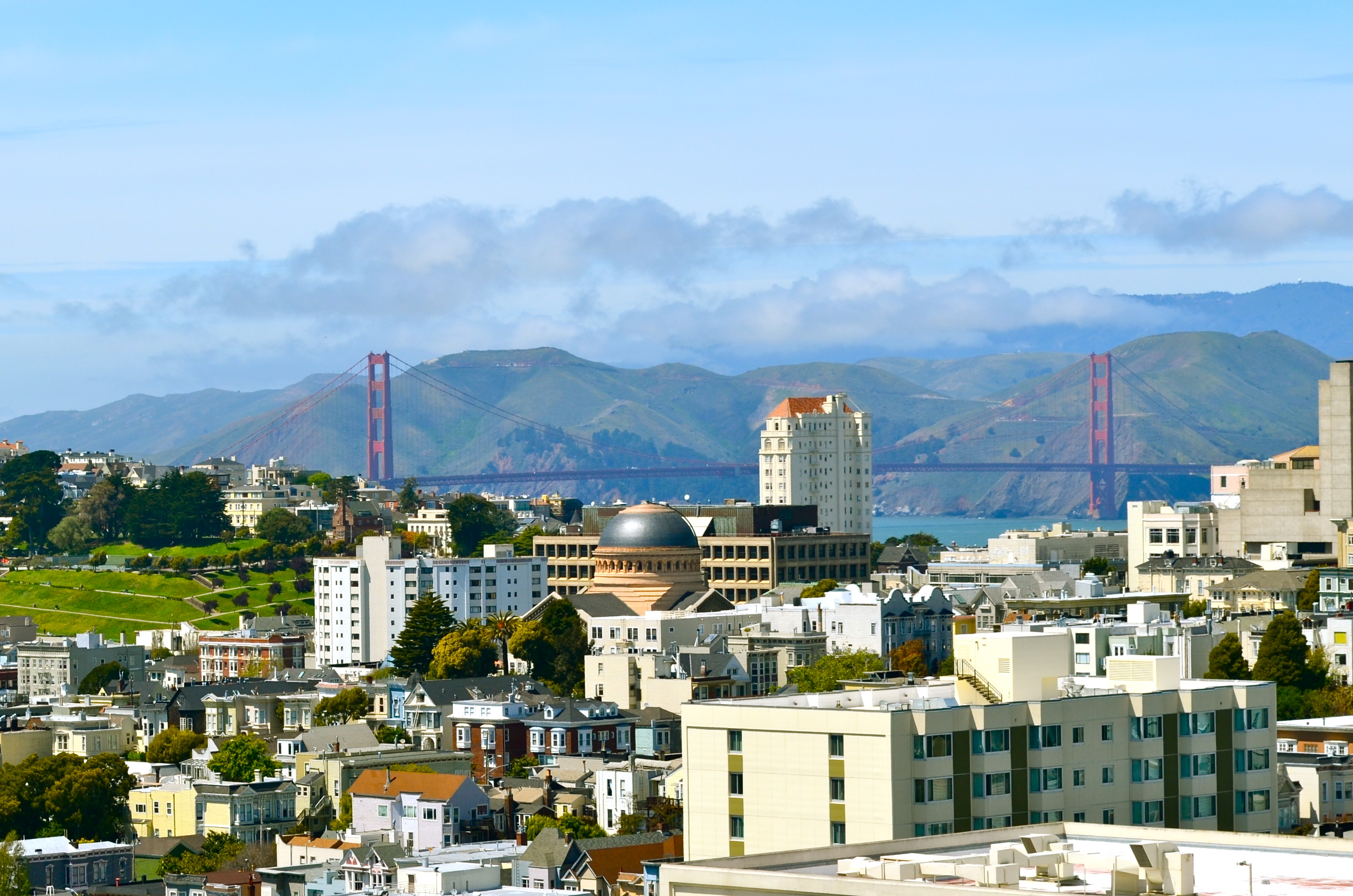
Yesterday, San Francisco celebrated the seventy-fifth anniversary of the opening of the Golden Gate Bridge. It was on May 27, 1937 (a Thursday, interestingly enough) that the world-renowned Golden Gate Bridge opened to the public. Schools and businesses were closed, and the city of San Francisco declared a holiday to celebrate the event. That first day, the bridge was open for pedestrian traffic only. Five years in the making, the bridge fulfilled a vision that had been nurtured for sixty years or more before construction finally started in 1932. Engineer Joseph Strauss was the moving force behind the undertaking, and his initial design of 1927 was the focal point for the effort persuade the politicians and the people that the bridge was not merely possible, but necessary.

It is almost inconceivable that construction of the Golden Gate Bridge was begun even as the country was in the depth of the Great Depression. To add to this astonishing fact, consider that the massive Bay Bridge was being built at the same time! What great courage and confidence, and far-sighted vision it took to do so much at such a period in our history. New construction techniques were developed to address the unique challenges of the project. Unprecedented cooperation among state, county, and city governments was pioneered. And a new “Wonder of the World” was created.

Strauss’ original design was much modified by the time construction began; the famed Art Deco appearance was the work of associate architect Irving Morrow. Strauss made the final selection of “International Orange” for the paint scheme of the bridge, feeling that the bright color would help provide navigational safety for ships and planes. Though the color was chosen for imminently practical reasons, it has proven to be a fortunate choice for the beauty of the bridge as well. Situated in a naturally beautiful setting, the bridge somehow compliments the scene.

Twenty-five years ago, on Sunday, May 24, 1987, my brother Bill, my friend Michelle Gluck, and I braved the crowds to take part in the Fiftieth Anniversary Bridge Walk. Unlike on the opening day in 1937 when foot traffic was permitted all day long, in 1987 the plan was to allow pedestrian access for only two hours in the morning. This relatively short time for pedestrian access was the result of a compromise: Marin County had insisted that bridge not be closed to vehicle traffic at all, while pretty much the rest of the world wanted it closed all day so people could really enjoy the pedestrian experience. Marin County, then-current sentiment held, was just being a spoil-sport (I have always assumed, personally, that the county government was simply showing how powerful it could be, exercising its sovereign authority despite almost universal sentiment to the contrary; the urge to exert power has always been a common governmental trait.) The planners in 1987 had forecast a crowd of between 150,000 and 200,000 people with perhaps 50,000 expected to make the walk across the bridge. They were in for a shock!

Well over a million people converged on San Francisco that day, and some 750,000 or more were determined to avail themselves of the once-in-a-lifetime chance to walk across the main roadway of the bridge. (actually there were a surprising number of old-timers planning to do this a second time!) More than a quarter of a million folks actually made it onto the bridge that Sunday morning in 1987 (counts range from SFPD’s low of 250,000 to the bridge’s official engineering report’s high of 800,000!) Bill, Michelle and I had reached into the middle of the span when everything came to a crushing halt. People had poured onto the bridge from the Marin side (which was not planned) and others had decided to turn back. But there were hundreds of thousands still coming in from San Francisco. It was a situation that could have invited panic or worse: there was almost no room to move for well over an hour as officials began to turn people away at the access points, and to clear people off of the bridge from the ends. The two-hour limit had stretched to almost six hours by the time all were cleared out. As things returned to normal, photographs showed that the weight of the massive crowd had actually flattened the gentle arc of the bridge deck by a full ten feet!

I will always be impressed though, that despite the tension of the situation, (no pun intended!) there was no panic, no riot, no calamity. Around our little group, folks began introducing themselves, talking about why they had decided to take the walk, telling jokes, and — with a little sense of gallows humor as we all heard eerie metallic groans and pings emanating from the bridge — making jokes about hurling into the water when the cables started snapping! One young man nearby decided we should all sing, just to keep things calm, and we all joined in on Sweet Chariot and other soothing, mellow tunes. The whole experience was likely an “only-in-San-Francisco” sort of occasion.

The Golden Gate Bridge held the title of the longest span in the world when it opened in 1937 and retained that status for 27 years until the Verrazano Narrows bridge was opened. It is still an inspiring monument to vision, ingenuity, determination, and the can-do spirit. Functional and lovely, it seems to me that no better monument could have been built.

Jamie Rawson
Flower Mound, Texas

Golden Gate Bridge 16 April 2012

Golden Gate Bridge 16 April 2012