Unknown's avatar

About Jamie Rawson

I make my living teaching a variety of high-tech subjects, but my undergraduate degree is in history, and history remains an avocation. I have diverse and widely varied interests and opinions, but if there is any theme which ties all of this together, it is perhaps Professor William Slottman's view that we study history to learn compassion.

Cinco De Mayo: Remember The Fifth Of May!

Today is celebrated in memory of the Battle of Peubla, Mexico as “Cinco de Mayo” – the Fifth Of May. Though observation of this holiday is quite localized in Mexico, being mainly celebrated around the city of Puebla, it is widely observed in the United States (and even Canada these days.) A common misconception is that Cinco de Mayo is “Mexican Independence Day,” but this is not the case. Mexico’s independence is honored on 16 September. Cinco de Mayo commemorates an important military victory, and its observance was decreed by Mexico’s legally elected president Benito Juarez on the 9th of May 1862. Because the outcome of the battle had a lasting impact upon the history of the United States, it is not at all strange to find its anniversary celebrated here, though it appears that few people delve into these connections.

On this date in 1862, Mexican forces led by Texas‐born General Ignacio Zaragoza Seguin (he was born in Goliad, Texas) and General Porfirio Diaz defeated an invading French army at Puebla on the road to Mexico City. The French forces outnumbered the Mexican troops at least 2 to 1, and they had much more modern armaments such as rifled muskets. Some of the Mexican troops carried muskets that had seen service with British troops in the Battle of Waterloo 47 years earlier (the selling off of outdated weapons to developing nations being an old and respected tradition!) It is a wonderful irony that those same “Brown Bess” muskets beat the French a second time! Despite the unequal odds, the ferocity and audacity of the Mexican troops defeated the French nevertheless.

This patriotic victory stalled the French invasion for more than a year, and though the French ultimately remained in Mexico until 1867, this battlefield success proved that Mexico could face the military might of Europe without relying on the support of the United States and its Monroe doctrine (the U.S. was rather preoccupied with an internal struggle at the time.)

The French had invaded Mexico at Veracruz in April of 1861 along with British and Spanish troops under the pretext of collecting payment toward Mexico’s outstanding loans owed to those countries. The year before, after three years of bitter civil strife between the conservative party led by Felix Zuloaga and the liberal party led by Benito Juarez, Juarez had formed a government and had, of necessity, suspended payment on all foreign debt. (A common tactic to this day.)

After Juarez’ government negotiated terms for extended repayment with both Britain and Spain, France’s Napoleon III (Louis Napoleon, a nephew of the Napoleon) declared that France was unsatisfied and would remain in Mexico until full repayment was completed. Britain and Spain withdrew their troops, but Napoleon III, confident that he could succeed while the United States was rent by Civil War, decided to install his own puppet government in Mexico.

The conservative faction was impressed with Louis Napoleon’s plan to place a European monarch at the head of Mexico, and backed the French. The liberal republicans who supported Juarez vowed resistance. As the powerful French force advanced from Veracruz to Mexico City, they won city after city and seemed to be unstoppable; after all, the French army had not lost a battle since Waterloo. But, at Puebla, the loyal Mexican forces rallied and made what was almost certainly a last‐ditch, suicidal stand. Yet they prevailed and turned back the French advance.

Since “Cinco de Mayo,” is a Mexican holiday, some may wonder why we in the U.S. would have any interest in it. Well – as is true for so much of history – there is an important but often overlooked connection between the Battle of Puebla, the Mexican Victory/French defeat, and the very fate of the United States of America.

My friend George Krieger was good enough to point out this connection to me some years ago, and I feel it is worth sharing, because it turns out the United States of America was a very real beneficiary of the Mexican victory.

In May of 1862 The United States of America had been engaged in a fierce Civil War for just over a year. This meant that the U.S. could not intervene against the French in Mexico as I mentioned earlier. But it is also worth noting that after nearly a year without new shipments of raw cotton from the South, the vast cloth mills of England and France were becoming idle. Many politicians and patricians in England were very interested in throwing their support, financial and military, to the Confederacy. In France, Louis Napoleon was similarly eager to support the Confederacy.

The reasons behind this notion of supporting the Rebels were more than just a desire to keep the mills running and the people working. There were also geo-political considerations: neither England nor France were anxious for a growing United States to become a Western rival to their dominance of world trade and politics. It would help both England and France to maintain their global positions if the United States remained two separate countries (preferably squabbling with each other!)

In his concise history of the Confederacy, The Confederate Nation: 1861 – 1865, Emory Thomas notes: “… diplomatic circumstances were a bit more volatile … than historians have often assumed. The Powers had not declared irrevocable neutrality.[1] James McPherson writes in Battle Cry of Freedom, his acclaimed one-volume history of the Civil War, “Napoleon [III] dared not act unilaterally … he recognized that a confrontation … without Britain at his side might scuttle his plans. From his summer palace, Napoleon therefore instructed his foreign secretary: “Demandez au government anglais s’il ne croit pas le moment venu…“* And McPherson further notes that a Union diplomat in London, James Mason, sent his superiors dispatches warning of intervention.[2]

The threat of Anglo-French intervention in the United States Civil War was quite real and such intervention would have been disastrous for the cause of The Union. Great Britain had the greatest navy in the world, and it was chiefly lack of a navy that put the South at a great disadvantage in the war from the start. And, too, France had a large and well-trained military presence on the North American continent, in Mexico.

If the French army had triumphed at Puebla, it is very possible that Louis Napoleon would have been willing to take steps to aid the Confederacy. Had the French not been forced to withdraw and regroup, and to spend another year recovering from the Mexican victory, the United States might not exist as we know it today. Unreconstructed Rebels amongst us notwithstanding, the world would be a much different place had the Union been sundered, very likely a much worse place as well, for what nation, then, would have been able to defeat an Adolph Hitler, or to bring down a Soviet Union?

Always bear in mind that events in history do not happen in a vacuum. The events a world away affect us, and surely the events next door must as well. The failure of the Polish wheat harvest in the Fall of 1862 also helped to deter Anglo-French intervention in our Civil War (the details of which are for another essay.) But it remains that the victory celebrated by our Mexican neighbors indeed helped to make the world we have today. It was Mexico’s greatest patriotic victory, at the time surpassing in importance and emotion even Mexico’s independence from Spain. But it also was a victory for our One Nation, Indivisible.

Here’s to the Fifth of May! And my thanks to George Krieger for reminding me of this connection.

The emotional impact of the victory is commemorated in the festivities celebrating “Cinco de Mayo.” In the modern U.S., the day has become yet another occasion for marketing hype and enthusiastic consumption, with little or no concern for the actual reason or origins of the event (just as have other national holidays such as St. Patrick’s Day, Oktoberfest, and even Chinese New Year.) It is primarily owing to the marketing muscle of U.S. Mega-Brewers that we find Cinco de Mayo celebrations in Hawaii, Alaska, across the lower 48, and even in major Canadian cities these days. There is little thought of how the Battle of Puebla affected contemporary history. Rather, it is simply another reason to have a party (and to consume immense amounts of beer.) But that’s terrific! We can always use another excuse to celebrate!

+-=-+-=-+-=-+-=-+-=-+-=-+-=-+-=-+-=-+-=-+-=-+-=-+-=-+-=-
Jamie Rawson
Flower Mound, Texas

Las armas nacionales se han cubierto de gloria . — Zaragoza

[1] The Confederate Nation: 1861 – 1865, Emory M. Thomas, Harper & Row: New York, 1979. p. 182.

* “Ask the English government if they think that the moment has come…”

[2] Battle Cry of Freedom: The Civil War Era, James M. McPherson, Oxford University Press: New York, 1988. pp. 554-555.

Chris Rawson – Fifty Years Ago

InMemoriam
famscans-33

This day, 12 April, is as freighted with important events as any in the calendar. In 1204 on this day, the Crusader armies ostensibly arrayed against “infidels,” began the bloody sack of Christian Constantinople. It was on 12 April 1861 that Confederate guns opened fire on the Union hold-outs in Fort Sumter and thereby set off the American Civil War. It was also on 12 April 1945 that President Franklin Roosevelt collapsed and died from a massive stroke. And there are positive events associated with this day as well, including Yuri Gagarin’s successful mission as the first human in outer space. Today, however, I again take the privilege to write about a very personal anniversary upon this day.

I cannot help but note, as we recently celebrated Easter, that we are reminded that the reason for this holiday is to celebrate Life. For Christians, this is always a celebration of Life Everlasting and the Salvation that Jesus made possible for Mankind. Pre-Christian traditions also took time at this high point of Spring to celebrate the rebirth of nature after the bleakness of Winter. Familiar Easter symbols such as rabbits, (life abundant) eggs, (life emerging from lifelessness) and bright flowers (life reborn) have their origins in these Pre-Christian celebrations, though the symbolism applies fittingly to the Christian celebration.

Yet, as the Book of Common Prayer reminds us, in the midst of life we are in death. Next Friday, Good Friday, commemorates the crucifixion of Jesus and his earthly death. For the past fifty years, each Good Friday is also a time of personal remembrance for me, because it was fifty years ago today, on Good Friday, 12 April 1974, that my brother Chris was killed in an airplane crash. Though it has now been fifty years, this loss is still with me. It is not a fresh pain, of course, it simply is a loss that I have grown accustomed to, but which nevertheless remains a loss.

Chris was a wonderful brother. The passage of time, as is natural, has caused me to forget any flaws and to remember only the good things. Yet I can say this unreservedly even so.

famscans-77

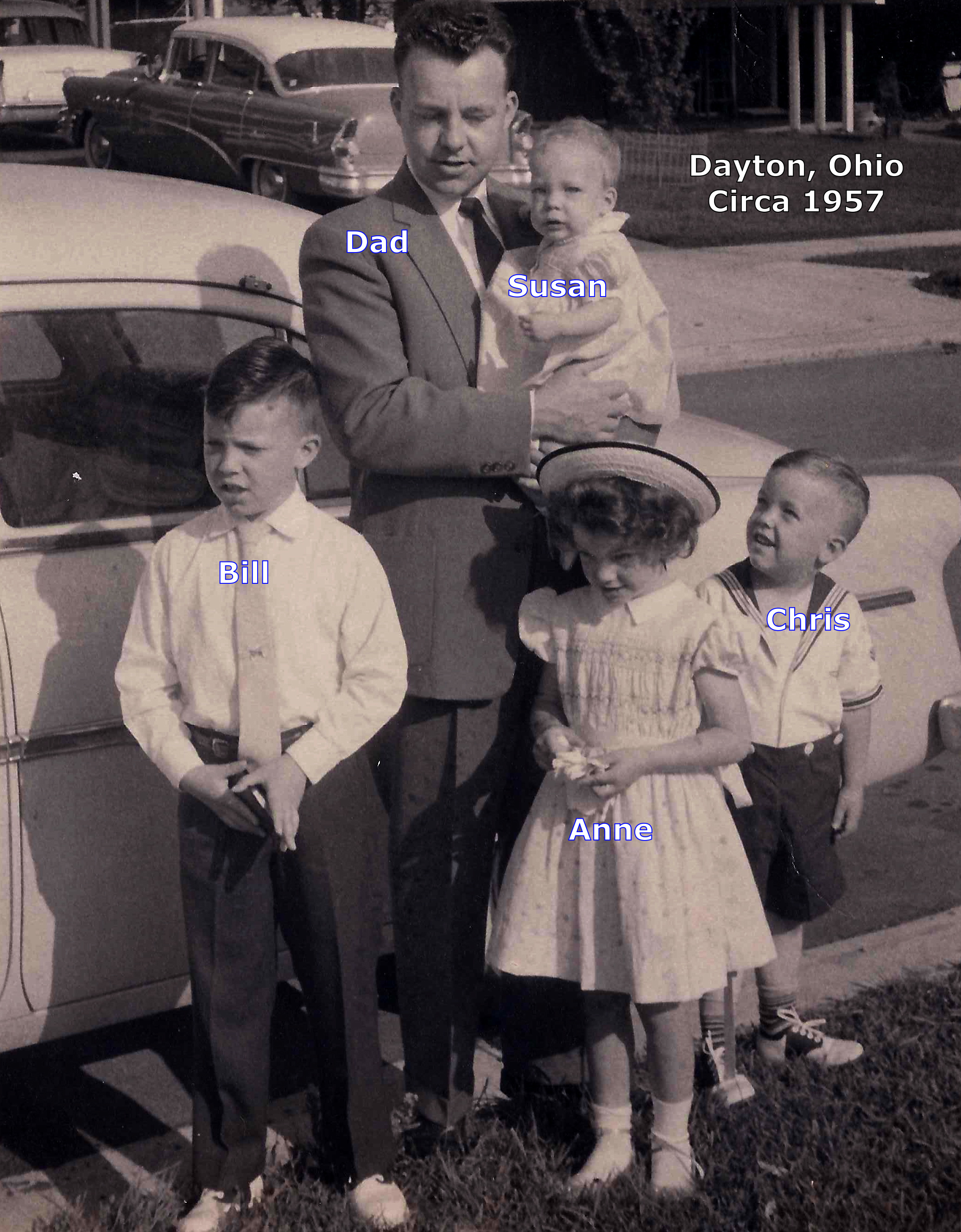
Chris being born three weeks before Christmas, family lore has it that oldest brother Bill declared the new baby should be named “Christmas!” That may or may not be the case, but Chris was indeed named Chris, though for aesthetic reasons, my folks decided to dub him “John Christopher Rawson.” By all accounts, he was a sweet child, and a wee bit ingratiating: he was well known for his endearing plea, to anyone who seemed a likely touch, “Cookie?” He so often asked for a cookie, in fact, that for a time he bore the nickname “Cookie.” (This moniker, oddly enough, returned to haunt him in his college days. For entirely different reasons, his dorm-mates dubbed him “Cookie” as well!)

Chris had so many interests that, as a youngster, he was often described by his teachers as “unfocussed.” I think that was a fair description, but I wonder why anyone might have an expectation that an inquisitive and energetic youngster should be “focussed.” He enjoyed nature and the outdoors, and he delighted in hiking and horseback riding. He tried his hand at turns in painting, wood carving, and clay sculpture; he also enjoyed cooking and baking. In high school he had the distinction of being the very first male student to enroll in a “Home Ec” class!

famscans-58

When Chris was in his early teens, at a time when my father was considering an employment opportunity in Saint Louis, Chris decided to design an old-fashioned flatboat to take on a drift down the mighty Mississippi. He drew elaborate plans, did research on materials and costs, and spent time at the library to learn about similar designs. Ultimately, he built a 1/20th scale model of his plans in balsa wood. This plan was never realized (my father declined the job offer) but we had that wonderful model for many years.

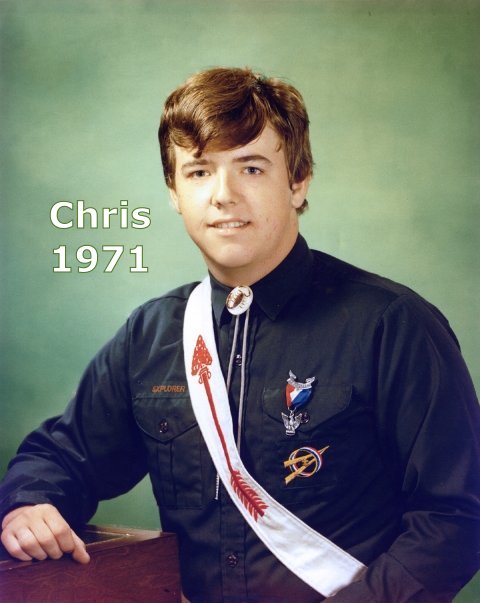
Chris was deeply involved in Scouting and attained the rank of an Eagle Scout.

JCReagle
For many years he spent his Summers as a camp counselor at the Boy Scouts’ Camp Emerald Bay on Santa Catalina Island off of the Southern California Coast. He introduced my twin brother Rob and me into Scouting. We three did a great deal of hiking together with our troop, and we “conquered” many of California’s tall peaks. I have an especially fond memory from the Fall of 1972. Our scout troop was hiking in the Grand Canyon. At that time, Chris was attending school at Northern Arizona University in Flagstaff. As night descended on our first day in the Canyon, I was startled to hear a familar voice call out: “Rob and Jamie Rawson had better answer their older brother!”

Chris had hiked all the way to Phantom Ranch where we were encamped to join us for the long weekend! He led us on several day-hikes where he served as a well-informed tour guide sharing with us younger Scouts things he had learned about the geology of the canyon in a class at college. Chris supervised some pretty fancy meals as well, for he had packed in some steaks and potatoes and other non-standard camp fare. The Scout leaders were especially glad to see him, for he had ensured his welcome by bringing in a case of beer! (Just for the adults!)

Chris had many interests and enthusiasms. He loved drama (he played the comic-relief role of the porter in a production of MacBeth) and he loved stagecraft (he once designed the set for a college production of Jesus Christ Superstar.) He was fascinated by film and the movie business and he made several 8mm films, including his magnum opus, Kincaid’s Gold, a thinly veiled rip-off of a Hollywood film of similar name.

“The Delphian 1971”
Rolling Hills High School yearbook

In the last year of his life his great passion was flying. Chris joined the Air Force ROTC. He took training at Lackland Air Force Base in San Antonio, Texas in the summer of 1973. The training was intense, but he took the time to mail a small Texan cactus to me and Rob for our cactus garden. During the next year he took opportunities to fly whenever he could.

In the Spring of 1974, Chris was eagerly looking forward to completing college and starting a career in the U.S. Air Force. He had an opportunity to take an elective class in a field outside his major, and so he decided to take a class entitled, “The American Way Of Death.” The course examined several works about the modern manner of dealing with death and dying, and the reading list included Elisabeth Kübler-Ross’ seminal examination of the stages of grief, On Death And Dying. Also among the works listed was The View From A Hearse, which offered a specifically Christian perspective of the issues of death and dying. Chris found this class especially fascinating, though I know not why, and he made a particular point of leaving these two books with me and Rob to read when he returned to school after his Spring break at the end of March that year. I read these books that first week of April 1974. I have both books in my library still.

Good Friday, 12 April 1974 was a stunningly beautiful day in Southern California. The air was clear, the temperature mild. It was a day so perfectly lovely that I well might have remembered it ever after just for that. I even recall thinking that afternoon what a fortunate day it was.

Rob and I had arisen at 4:00 am to accompany my mother to the Los Angeles Flower Market to pick up the stock for the Easter weekend at our flower shop. After we had finished cleaning and preparing the immense load of flowers back at the shop, Rob and I went to a local lunch counter. We ordered chicken salad sandwiches for lunch, only remembering too late that we should not have ordered meat on Good Friday. Fortunately, when the waitress brought the sandwiches, the cook had gotten the order wrong: the sandwiches were tuna! (Which was just fine for Good Friday.) She apologized and offered to fix our order, but Rob and I explained how happy we were for the substitution. It certainly seemed a fortunate day.

After our lunch, Rob and I walked to our friend Mike Sherwood’s home which was not too far away. We three decided to walk to our friend Ed Kraus’ house. Somewhere in our walk we picked up another friend, and we kept walking. We decided to hike along a dry stream, finally resting in an immense storm water culvert far below the roadway; it was our ‘secret cave.’ We leaned against the curved, corrugated steel walls of the culvert and spoke of many things, including mortality and fate. We also commented upon the stunning beauty of the day.

At length, we decided to head back to our homes, once more thinking how fine the day had proven to be.

We were watching the broadcast of Ben Hur that evening when the telephone rang, delivering the stunning, tragic news. To this day, I still cannot watch the scene where Messala and Ben Hur meet in the grand hall of Hur’s urban villa. It remains too powerfully evocative of that horrible call.

I can never forget hearing my Mother’s immediate reaction as she received the call, nor shall I ever forget my Father’s stoic, calm, controlled, and very “military” handling of the overwhelming news. His long career in the U.S. Air Force had trained him to stay collected and effective. It would not be until five days later that my Dad broke down and gave vent to the terrible pain he felt. In all my life I had never seen the man cry, even a little. Yet he broke down and wept uncontrollably for perhaps fifteen minutes as we sat with the casket before the Rosary service. Rob and I hugged him as tightly as we possibly could, as he cried and cried. My world was rocked nearly as much as it was upon first hearing the news.

Immediately after taking that fraught phone call, my Father called his long-time friend and Air Force colleague, Don Davis, and though the hour was late and the trip long, Colonel Davis set out immediately to come to be there for us. The next day the whole Davis clan joined us, and though the enormity of the loss remained, the care and comfort of dear friends – family, really, in all but blood – helped to make a dreadful time vastly less dreadful. My Grandmother Rawson, the last of our grandparents, came in that Easter Sunday afternoon from Washington, D.C., and my Uncle Mike and Aunt Kiki arrived from Washington that Monday afternoon. Our house was filled with friends, and family, and relatives, and the love and comfort was so thickly tangible that it truly eased the pain. After a few days, it actually became possible to laugh and to feel a bit light-hearted, despite the sorrow.

The funeral service was held at Saint John Fisher Catholic Church on Thursday 18 April. The congregation’s recently appointed pastor, Father Vince Barrett, celebrated the funeral mass and delivered a brief but fitting homily. Among the hymns that were sung, Amazing Grace stands out in my mind. That hymn retains for me a capacity to bring moisture to my eyes. As we exited the church, my Uncle Mike played the mournful, traditional piper’s lament, Sleep, Dearie, Sleep. Mike had not brought his pipes with him when he travelled to California, but we were fortunate that Eric Rigler (who was at that time just starting what would become his renowned career as a piper; you have most likely heard his music on a movie soundtrack) offered to lend his bagpipe for my uncle’s use.

We buried Chris at Los Angeles Veterans Cemetery in Sawtelle/Westwood, Los Angeles on 18 April 1974.

JCRgrave

As we rode in the limousine to the graveside, a very long drive from the Palos Verdes Peninsula to Westwood, we told stories about Chris, and as we became more and more enwrapped in the memories, we began telling the sorts of tales of silliness and calamity that we all know of one another, and we laughed. It did not seem irreverent. As Shaw observed, “Life does not cease to be funny when people die, any more than it ceases to be serious when people laugh.” I did feel bad about making the limo driver laugh, though, for he was quite needlessly apologetic.

After we returned home, after the post-funeral feast, life began to resume an aspect of normality. But it was never the same. It never has been, of course, which is inevitable: life is never the same, no matter what events or circumstances come about.

At that time, and in the decades since, I tried to understand the “why” of this loss. There was no reason, no purpose, no greater cause served by Chris’ death. It simply happened. In the midst of life we are in death. On the threshold of the Easter celebration of Life and Rebirth a life was lost. I long ago concluded that the “why” of this loss will remain unknown to me in this life. There is no compensation possible, there is no “getting over it,” there is only getting used to it. And I have done so, though a chance recollection can still cause me to choke up, and a particularly emotional scene in a drama can bring on the waterworks.

Several years ago, the chorus I sing with, The Turtle Creek Chorale, sang a powerful and moving piece, Emily Dickinson’s poem Will There Really Be A Morning? set to the beautiful music of composer Victor Johnson. When first we sang through the work, I had to slip out of rehearsal for a private moment of overwhelming emotion, because I so clearly recalled that very question in my own mind that sad night: “Will there really be a morning?” And, yes, there will be. Life goes on as it must, and will in any case. And it would serve no purpose to be angry or resentful for the loss. It is not unjust; it is not just. It just is.

But I write this not to bring down peoples’ spirits; rather I write this to remember a fine person who has been gone far longer than he lived. I recall him very often, and in my mind he well deserves to be remembered.

So as we come to celebrate Life and Rebirth, as we rejoice in Spring and think of delightful things, we also remember too those who are not here with us. The delight of Spring and the mystery of Easter embrace both reflections.

John Christopher Rawson 1952-1974

Chris Rawson, USAF ROTC. Taken 11 April 1974, the day before he died.

NEWS ARTICLES

The Triangle Shirtwaist Factory Fire

It was on this day 103 years ago, Saturday 25 March 1911, that the ghastly Triangle Shirtwaist Factory fire occurred in lower Manhattan. The fire remains one of the deadliest fires and one of the worst industrial disasters in American history: 146 young women died as a result of the fire. About a third of the victims burned to death, about a third were suffocated or trampled in the panic, and about a third died when they jumped helplessly from the upper floor windows to escape the inferno.

The owners of the Triangle Shirtwaist Company were running a genuine sweatshop. The workers were mostly young immigrants who worked 12 to 14-hour days, six days a week for about 15 cents an hour. The factory was a cramped, dark, and dank space occupying the eighth and ninth floors of the building. The litter of rags and cuttings helped to spread a small fire rapidly. Attempts to douse the flames were foiled by a single rotten fire hose and a control valve which had rusted shut.

As the fire spread, women began rushing to the only operational elevator, which could carry only a few at a time. It broke down under the overloaded conditions after a couple of runs. Young women tried to escape via the small stairways as well. This was to no avail as one stairway had been locked (“To prevent the girls from stealing,” according to the foreman) trapping several dozen victims, while the other stairway had a door which opened into the factory, and could not be opened against the crush of panicked people.

Ironically, the building which housed the Triangle factory was a modern, “fireproof” construction of steel and concrete. And the structure did indeed survive the deadly blaze. In fact, the building still stands and is in use to this day.

Fire safety standards of the day were minimal, but such as they were reflected the interests of insurance firms. At that time, property was far more commonly insured than lives. Architectural and engineering standards reflected a primary goal of preserving the structure rather than its occupants. Though in 1911 New York City had industrial safety laws which were considered a model for the nation, the laws were essentially unenforced. Overworked and underpaid fire inspectors were readily bribed into overlooking useless firefighting equipment, illegally locked exits, and other failings. But even in a city used to corruption and dreadful working conditions, the horrific loss of life at the Triangle Shirtwaist factory stirred action.

The owners of the factory eventually stood trial, but were completely acquitted, despite the fact that many jurors believed that they had failed to provide the required safety features. A suit against the building’s owner was more successful; after several years, the victims’ survivors were compensated about $75.00 per life lost.

In the wake of the disaster, New York City passed a far more stringent set of fire safety laws, as did the state. Many other states followed suit. New York City also put some real teeth into its laws by providing for the hiring and training of many more fire inspectors. The International Ladies Garment Workers Union organized to bring political pressure for Federal safety standards.

The building, originally bearing the eerily ironic name “The Asch Building,” still stands. It was restored after the fire and it was eventually donated to New York University. It is in use to this day as the main science facility for NYU. The late Stephen Jay Gould, the Harvard paleontologist whose essays helped bring esoteric science to the general public, once had an office in the building; upon discovering the building’s history, he was inspired to write an essay about biological and social evolution.

Ultimately, industrial safety and working conditions were improved throughout the nation. The Triangle fire drew attention to the issues as nothing before had. But it was not the last time that improper safety precautions and illegally locked doors would result in fire deaths. As recently as 1991, 25 factory workers died in a poultry processing plant fire in North Carolina; reading the OSHA assessment of the tragedy, one can only wonder if anything had really improved in the 80 years between 1911 and 1991.

OSHA Report:
http://www.osha.gov/SLTC/etools/poultry/general_hazards/firesafety.html

Jamie Rawson
Flower Mound, Texas

Capital and Labor are both wild forces which require intelligent legislation to hold them in restriction.

— John D, Rockefeller

As We Conclude Black History Month 2014, A Personal Memoir

Today, 28 February, marks the conclusion of Black History Month. I have been remiss by not explicitly recognizing this worthwhile observance. So, as we come to this conclusion, I would like to offer a very personal “history” for this occasion. This may be presumptuous of me, a White Male, to tell the story of a Black Female from a completely different background, but I feel it is suitable. History is composed of far more than the mighty and well known, and the “every-day” folk who make up history have stories worth telling. My subject was never a “mover and shaker,” nor a possessor of any great power. My subject contributed no famous inventions, nor led any potent movements. Yet for all her seeming lack of great distinction, she made a positive impact upon a great many lives, and, in her own way, she achieved a small measure of local fame. However, foremost, I choose to tell her story because I believe it serves as an important lesson in the larger picture of history as well.

I choose to write about Myrtle Davis of Berkeley, California. I first met Myrtle when I was a new freshman at The University of California, Berkeley in the Fall of 1977. We remained in regular contact from that time until her death in 1999. I came to know Myrtle in her capacity as cook for Tellefsen Hall, a residence for, at that time, male members of the University of California Marching Band. The house board had hired Myrtle the previous Spring. Myrtle had worked for almost twenty years previously at the campus’ ΑΟΠ sorority, and she had worked at other sororities prior to that position. When asked why she decided to take the job at Tellefsen Hall, she once observed that she had grown, “tired of dealing with the girls,” and wanted “to find out what dealing with the boys would be like.”

As cook for TH, as Tellefsen Hall is often known, Myrtle became a well known and well loved figure for several generations of Tellefsen Hall residents and Cal Band members in general. Myrtle served as cook for TH from the Fall of 1977 until her retirement in 1986. Myrtle was one of those cooks who may rightly be described as “a treasure.” She was a wonderfully talented cook. Her meals ranged from the plain and penny-wise to the festive and fancy. While it is a common stereotype that students hate the food at school, Tellefsen Hall residents enjoyed meals of remarkable quality and variety.

From a management perspective, Myrtle was a skilled kitchen administrator who ran a tight ship and consistently stayed within her allotted budget. I always marveled at the fact that Myrtle rarely wrote down her expenses. She kept all the kitchen receipts in a drawer. She would evaluate each receipt and invoice as it came in – and she would instantly spot any error or discrepancy – and then put it in the drawer. She simply kept a running total and budget in her head. In my time at Tellefsen Hall, she never once ran over budget and never had any errors in the accounts.

Myrtle was a tough negotiator, too. She maintained good relationships with all her suppliers, many of whom she had been dealing with for decades, but she never eased up if she felt they were delivering less than their best. Once when the butcher’s assistant delived some roasting beef that Myrtle found unacceptable, the owner himself showed up with the replacement order and apologized profusely.

“It was a mistake, Myrtle,” he insisted, “You know I’d never expect you to accept that.”

On another occasion, the bakery had sent French bread that had been labelled “Dark Bake.” Frankly the loaves appeared to be overdone and slightly burnt. I shall never forget Myrtle getting on the telephone and chewing out her route manager:

“Dark Bake? Dark bake?!?! You burnt a batch of bread and try to pass it off by slipping it into wrappers that say ‘Dark bake!?!?'”

Once again, replacements were rapidly forthcoming. Suppliers disappointed Myrtle at their peril.

Myrtle had a truly impressive memory. She retained perhaps several hundred recipes in her head, only rarely consulting her notes when preparing meals. For frequently made items, such as pie crusts or dinner rolls, she used no notes at all. Yet her output was consistent time after time, year after year.

Myrtle was keenly interested in current events, and on the break between breakfast and lunch, or between lunch and dinner, she would listen to her radio in the pantry – later a small television provided the news – and she would read the San Francsco Chronicle cover to cover. I never ceased to be amazed at the volume of information she digested daily, and how many news stories she kept abreast of. And I was always impressed at her ability to hold her own in discussions of current events. She once observed that because of these discussions, she had “been studying at Berkeley for years!”

After she retired, Myrtle took great pride in the fact that she had become a part of Cal Band history. In the 1993 publication The Pride Of California: A Cal Band Centennial Celebration, Myrtle is mentioned in Chapter 5: “Residents of the late ’70s and early ’80s have fond memories of Myrtle Davis, who was considered not only the best cook on campus but the de facto “house mother” as well.”

This was indeed the case. Many almuni of TH recall Myrtle acting as a confidant, dispensing advice as wished and admonishments as needed, as well as offering a shoulder to cry on when called for.

Myrtle could also be strict and stern with misbehavior. One June weekend in 1980, three of us celebrated a birthday with a late morning outing to the the pinnacle of Grizzly Peak in the Berkeley Hills. Once we arrived at this incredible vista point, from which one can view essentially the entire Bay Area, we unpacked a picnic lunch of Tillamook cheddar cheese, fresh sourdough bread, tart green apples, pickled onions, and Ranier Ale. Lots of Ranier Ale. The ale being consumed, and lunch being finished, we considered driving home. Thankfully a degree of prudence caused us to rethink the idea, and it was not until nearly six more hours had passed that we actually set out for TH. I took the wheel and safely navigated the twisted and torturous route back.

We arrived home so late that we had missed dinner, and we pulled up just as Myrtle was leaving. When she spotted us, Myrtle got out of her car to dress us down. I have rarely felt so small and guilty as when she scolded me for driving after having been drinking. “I don’t care if you waited six hours! That’s just plain dangerous! And stupid! If you’re going to go out and drink, walk!” (And she revisited the topic with me the following Monday morning. She was serious!)

On at least one occasion, during a Saturday after Finals Week in early Spring of 1979, Myrtle came to the “defense” of TH when a war party of band members who were not TH residents decided to storm the house, assaulting the building by using giant slingshots to launch unripe plums from the local suburban forest at the front of the building. Myrtle was working in the kitchen when she heard the first salvo strike the house, making a distinctive “thud-th-th-th-thud-thwap!” sound. When she stepped out to investigate, she saw the assault team and artillery; without hesitation, she began sounding the Tellefsen Hall dinner bell as an alarm.

“We’re being attacked!” she explained to everyone who responded. And so the battle was joined.

(I cannot recall every detail of that epic struggle, but I do recall that stains from semi-ripe plums speckled the house front for several weeks thereafter.)

I could fill pages and pages with further memories of Myrtle from my time in school, and perhaps I shall one of these days. But it is necessary that I move on from my own memories and relate Myrtle’s story as best I can, for it is in this story that the lesson lies.

Myrtle was born on 17 December 1916 in Houston, Texas. Her mother was a house cleaner and maid who worked for a well-to-do Jewish family in the River Oaks neighborhood of Houston. River Oaks was an exclusive enclave of Houston’s very wealthy, and by a combination of deed restrictions and a “gentlemen’s agreement,” excluded minorities from being residents, including Blacks and Hispanics. It is also said that Jewish families were originally excluded as well, which would be consistent with the mores of that age, yet as Myrtle related her story, the family was Jewish. Any Blacks or Hispanics seen in River Oaks in that era were working as domestics, landscape workers, or laborers. It was a time when segregation and discrimination were openly and often unquestioningly accepted.

When Myrtle was 9, she began accompanying her mother to work, helping out in the kitchen. The family who employed Myrtle’s mother was wealthy enough to have a full-time maid and a cook. Myrtle showed early aptitude for cooking, and for some years worked as an unpaid assistant in the kitchen as well as a helper for her mother. The key thing was that it meant that Myrtle had meals during the day as well as leftovers to take home. As the Great Depression settled in and jobs became scarce and incomes shrank, payment in kind such as meals and leftovers became crucial to getting by.

Myrtle attended school until she completed 8th grade. At that time, it was considered unneccessary for females to pursue further education, and this was particularly true for female minorties. In a later age, who knows what Myrtle might have accomplished with a more extensive education? In her school days, Myrtle recalled, she excelled at both math and spelling. Her math skills and prodigious memory may be inferred from the fact that she maintained so much kitchen budget and bookkeeping data in her head. Her spelling expertise is attested by her annual appearance in a county-wide spelling bee every year from 4th grade to 7th grade. In her 5th grade year, Myrtle advanced to the final round, only to be eliminated on the word “deaf.” She asked them to repeat the word. Because she lived in an environment where that word was pronounced “deef,” she spelled out D-E-A-T-H, and lost the competition. I could detect that, even more than five decades after, she felt keenly that this was unfair.

In Texas of the late 1920s, educational opportunities for Black females were limited indeed, as were employment opportunities. If one’s mother worked as a domestic, it was all but a certainty that that is the path one would follow.

When Myrtle was 15 or 16, right about the very deepest period of the Great Depression, she was hired as the full-time cook for the family. Though the family was Jewish, they were not strictly observant. Myrtle recalled cooking breakfasts which included bacon and/or ham, along side Southern staples such as grits and cornbread. She remembered with evident pride that her cakes were a particular favorite of the head of the household.

Myrtle managed the kitchen budget and dealt with suppliers efficiently and effectively. She told of being praised by her employers for consistently managing to stay within or under budget while producing outstanding meals.

The family had a daughter just about Myrtle’s age. The two played together when they were small, but as they grew up, that was no longer acceptable. Nevertheless, Myrtle recalled that the daughter was always kind to her.

In the later 1930s, the family no longer employed full-time staff, and Myrtle took a job cooking in a small restaurant in addition to cooking breakfast and weekend dinners for the family.

Though the Great Depression was easing, times were still quite hard. Houston was less severely hit than Northern manufacturing centers, because demand for oil remained reasonably steady. But large numbers of unemployed people came to Houston from Louisiana and this influx made service jobs hard to find as well as further depressed wages.

At some point during her teen years, Myrtle “took up” with a young man who had no steady employment. I am not surprised that I have never learned details of this relationship, though Myrtle did reveal that the fellow once tried to beat her in a drunken rage when she refused his demand of cash to buy booze. She apparently had the better of the altercation and whupped him.

At some point peripheral to the Second World War, Myrtle met and later married Andrew Davis. I have attempted to find the specific date for the marriage, but have so far come up blank. I know that during her time at Tellefsen Hall, Myrtle and Andrew were celebrating anniversaries numbered into the 40s. Andrew Davis was trained as a chef, so perhaps they met because of some job in common.

During World War Two, Andrew served in the United states Navy aboard troop transports in the Pacific theater, so the couple relocated to Oakland, california for the duration. As a Black man, Andrew was limited to serving as a steward aboard the ships. Though he was a trained chef, his duties were limited to serving food and to making coffee and other menial chores.

Andrew once told of the time when he and some of his fellow stewards grew weary of continually making coffee in the immense, industrial sized pots. The troops aboard ship drank coffee almost continuously. After one complaint session among the stewards, Andrew announced that he’d slow down the coffee consumption. Taking a large scoop of plain white sugar in hand, Andrew, as he liked to recall with a chuckle, opened the lid of one of the huge coffee brewers and hollered back to a fellow steward, “Hey, you forgot to add the saltpeter!” and dumped the sugar in the vessel. Thus coffee consumption declined precipitously!

By the end of the war, Myrtle and Andrew decided to remain in California. Myrtle had begun working as a cook at a women’s dormitory on the Berkeley campus, and Andrew found work at Larry Blake’s Restaurant on Telegraph Avenue in Berkeley. In 1946, using money that they had saved during the war years, augmented by a considerable nest egg which Andrew had garnered aboard the troopships by playing craps among his fellow stewards and troops aboard, they purchased a small, neat house in South Berkeley at 1401 Alcatraz Avenue. They would remain in this house until their respective deaths almost 53 years later.

Andrew and Myrtle Davis in the kitchen of Tellefsen Hall, June 1982.

Andrew and Myrtle Davis in the kitchen of Tellefsen Hall, June 1982.

Myrtle continued to work as a cook on and around the Berkeley campus until she retired from Tellefsen Hall. Andrew remained at Larry Blake’s until he retired as head chef in the Spring of 1979. Although this represented his formal retirement, Andrew could not stay idle long. He began accompanying Myrtle to Tellefsen Hall on the weekends, “just to keep her company,” and quickly returned to cooking, making onion rings and barbecued ribs and all manner of delicious food, especially his soups. Andrew loved to tell how Larry Blake himself had once praised his soups, proclaiming, “Andrew, your soups are better than sex!” Though he was never an official employee of Tellefsen Hall, Andrew became a more and more frequent presence at TH, and no holiday or special occasion passed without his culinary contribution.

Myrtle and Andrew never had any children of their own, so they took especial pleasure in following the lives of the many young men and women they had come to know. They attended many weddings and other celebrations, and on at least one occasion provided the rehearsal dinner at Tellefsen Hall for a wedding between two Cal Band members. Occasionally, they would host Sunday afternoon dinner at their home on Alcatraz Avenue, inviting their “alumni.” They touched many lives.
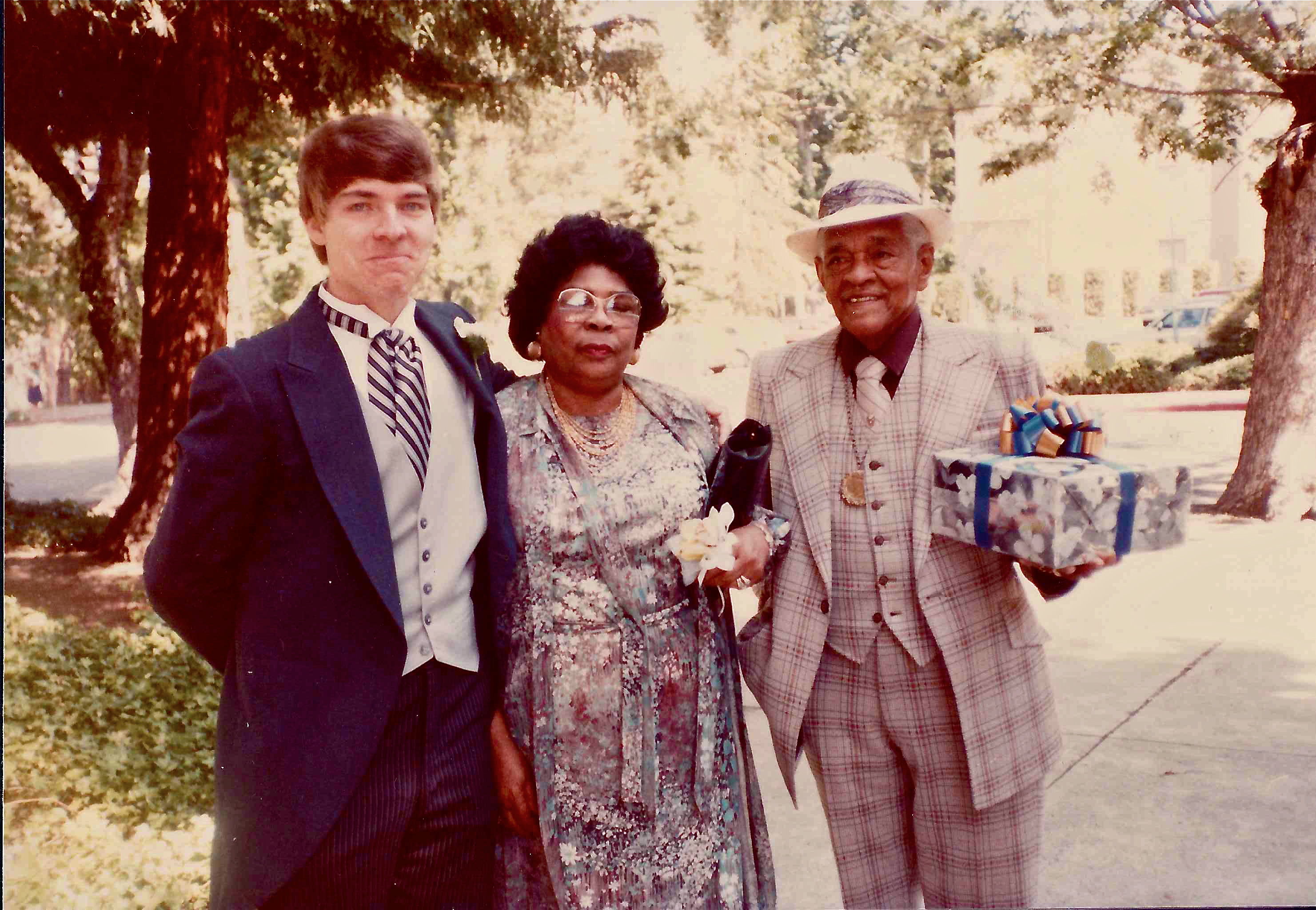
Me, Myrtle, and Andrew Davis, just before my brother's wedding, 23 June 1984.

Me, Myrtle, and Andrew Davis, just before my brother’s wedding, 23 June 1984.

It goes without saying that they both were and remain important in my life. Barely a day goes by that I do not think of them, especially as I love to cook and I owe them so much for what they taught me, both in the kitchen and beyond. It is rare for a person to know me for more than a day or two without hearing some tale about Myrtle and Andrew.

Myrtle Davis was an uncommonly bright and capable person. Her management skills were such that she could have easily been a success running far larger enterprises than rooming house kitchens. Her unusal memory, her ability to consume and retain information, and her practical mathematical skills all indicate that she could have achieved greatly in a wide range of fields.

Unfortunately, Myrtle was born into an age which elevated and enshrined racial discrimination and segregation, and barred even the talented and promising from educational and employment opportunities “above their station.” A Black woman born in Houston, Texas in 1916 simply was not offered the opportunity to develop her abilities to their fullest. While we who knew Myrtle greatly appreciate her mastry of the kitchen, it has always seemed clear to me that in a later day and age, she would have had a very different career path, and would have been able to positively impact even more lives.

I earlier mentioned that I take a lesson from Myrtle’s story, a lesson that makes this memoir a fitting piece for inclusion in Black History Month. It is simply this: both individuals and the greater society as a whole are ill-served when discrimination is accepted policy. Even when determined individuals succeed in such an environment, full potential is generally sacrificed.

I am pleased that in the United States in 2014, racial discrimination is no longer approved of in law, and rarely openly approved of in any context. I know that there is still a long road ahead; we are far from free of this pernicious heritage. But we have improved, and that is all to the good.

Jamie Rawson
Flower Mound, Texas

All of us do not have equal talent, but all of us should have an equal opportunity to develop our talents. — John F. Kennedy

34 Years Ago In Dallas, Texas

It was the evening of 19 February 1980 that 38 men gathered for the first rehearsal of the newly formed Turtle Creek Chorale in Dallas Texas. At the time, the idea of having a men’s chorus which drew membership from and which would serve Dallas’ large, but not highly visible, gay community was a bold and daring notion, and far braver than one may readily conceive today. In the thirty-four years which have passed since that day in 1980, so much has changed so dramatically that it is difficult to realize the very potent courage and powerful conviction that those 38 singers expressed by daring to take part in that first rehearsal.

The idea to form a gay men’s chorus for Dallas was famously born as three friends chatted over cocktails one Sunday afternoon in Dallas. The San Francisco Gay Men’s Chorus had been founded less than two years before as the world’s first musical organization specifically serving the gay community, and its initial successes and setbacks were much discussed in gay communities across North America. It had been more than a decade since the watershed Stonewall Riots, and the gay community was finding more acceptance than ever before. People wanted more social outlets than gay bars could provide, and many wanted to be a part of something which could provide both a creative outlet and a channel for community service. Musical organizations filled this need wonderfully, and many long-established gay and lesbian choruses and bands were formed in this era

Since the social and political climate in Dallas of 1980 was far from progressive, it was decided that the name of the chorus should reflect the area of the city from which much of its membership would be drawn, but would not include the word “gay.” For some years, this led folks in choruses who were more politically active to infer that the TCC was “in the closet,” yet this was never the case. The very first flyer promoting the first rehearsal of 19 February makes it quite clear; it proclaims the chorus to be created for gay men who would like to sing and work with other gay men, and it notes that the first public performance had been planned for Gay Pride Week. The poster also emphasizes that “our purpose is good music,” and the chorus would be “an organization dedicated to enjoying and performing the finest four-part male choral music.”

TCC-ONE

It is not possible in this short narrative to give the history of the Turtle Creek Chorale the treatment it is fully due. But the highpoints can be noted.

The Turtle Creek Chorale (“TCC”) gave its first public performance in April of 1980 after just 8 weeks of rehearsal, and its first formal concert was in June of that year. As is often the case with community arts groups, the TCC had its early struggles as it strove to develop its identity and to find the needed funding to keep the organization alive. Members who sang during the chorus’ first decade recall car washes and bake sales and other typical fund-raising efforts that kept the organization afloat.

The early years of the Chorale coincided with the most devastating period of the AIDS crisis. The impact upon the chorus was huge, both emotionally and pyschologically, and practically. Yet the organization persevered. The membership worked hard to support one another during a time when memorial services and funerals far outnumbered concerts. The impact of AIDS upon the Turtle Creek Chorale and the chorus’ response is memorably and movingly documented in the PBS feature After Goodbye, which first aired in 1993.

The organization also worked hard to find leadership with the right combination of musical creativity, and experience, mixed with vision and energy. The chorus needed someone who could embrace and embody its core values of making beautiful music and building bridges among people of all walks of life. The quest was somewhat constrained by the simple fact that the Chorale had a miniscule budget from which to pay for the talent they needed! Yet, as some sage once observed, “The Universe provides,” and so it did in this case. Doctor Timothy Seelig, who had been dismissed from a church position in Houston when he “came out” in early 1987, decided that the Turtle Creek Chorale was an opportunity he wanted to pursue, despite the rather uncertain finances of the organization.

Dr. Seelig brought both outstanding musical credentials and remarkable vision to the TCC. For the next two decades, Dr. Seelig would direct the chorus as it attained one milestone after another. The chorus rose to international stature, its joint recording of John Rutter’s Requiem with the Women’s Chorus of Dallas reached the top of Billboard magazine’s classical charts, and by the mid-1990s the TCC was recognized by Grammy Magazine as the most recorded men’s chorus in the world. The chorus performed for Queen Elizabeth II’s visit to Dallas, and for the Inaugurals of Texas Governor Anne Richards and Dallas Mayor Ron Kirk. The chorus frequently joined forces with other North Texas musical groups and consistently reached out to an ever-broadening definition of “community.” The Turtle Creek Chorale was invited to perform for both regional and national conventions of the American Choral Directors Association and performed concert tours across the US and abroad. The TCC was also featured in two award winning PBS documentaries in 1993 and 2005. On top of all these achievements, the chorus continued to devote thousands of man-hours every year to community service, and to remain a valuable asset for the city of Dallas.

In 2007, after 20 years of service embracing fully 2/3 of the history of the chorus, Dr. Seelig stepped down as artistic director. It would be easy to understand if he simply chose to “rest of his laurels” and to bask in his two decades of landmark accomplishment, but, characteristically, he has thrown himself into new projects and today, as Artistic Director of the San Francisco Gay Men’s Chorus, continues to provide leadership and service to his many communities.

Following Dr. Seelig’s tenure, an extensive nationwide search in 2006-2007 found Dr. Jonathan Palant, who served as the TCC’s Artistic Director through the 2011 season. Dr. Palant brought impeccable musical credentials and energetic embrace of the chorus’ mission to his role as artistic director, the chrous continued to accumulate accolades and to achieve notable milestones, including a concert tour of Spain in July of 2010. Significantly, community service remained a core value for Dr. Palant and the chorus, as exampled by 2010’s “Voices For Haiti,” a fund-raising concert for Hatian Earthquake Relief. Doctor Palant felt that the TCC simply had to find a way to help and he worked with many organizations and artists to make this happen in an astonishingly short time. This concert was a 6-hour “marathon” featuring several musical groups and performers from North Texas, and was hosted by Dallas’ Cathedral of Hope.

After Dr. Palant’s departure in July of 2011, then Assistant Professor and Director of Choral Activities of Eastern Michigan University, Trey Jacobs was selected to serve as “Interim Artistic Director of the Chorale. Though the job was originally conceived of as “interim,” it became immediately apparent upon his taking the podium that his position should become permanent, and in March of 2012, Trey Jacobs was named Artistic Director.

Under Trey Jacobs, the TCC had remained a key element of Dallas’ artistic culture. In July of 2012, the Chorale delivered a highly acclaimed performance at the GALA Choruses Festival in Denver, Colorado, and in December of that year, the TCC broke new ground with a holiday concert series that featured two complete and completely different concert offerings. In March of 2013, the chorus was honored to take part in choral Clinics for the American Choral Directors Association convention in Dallas.

As I say, it is impossible in one essay to adequately cover 34 years in the history of such a vital and vibrant organization. Suffice it to say: Happy Birthday, Turtle Creek Chorale! Here’s to many, many more!

Jamie Rawson
Flower Mound, Texas

tcc34-3

Faithful Fidel?

It was on this day, 16 February 1959, that Fidel Castro was sworn in as Prime Minister of Cuba’s newly created provisional government. He formally retained power until he resigned as head of state in February of 2008, making him by far the longest-ruling leader in the Western Hemisphere, and one of the most “successful” dictators of all time. He still holds the post of First Secretary of The Cuban Communist Party, which means his influence on Cuban affairs is still quite powerful. His 49 year reign saw events ranging from the nuclear brinksmanship of The Cuban Missile Crisis to the collapse of Soviet Communism. And still he hangs on.

Two stories are often repeated about Castro’s life before his revolutionary days. One purports that Castro was scouted by an American major league baseball team. This is usually framed as being a find of Joe Cambria, the Washington Senators’ famous eye for Cuban talent, who in fact did bring many Cubanos into major league ball. This tale further has Casto’s bitterness at being rejected growing into a general hatred of all things American.

Unfortunately, there is not a shred of evidence to support this claim, and Yale professor Roberto Gonzalez Echevarria, in his history of Cuban baseball, notes that the only link between Castro and baseball that has been discovered is a 1946 box score from a Havana University game which list the pitcher as “F Castro.” Oh well, it makes a great story even if it is not so.

The other anecdote about Castro and the United States tells of a 12 year old Fidel writing a letter to President Franklin Roosevelt asking for money: in the letter dated November 6, 1940, Castro asked the President, “If you like, give me a ten dollars bill green american … because never, I have not seen a ten dollars bill green american and I would like to have one of them.” (He also stated “I don’t know very English …”) He signed the letter, “Your Good Friend, Fidel Castro.”

In addition to being a nifty little tale, this historical Footnote has the advantage of being authentic: the actual letter is preserved in the United States National Archives. Apparently Roosevelt did not send the requested sawbuck to young Fidel; if he had, who knows how differently things might have turned out?

Jamie Rawson
Flower Mound, Texas

Strife In Iraq: Thoughts as Fallujah Falls Yet Again

“How much longer are valuable lives to be sacrificed in the vain endeavour to impose upon the Arab population an elaborate and expensive administration they do not want?”

— Editorial on the Occupation of Iraq in The Times of London

You may well recall the sequence of events, but a brief survey of the events in the first year of the occupation Iraq is proper here:

The initial invasion of the Occupation forces seemed to be remarkably successful. By May, the major cities of Basra in the South and Baghdad in the center had been secured. Though there had been civil disorder and rioting, it seemed that these matters had been brought under control by late Spring. The occupation forces had suffered relatively light casualties during the invasion, which gave rise to expectations of a quick resolution to the military aspects of the invasion. Indeed, the government claimed – prematurely, as became obvious later – that the goals of the operation had been successfully achieved and that the mission had been completely accomplished.

Things in the Middle East are not always as they first seem, of course. By June the insurgency had started in earnest. It apparently started in late May when British troops arrested a Sheik in the small town of Tel Afar. Locals hurled rocks and bricks at the British soldiers, and a full scale riot ensued. The losses for the British were shocking: though it had seemed all was under control, they day proved as deadly or deadlier than during the hot days of the actual invasion. Two officers and fourteen troops were killed by the mob violence.

British newspapers made great note of this debacle. Even papers which had supported the occupation previously publically questioned the government’s assessment of the situation and expected stability of the region. In the United States, though, few papers made much mention of this clash (it did not, after all, involve American troops.) Still, most of the press supported the occupation, and expected calm and order to be quickly restored. But it was not to be.

To impose quiet upon the region, the town of Tel Afar was ordered cleared of its inhabitants. Far from quelling the insurrection, this heavy-handed approach only fanned the flames of resistance to the occupation. Nearby Mosul developed into a focal point of the insurgency. Improvised explosive devices were used to blow up an armored transport and the bodies of the soldiers aboard were dragged disgracefully through the streets to the cheers of the locals and the horror of the media which covered the situation.

By July, religious leaders of a Mohammedan faction in Karbala had issued a fatwa declaring a Jihad against the occupation, calling for support from Mohammedans around the world. Soon, the insurgency had spread across the whole region. Since there really were not enough troops on the ground to properly control the situation, the Air Force was called in to help drive back the insurgents. Thus came the shocking spectacle of the occupying forces who had come ostensibly to bring order and peace dropping bombs upon the very towns and cities they had liberated.

The media began to lose its enthusiasm for the occupation as the fighting – supposedly finished in the Spring – dragged on. On October 15, a major battle took place in and around Mosul; some 2,000 troops became casualties in one week alone (about 400 killed and 1,600 wounded, some gravely.) Order had been restored for the moment, but it had become stunningly clear that the situation was not stable and that the occupation was violently unpopular with the populace. Though Sunni and Shi’ite had been traditional foes, all the population seemed united against the Western forces’ armed presence in their land.

The Times of London, reliably a supporter of the Prime Minister abandoned his cause and editorialized as quoted above. One British cabinet minister noted: “Pouring armies and treasure into these thankless deserts cannot continue.” In a surprisingly short time, the apparent widespread support of the occupation had disappeared in a cloud of disillusionment and political finger-pointing.

As the very first calendar year year of the occupation drew to a close, it became clear that the occupation would not be short-lived, and that the cost in the dead and wounded would prove far higher than the early confident projections had indicated. It also became clear that some sort of plan for at least limited local rule would have to be offered as a means of diffusing part of the insurgency. The difficulty, of course, was not only suggesting a plan that might mollify the rebels, but also finding a person to lead the local government: it would not do to select a Kurd, for that minority was hated by Shi’ite and Sunni alike, but the Sunnis would obviously reject a Shia, and the Shi’ites would reject s Sunni. It was a thorny situation, and one with no good answer.

The only practical solution would be to install a compromise leader – equally unpopular as one observer noted – and to support the local regime with continued military presence from the Western occupiers. It was a formula for an open-ended commitment that could last for years.

And, in fact, it did end up lasting for years. Indeed, more than FIFTEEN years after the occupation forces arrived in Baghdad, they were still there, propping up the unpopular Iraqi government. The last of the occupation forces did not leave Iraq until Iraqi general Bakir Sidqi established a military dictatorship in 1936!

Yes, Nineteen Hundred Thirty-Six.

The occupation of Iraq to which I refer took place between 1920 and 1936. The Times editorial ran in November of 1920. The cabinet minister who deplored the waste of lives and money in a pointless occupation was Winston Churchill. The occupying forces were the British and Indian Armies. And the insurrection never completely ended during that almost sixteen year period. Reading the daily newspapers of England in the 1920s gives one an eerie sense of deja vu; we have seen the whole scenario played out before our own eyes.

In 1920, Britain was the good guy, having freed Iraq from its 600 year domination by the Ottoman Empire. “They will greet us as liberators,” British analyst Rupert Whithead wrote in a report to Prime Minister David Lloyd-George, in yet another uncanny parallel with more recent history. The prospect of bringing freedom and liberty to the oppressed peoples of Iraq appealed to the Liberal Party government of Lloyd-George, and the possibility of cheap, dependable oil supplies for the Anglo-Iraq oil company appealed to the Tories. Something for everyone, it seemed, and an all around “win/win” situation.

Alas, it was not so.

+-+-+-+-+-+-+-+-+-+-+-+-+-+-+-+-+-+-+-+-+-+-+-+-+-+-+-+-+-
Jamie Rawson
Flower Mound, Texas

If men could learn from history,
what lessons it might teach us!
But passion and party blind our eyes.

— Samuel Taylor Coleridge, 1831

A Very Personal Memory Of This Day Fifty Years Ago

Tomorrow, the minds of millions and millions across the country and around the world will be focussed upon and will recall a day of national tragedy, and well that day should be remembered. However, I am today thinking of a more personal recollection.

On the evening of Thursday 21 November 1963, my family sat down to dinner at the big kitchen table in our house at 8417 Crown Place in Fort Hunt, Virginia, just a short walk from the Potomac River, and a short drive to Washington, D.C. The table at which we sat was actually made from a heavy wooden door mounted on a steel frame; Mom had gotten it on sale at The Door Store in Georgetown. It was a practical and inexpensive solution to accommodate a large family. We were at that time a family of eight: Mom and Dad, and in order of age, Bill, Anne, Chris, Susan, and Rob and me. Two benches along the length of the table sat three kids each, Mom and Dad sat at the ends. On that evening, Rob and I and Anne were on one side, Dad to my left, Mom to my right. After saying Grace, Dad cut up a substantial meatloaf, and we passed the mashed potatoes and the vegetable (Brussels sprouts! No one really enjoyed them …) And, naturally, we began talking about events of the day and other matters.

It is perhaps unusal that I have a vivid memory of a family dinner of fifty years ago, but I have good reason to recall it.

We engaged in the usual dinner hour conversation. Rob and I were excited because we were to celebrate our fifth birthday in two days with a party to which several of our friends were invited. Our birthday was actually not until the following Tuesday, but the Party was scheduled for that Saturday for logistical reasons. My Mom and Dad asked the “big kids” about their day at school as they typically did. Brother Bill complained about an assignment in Latin class; Chris asked about getting help with his science homework.

My sister Anne began to talk about a book that she was reading. The book was Jim Bishop’s classic, hour by hour dissection of 14 April 1865, The Day Lincoln Was Shot. Anne asked my Dad about many of the troubling questions the book raised, especially about the inadequate security provided for the President that day. A lively discussion ensued.

Because we lived so near to where these events had unfolded almost a century earlier, the discussion seemed more like a conversation about current events than a digression into the distant past. We had seen Ford’s Theater, for example. Washington D.C. and its environs were familiar indeed.

I recall my Mom explaining about Booth’s flight from the capital, Doctor Mudd’s alleged complicity, and Booth’s ultimate death in a Virginia tobacco barn, shot by Sergeant Boston Corbett. My Mom told us that Booth’s death was a terrible loss, since it meant that so many questions were unanswered.

“They should have arrested him and put him on trial,” Mom said.

And I shall never forget my Dad’s observation that, “It seems they always shoot the assassins.”

Given the tragedy which unfolded the next day, this particular dinner hour has always remained starkly clear in my memory.

Jamie Rawson
Flower Mound, Texas

Those who do not know history are condemned to repeat it.

— George Santayana

The Gunfight Of All Gunfights

It was on Wednesday, October 26, 1881, in the rough-and-tumble frontier town of Tombstone, Arizona, that The Earp Brothers: Wyatt, Morgan, and Federal Marshal Virgil, and their good friend Doc Holliday confronted “The Clanton Gang” in the widely renowned “Shootout at the OK Corral.” The Clanton Gang consisted of five men: Billy Claiborne, Billy Clanton, Ike Clanton, Frank McLaury, and Tom McLaury.

The events leading up to the gunfight are a bit complex, but suffice it to say that Tombstone had been a dangerous place before the Earps and Doc Holliday showed up with their brand of rough justice. In more than a dozen major screen portrayals of the famous fight, Hollywood has usually portrayed the Earps and Holliday as the vanguard of justice and civilization in a lawless town; those who support the Clantons claim that the Earps and Holliday were just the paid stooges of the town’s business and mining interests, trying to intimidate the local cowboys.

The local newspaper, the lugubriously yclept “Tombstone Epitaph,” reported the following day:

Stormy as were the early days of Tombstone nothing ever occurred equal to the event of yesterday. Since the retirement of Ben Sippy as marshal and the appointment of V.W. Earp to fill the vacancy the town has been noted for its quietness and good order. The fractious and much dreaded cowboys when they came to town were upon their good behavior and no unseemly brawls were indulged in, and it was hoped by our citizens that no more such deeds would occur as led to the killing of Marshal White one year ago.

Since the arrest of Stilwell and Spence for the robbery of the Bisbee stage, there have been oft repeated threats conveyed to the Earp brothers – Virgil, Wyatt, and Morgan – that the friends of the accused, or in other words the cowboys, would get even with them for the part they had taken in the pursuit and arrest of Stilwell and Spence. The active part of the Earps in going after the stage robbers, beginning with the one near Contention, has made them exceedingly obnoxious to the bad element of this country and put their lives in jeopardy every month.

The gunfight itself lasted about 30 seconds. when the smoke had cleared, Billy Clanton and Frank McLaury had been killed and Tom McLaury lay mortally injured. Morgan and Virgil Earp were badly wounded, and Doc Holliday was winged as well. A pretty bloody morning’s work, all in all.

When Hollywood retells the tale – or any tale of the Old West – it seems that no one ever is called to account in the wake of such a battle. Yet that just isn’t so. Lawless though those old frontier towns may have been, they nevertheless never took homicide lightly, justifiable or otherwise. Few folks today are aware that all three Earp brothers and Doc Holliday were immediately charged with murder and all had to post bond with the local court.

About a month later, the court ruled that there simply was not enough evidence to proceed to trial, and so the Earps and Holliday were “no-billed,” not exactly exonerated. To this day the matter is hotly debated: should they have been tried? Were they guilty of murder?

Morgan Earp was assassinated not long after the famed gunfight, Virgil was crippled in another attack. Doc Holliday “died with his boots OFF” after a long and chronic case of tuberculosis (which is why he came to Arizona in the first place.) Wyatt Earp roamed about the West, usually pursuing mining-related opportunities such as running gambling in boom towns. He and his third wife Josie operated a saloon in Nome, Alaska during the Klondike Gold Rush, and they returned to California reasonably wealthy. Wyatt Earp worked various mining claims in the Mojave Desert until his death in Los Angeles in 1929. Wyatt Earp befriended many of the notables in early Hollywood, and is said to have consulted on some early Westerns. He is buried in Colma, south of San Francisco.

————————————————–
Jamie Rawson
Flower Mound, Texas

This is the West. When the legend becomes the fact, print the legend.

— “The Man Who Shot Liberty Valence”

FURTHER READING:

There are a great many works about or touching upon this gunfight. Of recent interest is Jeff Guinn’s:

The last Gunfight: Simon & Schuster, 2012; ISBN-10: 1439154252

A wonderfully detailed account that is resolutely NOT romanticized. Well worth reading.