Unknown's avatar

About Jamie Rawson

I make my living teaching a variety of high-tech subjects, but my undergraduate degree is in history, and history remains an avocation. I have diverse and widely varied interests and opinions, but if there is any theme which ties all of this together, it is perhaps Professor William Slottman's view that we study history to learn compassion.

Kristallnacht

It was 73 years ago this very day that the Nazis finally dropped all pretense and declared open warfare on Germany’s Jewish minority. After five years during which greater and greater legal debilities were placed upon the Jews by the Nazi government, all the masquerade of legality was dropped and mob violence was unleashed with the infamous Kristallnacht, or “Glassnight”, the night of shattered glass. The name derives from the smashed windows of Jewish homes and businesses, but also has a sense of breaking glass to release something, in this case the fury of bigotry.

Thousands of Jewish shops, offices, and places of business were looted and burned; tens of thousands of Jews were arrested and deported to concentration camps “for their own safety.” At least a hundred Jews were killed by the mobs than night – the actual number is likely to have been far greater – and thousands were brutally beaten or raped. No one was prosecuted for either vandalism or murder, but rapists, perversely enough, were prosecuted by the Nazis; in their racist ideology, a rapist risked contaminating the Aryan purity of German blood, and could not be tolerated!

The situation for germany’s Jews rapidly worsened after “Kristallnacht.” Jews and other “inferior races” were deported in vast numbers to labor camps and death camps. Their property was confiscated – in some cases to help pay for the damages wrought in Kristallnacht! Though these people were still tax-paying German citizens, they were stripped of all rights and protections; as Harald Wertmuller noted, “because ALL Germans wished it so.”

By the time the Nazi regime had embarked upon its program of the subjugation of all Europe, no further question of laws nor of rights arose. They had power, and they had precedent within the nation and state of Germany. Some six million Jews and six million Gypsies, Slavics, homosexuals, cripples, insane, chronically ill, and other people labelled “Undesirable” perished in the Nazi death camps. One can understand the label “Holocaust,” “all-consuming fire.”

Kristallnacht was not authorized by any law, though burdensome legal restrictions had already been emplaced upon German Jews; it was sufficient for the legally elected government to simply ignore the mob barbarity. Kristallnacht was an almost inevitable outcome of a government which progressively debased and disenfanchised its own productive citizens.

I am deeply thankful that we in the United States of America have our Constitution, which – though it irritates many – specifically protects against an unrestrained tyranny of the majority. Letting the majority have its way without limit looks pretty good … until you find yourself in the minority.

Jamie Rawson
Flower Mound, Texas

Terrorists! Terrorists EVERYwhere!

“Please to remember The 5th of November,
The gunpowder treason plot.
I see no reason Why gunpowder treason
should ever be forgot.”

— English nursery rhyme

Consider the NEWS FLASH: an insidious terrorist plot, by reactionary religious fanatics, to destroy the legislature and assassinate the chief executive by means of a powerful explosion is discovered and, thankfully, foiled before it could be carried out. In the wake of this near disaster, thousands are arrested, a suite of new laws is enacted greatly reducing the rights of suspected terrorists and vastly increasing the powers of the police and judicial forces, and governmental properties are fortified and barricaded from the streets.

This may sound as if it were ripped from today’s headlines, but it happened four centuries ago in England during the early reign of King James the First and Sixth. A coterie of zealous English Catholics under the nominal leadership of Guy Fawkes (aka Guido Fawkes) smuggled some 36 barrels of high-grade gunpowder into the cellars below the chambers of Parliament. The plan was to ignite this cache of explosive during the full parliamentary session which was scheduled for the 5th of November 1605. The king and all key members of government would be present.

Because of amateurish bungling by several plotters (one man warned his brother-in-law to stay away from Parliament on the 5th!) the plot was revealed just hours before it was to have been carried out. The reaction was swift and ruthless.

The plotters allegedly intended to destroy the English government in order to re-establish England as a Catholic kingdom. They possibly planned to install a prominent English Catholic nobleman as king; the vague nature of the plans led to many arrests among the Aristocracy. Matters were rather muddied as to who might be involved. Though there were relatively few practicing Catholics among the English peerage, there were large numbers of the nobility who made outward signs of adherence to the Church of England, but who were possibly secretly clinging to the Old Faith. Suspicions, accusations, and mistrust continued to cloud the issue for many years after the plot was exposed.

King James himself was permanently shaken by the event, and he is said to have never felt completely at ease in London ever after. (Of course James, as a Scot, may have had other reasons for this as well!) One timeless result of the Gunpowder Plot may well be The King James Version of The Bible. Needing to standardize the text that would be read in the state-sponsored Churches, and to be sure it was correct for both religious and political purposes, James convoked a commission of England’s most prominent theologians to draft a new and standard English translation of The Bible. Though there are textual difficulties with the resulting scripture, the King James Version is a landmark in the development of the English language and of English literature.

Another possible legacy of the plot is Shakespeare’s masterpiece, Macbeth. Written in 1606 and first performed before the Royal Court, Shakespeare’s shortest drama emphasizes many topics near to the interest of the Scottish King James: witchcraft, treason, the legitimacy of the descendants of Banquo upon the Throne of the Scots, the triumph of the righteous. In the famous porter’s scene – a bit of comic relief in an otherwise blood-soaked play – there are references to the gunpowder plot, albeit somewhat coded. Michael Wood explains in Shakespeare that contemporary audiences would have understood the references: “Here’s a farmer, that hanged himself on the expectation of plenty” would recall the fact that the condemned Jesuit Henry Garnet had used the alias Farmer, while the next line, “come in time; have napkins enow about you; here you’ll sweat for’t.” would invoke the image of the faithful collecting the blood of a beheaded martyr by dipping cloths into the gore on the scaffold as a sort of talisman; the scene is replete with similar references as Wood relates. In his marvelous Will In The World, Stephen Greenblatt goes into even greater detail on this interpretation.

Macbeth was written to charm and flatter a Scottish King, on an English throne, and to reinforce in the public’s mind his proper legitimacy in a time of great strain and stress for King and Country.

The trials of the plotters were hasty affairs, and the usual rules of evidence and testimony were discarded due to the extremely pressing urgency of the plot against the government. Convictions were needed rapidly. Torture was employed – contrary to English law – and full confessions were obtained. Fawkes and several accused co-conspirators were convicted and sentenced to be hanged, drawn, and quartered, and to have their bodies burned. These executions were carried out with maximal cruelty, ensuring the greatest torment and potential deterrent effect. As was the practice in that day, the executions were conducted in public with mobs of jeering spectators hurling abuse and more at the convicts.

After the furor had died down, the 5th of November was declared a day of thanksgiving and celebration, with bonfires and other festivities, including the hanging in effigy of the eponymous Guy Fawkes. The tradition persists to this day, though the reasons for it are probably very far from the minds of the revelers.

In closing, there is a final question that has never been satisfactorily resolved: was there really a vast plot at all? Adam Nicolson in his excellent book about the creation of The King James Bible, God’s Secretaries, (U.S. title) notes that it is possible that an organized and coordinated plot never existed. Alice Hogge, in her book God’s Secret Agents, considers the plot to have been genuine, but that its scope and scale were enormously exaggerated by those who wished to crush any opposition within England.

-+-+-+-+-+-+-+-+-+-+-+-+-+-+-+-+-+-+-+-+-+-+-+-+-+-+-+-+-+-+-+-+-+-+-+-
Jamie Rawson
Flower Mound, Texas

Confusion now hath made his master-piece. — Macbeth II:iii

FURTHER READING:

Several fairly recently published books discuss The Gunpowder Plot. In light of current history, there is renewed interest in the crucial episode in early modern British history. Many of the recent books about William Shakespeare address this topic:

Shakespeare, Michael Wood; Basic Books, 2003: ISBN0465092640

Will In The World: How Shakespeare Became Shakespeare, Stephen Greenblatt; W. W. Norton and Company, 2004: ISBN 0393050572

Shadowplay: The Hidden Beliefs and Coded Politics of William Shakespeare, Clare Asquith; Public Affairs, 2005: ISBN: 1586483161

Each of these books is well worth the reading. I like Wood’s account as delightfully readable, thorough, and entertaining all the while. Greenblatt goes into far greater depth in textual analysis than does Wood, but he never gets tedious or dry. I heartily recommend both. Asquith, however, is definitely for the specialist. Her thesis is fascinating, but I feel she falls into the trap of perceiving everything as being explained by her radical theory. All the same, a thought-provoking book.

Other worthwhile books include:

God’s Secretaries: The Making Of The King James Bible, Adam Nicolson; Harper Collins, 2003: ISBN: 0060185163

God’s Secret Agents: Queen Elizabeth’s Forbidden Priests and the Hatching of the Gunpowder Plot, Alice Hogge; Harper Collins, 2005: ISBN: 0060542276

Both of these books are well written. God’s Secretaries is not the most comprehensive treatment of its subject – there are many weightier tomes on the topic – but it stands out as a thorough, highly readable account of the key points, and places these within the larger political and historical mood of the time.

God’s Secret Agents is a must. It is the first full overview of the people and events in the last half of the 16th Century which led to the pivotal Gun Powder Plot. Hogge draws heavily from material that has only recently been available for research such as secret state papers and transcripts of secret trials. Well worth reading.

Happy Halloween!

Today, the 31st of October, is widely celebrated as Halloween. From its origins as a religious festival among the Celts of Great Britain, Halloween has spread to much of the Western world as a day of fun and festivity of a purely secular and highly commercial nature. Halloween has so grown in popularity in the past three decades that it is now ranked by some sources as the second most important commercial holiday in the United States, bested only by Christmas. (Such rankings are rather fuzzy, though. It all depends upon what you wish to count. In any case, Halloween is obviously a very big deal.)

When I was young, Halloween was still often written as “Hallowe’en,” because it is properly a contraction of “All Hallows evening,” being the night before All Saints (Hallows) Day, November 1. With Halloween the night before a celebration of all the Saints, and perhaps in part because the holiday straddles the end of one month and the start of another, and due to the pagan Celtic celebrations which preceded it, Halloween has long been marked as a special time of the year when the dual worlds of the living and the dead can make contact. Thus the celebration is attended by ghosts and goblins and witches and fantastic beasts and all manner of denizens of the netherworlds.

Halloween was traditionally celebrated in Ireland with bonfires, singing, and dancing, and – one presumes – imbibing of spiritous beverages as well. To guide the revelers home in the dark hours after the festivities, turnips (so the story goes) would be pressed into service as lanterns to light the way. The vegetable would be scooped out and holes cut to let permit light to shine out; a few embers from the dying bonfire would be placed inside, and the traveller would hold the turnip by its greens on the dark homeward journey. It became traditional to carve impish face patterns into the turnip, and so began the tradition of “Jack of the Lantern.” Today we use a more easily carved pumpkin to make our Jack-o-lanterns, which are not really suitable for carrying, but make really attractive lights. (Personally, I express a certain doubt about the turnip tale: for one thing a turnip hardly seems like a logical choice for creating a lantern; too, the embers of a bonfire seem unlikely to shed much light. But I am simply relaying what I learned as a young lad. 🙂 )

In the 19th Century, Irish immigrants to North America brought the Halloween tradition with them. By the turn of the 20th Century, Halloween was already being commercialized, with cards, candy sales, and costume parties being promoted. Yet it was not until that late 1970s that Halloween began to assume the massive commercial presence that it enjoys today. Part of the explanation is no doubt the power of modern marketing, and part is perhaps the result of a culture shift. Today’s Halloween is far removed from its origins as a quasi-religious observation, and so may appeal to a wide range of cultural traditions. And who doesn’t occasionally enjoy costumes and candy?

In any event, enjoy the day however you may.

Happy Halloween!!!

-+-+-+-+-+-+-+-+-+-+-+-+-+-+-+-+-+-+-+-+-+-+-+-+-+-+-+-+-+-+-+-+-+-+-+-
Jamie Rawson
Oceanside, California

From ghoulies and ghosties and long legged beasties
and things that go bump in the night, Good Lord, deliver us!

— Scots Invocation

When Wall Street Laid One Of Its Many Eggs …

OCTOBER. This is one of the peculiarly dangerous months to speculate in stocks in. The others are July, January, September, April, November, May, March, June, December, August, and February.

– Mark Twain, 1894
“Puddin’ Head Wilson”

Was Samuel Clemens, AKA Mark Twain, a seer, as he sometimes alleged? Did he have a clairvoyant vision of “Black Tuesday,” 29 October 1929? Though Twain wrote that sage observation 35 years before that grim day, it has proven notably true on more than one occasion. (Of course, that “prediction” is obviously going to be inevitably “right,” but it is interesting that Twain starts the litany with October!)

On “Black Tuesday,” the Dow Jones industrial average tumbled 12 percent after losing 13 percent the previous day. October’s historic plunges also include that memorable but non-fatal crash on 19 October 1987, known as Black Monday.

Though the Great Stock Market Crash of 1929 was not the only reason for the Great Depression that burdened the entire decade of the 1930’s, it surely contributed to it, and it represents a single event that conveniently serves as the identifiable start of the depression.

After that terrible day in 1929, the market was more carefully governed and financial institutions were more closely watched to avoid the wild speculation and careless dealing that had been rampant during the unprecedented boom years of the 1920’s. Of course, any boom invites a relaxing of strictures – who wants to spoil a good thing? – and so the recent boom of the 1990’s saw some surprising shenannigans at some venerable and respectable institutions. Yet, though the economy today is far from booming, at least we also are not quite in that Great Depression …

But given these repeating patterns, one must surely wonder: can humans ever learn from the past?

Jamie Rawson
Pasadena, California
29 October 2011

Trafalgar

It was on this day in 1805 that England’s “Wooden Walls,” the venerable Royal Navy, under the command of arguably the greatest naval commander of all time, Admiral Lord Horatio Nelson, utterly defeated Napoleon’s combined French and Spanish fleet off of Cape Trafalgar, Spain. It was during the run-up to this fight that Nelson sent his famous signal to his fleet, “England expects that every man will do his duty.” And so they did. Though the Napoleonic Fleet had an almost 2-to-1 superiority in manpower, and was about 20 percent larger, including some of the largest warships then afloat, the superiority of British naval training and technology carried the day as they overwhelmingly bested the Franco-Spanish fleet. The Napoleonic fleet lost 22 capital ships, the British none.

One clear reason for such an astonishingly lopsided victory was that Nelson had abandoned the standard naval tactics which the “playbook” of every European navy called for. Since the advent of shipboard artillery, fighting fleets had met in great parallel lines, permitting ship-to-ship engagement abroadside (and allowing relatively safe and easy retreat if needed.) Nelson abandoned this cautions approach because he wanted a decisive victory, and long experience had show that line-of-battle formations rarely achieved anything decisive (which is why the naval hierarchies across Europe favored the tactic; it made for few clear victories, but it also made for few disasters. Then as now, naval brass are reluctant to risk losing capital ships.)

Nelson explained to his fleet captains over a dinner which featured English roast beef and Portuguese port, that he intended to drive his fleet through the French line of battle with a perpendicular arrangement of his fleet. Instead of meeting side-by-side, Nelson intended that his fleet sever the French formation and isolate it into two halves. This would render line communications useless for the French and Spanish, and would allow the British ships to bring their full gunnery broadsides to the bows of the French and Spanish ships. Of course, it correspondingly meant that as the British fleet approached the Franco-Spanish line, the British ships would be exposed to the same potentially devastating risk from the French. But Nelson knew that the French and Spanish gunners were no match for his tars. The Spanish and French fleets had been bottled up in their ports for several years, and the crews were inexperienced. The French also suffered from a lack of long-term naval experience, as most of the officers of the Royal French Navy had been exiled or beheaded during the French Revolution. Nelson counted on the greater experience of his officers and the better training of his gunners to more than offset the risk of his unorthodox strategy.

As events proved, Nelson was right to be so confident. Had he lost the battle, though, it is certain that he would have been subject court martial, and quite possibly execution. It is no surprise that his daring and successful tactics were rarely used again in the time that remained of The Age Of Sail. Yet through his daring, Nelson became and remains the greatest naval hero in British history. Monuments were immediately erected to his memory, and a great square in London was christened “Trafalgar Square.”

The Battle of Trafalgar completely removed any threat of a French invasion of England, and left Britain with an overwhelming command of the seas for the next century. Not before nor since in the history of Naval warfare has there been a battle that was so thoroughly one-sided and so strategically decisive. Nelson did not live to see the results of his victory, however. He died as the battle neared its end having been “shot clean through the backbone” by a French sniper. After the battle, his body was preserved for return home in a barrel of brandy mixed with myrrh. A passing Russian squadron paused to salute Nelson as his flagship, HMS Victory, carrying his body, sailed to England. Nelson was given a state funeral with interment in Saint Paul’s, as befits a national hero.

Trafalgar Square is dominated by Nelson’s Column to honor this victory and its author. It has been said that if Alexander The Great is first among the great generals, others (Caesar, Napoleon, Hannibal, and Lee) stand right at hand; Nelson has no equals among the great admirals.

(Of course, it is hard to imagine Nelson being so successful in today’s world where no celebrated figure escapes deep, personal scrutiny. Nelson shamelessly carried on a long-running and flagrant affair with a married woman, an ambassador’s wife, no less!)

Jamie Rawson
Flower Mound, Texas

We have lost more than we have gained.

— King George III, on receipt of the news of the victory at Trafalgar and Nelson’s death

The Acquisition Of Alaska

It was on this day in 1867 that the United States of America formally took possession of the territory of Alaska and the Aleutian Islands from Imperial Russia. United States Secretary of State, William Seward, had negotiated the purchase in March of that year, and with much political arm-twisting, Seward successfully convinced the Senate to approve the purchase by the barest of margins: one vote.

The purchase was a bargain: more than 600,000 square miles of territory were acquired for a mere $7,200,000.00, which works out to that famed “two cents an acre” which most of learned about in grade school. Many of us also learned that this transaction was roundly derided as “Seward’s Folly” or “Seward’s Icebox,” and that detractors predicted the creation of new posts such as “Secretary of Polar Bears.” And there is some truth to these notions. But it seems that most of these criticisms were from the Anti-Johnson Administration press of the day, and that a small majority of Americans in 1867 felt that the acquisition of more territory was a good thing for the United States, especially territory which bordered upon and hemmed in Canada, since the United States was having tense relations with Great Britain at the time.

In the perfect backward vision of the past 144 years, Seward’s decision to pursue and complete the purchase of Alaska certainly proves to have been far-sighted and beneficial: in the late 1890s gold was discovered in the territory, and by the early 20th century a thriving fishery industry was well established, and later an oil bonaza was developed. Furthermore, with the collapse of Imperial Russia in 1917 and the rise of the Soviet Union, the fact that the United States owned Alaska was an immensely important security bulwark for the United States and Canada. Imagine, at the height of the Cold War, if the Soviet Union had bases, missiles, and troops massed on the North American continent! How different things would have been. So, as I say, in retrospect, Seward’s purchase was one of the most important strategic acquisitions that the United States has ever made.

But we know that Seward had no idea that the Soviet Union would arise, and we can be sure he knew nothing of gold strikes and other material resources that would be discovered. So the question remains: why did Seward urge the United States, which had less than two years before emerged from the terrible and costly crucible of Civil War, to spend millions on a distant, marginal territory? What was his reasoning? What was his motivation?

The answer is actually surprisingly simple and rather prosaic: Seward was repaying a political debt, an ancient if uninspiring motive. The United States owed Russia for its support during the Civil War.

When the states of the American South united into the Confederate states of America in 1861, nearly every major European power immediately recognized the government of the rebellious states. In part, the European states were giving the United States a taste of its own policies: the U.S. had long had a policy of recognizing revolutionary states, much to the annoyance of Spain which lost almost all of her New World colonies through revolution by 1861, and so the recognition of the Confederate government was simply a repayment in kind.

But, too, in the global politics of the mid-nineteenth century, a strong United States represented a real rival to the power and influence of Great Britain and France, the two Superpowers of the age. The United States had declared with its Monroe Doctrine in 1823 that it intended to dominate the Americas, and it had risen to a predominant position in the Pacific Rim trade with the opening of Japan in 1856. Both Great Britain and France were uneasy with the power of the upstart nation, and both Great Britain and France would have liked to see the United States split and weakened.

Imperial Russia, on the other hand, had been defeated by an Anglo-French coalition in the Crimean war in the 1850’s and was still smarting from this humiliation and its burdens. Too, the young Czar Alexander II unexpectedly proved to be the greatest reformer in more than 400 years of Romanov rule. Alexander II reformed the decrepit state bureaucracy, revamped the military, sponsored legislation permitting modern corporations for the improvement of the nation’s infrastructure, and he consolidated and reduced Russia’s far-flung and expensive empire. Notably, he abolished Russia’s ancient institution of Serfdom.

Russia’s peasants were the last in Europe to receive the legal abolition of serfdom, a status equivalent to slavery. Alexander II undertook this bold, modernizing step almost singlehandedly in early 1861. Because of this liberation, some historians have explained Alexander’s diplomatic position as being motivated by a love of liberty and a hatred of slavery, but this seems unlikely. There is not the time nor the space here to properly analyse Alexander II’s long and eventful reign, but suffice it to say that his abolition of serfdom notwithstanding, Alexander II was probably not motivated by a hatred of slavery. Despite his progressive initiatives, Alexander II also maintained many of his predecessors’ oppressive policies.

Alexander’s strong support for the United States arose from both a desire to thwart his former adversaries, France and Great Britain, and a real and pressing need to develop an ally with usable ports. Since France and Great Britain were at odds with the United States due to their support of the Confederacy, Russia found a natural ally in Lincoln’s government: the enemies of my enemies are my friends.

In January of 1863, widespread famine in Russia’s Polish possessions led to open revolt. The first six month of 1863 held the potential for destabilizing the balance of power within Europe, and the specter of War loomed. It looked as if Great Britain and France might again be required to take up arms against Russia. And a weakened Russia would alter the balance between France and Great Britain. It was a delicate season.

Russia, for her part, needed an ally with ice-free ports for her fleets in case war broke out. Great Britain vastly dominated the seas, with France a distant second. Russia’s navy would have easily been blockaded in the Baltic and Vladivostok. Therefore, Alexander II ordered his fleets into American ports. The Baltic fleet arrived in New York Harbor on September 11th 1863 and was greeted with festivities and parades. This congregation of Naval power would help avoid overt British action against the Union. President Lincoln hosted the officers of the fleet at a White House banquet, and the Russian sailors were so moved by the appalling conditions of lower Manhattan’s tenement dwellers that they raised $5,000.00 for their relief! An interesting footnote is that a young Lieutenant, recently graduated from the Imperial Russian Naval Academy, passed his long, idle hours on duty with the fleet by writing his first symphony. The experience convinced him that his first love was music, and so Nikolai Rimsky-Korsakov resigned his commision when the fleet returned to Russia in 1865.

In early 1862, both France and Great Britain had dispatched warships to San Francisco Bay, and there they remained throughout the American conflict, a potential threat if either France or Great Britain decided to openly involve itself in the Civil War. Most of the Union’s much-needed gold supply flowed through San Francisco Bay. The appearance of Imperial Russia’s Pacific Fleet in San Francisco in early October of 1863 served to eliminate this threat. To this day, San Francisco honors the memory of the Russian sailors who fought a great fire that broke out in downtown San Francisco on October 23, 1863, and thus saved the city. The Russians overwintered at Mare Island, and there are graves of Russian sailors there today. These gravesites have been the source of a fair amount of controversy in the past year or so: the Russian consulate in San Francisco replaced the 19th Century headstones which simply read “Russian Sailor” with new, strikingly white marble crosses with individual’s names. Unfortunately, these new monuments were not authorized by the historic site and they do not harmonize with the existing, antique headstones on the other graves. The matter is still being debated at this time, with preservation purists and Russian patriots at loggerheads. It is to be hoped that peaceful compromise will be worked out among former allies.

After 1863, the tide of the American Civil War turned decisively – though not speedily – in favor of the Union, and Great Britain abandoned all thought of intervention. Louis Napoleon still hoped to do something until almost the very end, because he had his own little adventure in Mexico under way. Things settled down in Russia, and her fleets returned home from New York in early 1865, and from Mare Island later that year. Though the fleets never had to fire a shot in support of the United States, their presence was a great help in deterring foreign intervention on behalf of the Confederacy, and so materially contributed to the preservation of the Union.

In 1866, Czar Alexander II decided to divest the Russian Empire of its costly and sparsely inhabited overseas possessions. He decided it was time to call in a favor, and so approached Seward about a possible purchase of Alaska. Seward, wanting to be sure that the United States would never be seen as ungrateful, decided to honor the Czar’s offer. Thus was “Seward’s Folly” – a possible boondoggle, an extravagance for a country still burdened by the titanic debts incurred in four years of nationwide war, a political payback – transacted. And by having the character to repay a favor, the United States gained incalcuably.

Happy Alaska Day!!!

Jamie Rawson
Flower Mound, Texas

The 1989 Loma Prieta Quake

I wrote this on the cold and rainy Monday after the 1989 Loma Prieta Earthquake which took more than 60 lives and caused so much damage.

The destruction, while not general, is nevertheless staggering; the human character, while not perfect, is certainly inspiring. It is probably the single most indelible memory of a one minute interval that I’ll ever record. No description can hope to do justice to the experience, but after the passage of a week, I find myself unable to refrain from putting pen to paper. Thus I write, albeit impersonally, by means of my electronic livelihood.

The earthquake was, I’m sure, the longest minute of my life. It truly seemed to last hours. One hears that at such moments time crawls, but this was undoubtably the most vivid proof of that aphorism that I have personally experienced. Etched in my memory is the sequence in which the stages of recognition washed over peoples’ faces as the event unfolded. What was more striking in many ways, was the coolness and aplomb with which people behaved after the minute had passed. I am sure that I will never forget a detail of that afternoon.

We had just gathered for a general staff meeting. The atmosphere was festive since pizza and soft drinks had been provided. The meeting was to start at 5:00, and we were just getting settled in for an unremarkable hour or so.

Personally, however, I was peeved at having to attend the meeting. I had planned on driving up to Berkeley to attend an early evening meeting there, and I had hoped to leave work about half an hour early so that I could arrive at my Berkeley meeting in time. It is worth noting, ye students of fate and the possible, that such a plan, had it been carried out, would have put me somewhere on the Oakland stretch of the Nimitz freeway when the quake struck. I mightn’t have been in the Cypress section, but it would have been very inconvenient to say the least, and much more distressing, too. Needless to say, I have offered prayers of thanks for my good fortune.

When the quake hit we had just settled into our seats. The first motion was such that most people felt that some big truck was driving by just too fast. A second or two later, it became apparent that it was an earthquake, but, hey, no big deal – we get ’em all the time. Almost simultaneously, the wave of recognition hit everyone: this was not dying down; it was getting stronger! Without a trace of panic, though with undeniable urgency, Sue Finnegan slapped her hand on a table top and said, “Drop!” No one hesitated. Someone warned people to turn away from the glass, but again, voices were measured and controlled if not entirely calm. Years of training in school paid off; programmed reaction overrode panic. Some folks were laughing, some were silent. I kept repeating, “Holy Mother of God!” That’s never been an expletive of mine, but I guess it just seemed apt at the time. I stared obsessed at my wristwatch while I was underneath the table. We were down there for just under fifty seconds, and some few seconds had passed before we had ducked.

The ground felt as if it was heaving and pitching like a raft on a turbulent river. The noise was probably nowhere near as loud as it seemed at the time, but it was terrible. The sound of an entire building shaking and rumbling is simply too abnormal to be measured in any impartial manner. Trains roaring past rickety frame houses on nearby tracks cannot come close to recreating the noise. I have heard other quakes rattle houses and buildings, but no structure ever sounded like this. It added to the fearsomeness of the event. At some point the lights flashed and then failed completely, which emphasized the ominous sensation. It seemed surprising that no pieces of ceiling fell on us and that no windows broke. As powerful as the quake was, the building was equal to the test. We are all grateful.

After several lifetimes, when the shaking subsided – it didn’t really stop entirely for several more seconds – folks picked themselves up and hurried outside. No one panicked, but we were moving with great purpose.

Immediately everyone knew that this one was bigger than any we had been through before. Many of us had been in Los Angeles for the 1971 quake, and, frankly, with or without a degree in seismology, we were sure that this one was much stronger. I was absolutely convinced that somewhere in the Bay Area buildings were falling and people were dying. It was a very morose feeling. In fact, it surprised me to see that the old freeway overpass outside was still standing. Its vintage is such that I really expected to see it collapsed in a heap of rubble. Many people headed directly for home thus creating the greatest traffic jam I have yet seen here. Several others of us decided to sit and wait it out. Very soon news reports began filtering to us from the passing vehicles. At 5:03 the impending World Series seemed terribly important. At 5:05 it was entirely forgotten. (Since then it hasn’t really crossed my mind.) As the enormity of the quake’s impact was verified, the mood grew more somber still. After about an hour and a half, it seemed time to head home to whatever awaited. With no power and uncertain telephones, it was sure to be a long, anxious evening. And it was, it was.

The actual event itself was nearly terrifying. I hadn’t realized the truth of this seemingly obvious observation until late Friday afternoon. Having survived dozens of other earthquakes, even some rather severe ones such as that Los Angeles quake in 1971, I have come to see myself as a fairly cool and unflappable old hand at tremors and shakes. But one learns something about one’s self at times like these, and I have found that in response to this quake I am still about as nervous as a long tailed cat in a room full of rocking chairs. It took until last Friday for this to dawn on me because I hadn’t really quite gotten into a normal pattern of activity before then. And the revealing event was one of the countless aftershocks that we’d been feeling for the last several days. This particular one hit about 5:00 Friday evening. We were all proud of the way in which we had adapted to the upheavals of the week and we were pleased with our successful completion of a very unusual class week. We had endured well, and with few complaints; after all, we had survived intact and unharmed. But all of us were acutely aware of the tremors and rumbles that had made our familiar terra firma anything but for the last few days. We were finally trying to wind down from the week’s demands when this insignificant little tremor rolled through. Suddenly is was just too much; it wasn’t strong enough to be scary, but boy was it irritating! Like being within earshot of a kid who has an unknown number of balloons to pop at random, it’s not so much that each actual event is unbearable, it’s just that you wish like hell it would stop! Several of us who were sitting in the office at the time suddenly felt a compelling desire to express variations on this thought at the same time. We all came to realize that we were quite edgy and unsettled, and, as of today, we all still are. Each small tremor or rattle gives rise to some slight but palpable anxiety; sleep is still hard to come by. Yet life goes on.

It’s been a week for reflection and reassessment. Today it has been raining and gusting quite hard and unseasonably cold, almost as if to remind us all that we are being put to the test. Somehow, though, it seems that we are coming through as needed. Times have gotten tough, and the people have responded in kind. The news has been a relentless barrage of stories of grave misfortunes and great courage. The unhelpful wind shut down the rescue operation in Oakland Friday night, but the very next day a survivor was pulled from the debris. The Monday morning traffic was not terrible as anticipated. People seemed to have a great deal of patience. Of course, it isn’t as if it came as a surprise to anyone. Yet it is very encouraging and pleasing to take account of how people have behaved in this most stressing of challenges.

San Francisco is a pretty city, her splendid setting having been formed by the very geological cataclysms which threaten her. She is also a very gritty and determined city. Indeed, this observation certainly applies to the Bay Area as whole. Every community has been tried, and none has been found wanting. I think that this, in large measure, can be attributed to the training which Californians have in coping with earthquakes, but, too, an undeniable portion of the action may be inspired by the very lofty and mythic legends of courage and toughness among our forebearers from 1906. The stories and legends that have sprung up about “The Big One” are part of everyone’s consciousness in the Bay Area. The heroes of ’06 left very large shoes to fill. I honestly think that in 1989, we have found that those shoes fit us modern folk quite well. It’s a good feeling, and good to know as we face a future that will be permanently affected by that one minute on an absolutely perfect October afternoon.

Jamie Rawson
Monday, 23 October 1989
San Francisco, California

An Inglorious War

It was on this day in 1812 that British forces led by General Sir Isaac Brock soundly and roundly defeated American regulars under General Stephen Van Rensselaer at the Battle of Queenston (Queenstown) in Ontario.

The loss was significant for the United States as it precluded any invasion or conquest of Canada. More than 1,000 U.S. regular troops were captured, killed, or wounded by the victorious British. (I emphasize the fact that the U.S. troops involved were regular Army because there was a sizable contingent of various state militia troops who declined to take part in the battle, preferring to remain on the U.S. side of the Niagara River while the regulars were slaughtered.)

This battle was not unique in the history of this little-remembered and and strange war; U.S. ground forces were almost uniformly defeated when they engaged British troops throughout the conflict. Indeed, the only major land battle in which U.S. forces gained a notable victory was The Battle of New Orleans (8 January 1815) which was fought after the peace treaty ending the war had been signed! (24 December 1814.)

This is not necessarily a criticism of the U.S. Army, though. At the time of this conflict Britain had what was perhaps the most well-trained and battle-hardened Army in the world. Other countries had bigger armies (France, Russia) and others had well-trained armies (Prussia, Sweden) but no other troops had such a combination of training and experience. Britain had been fighting Napoleon’s French Empire for more than a decade when it engaged the U.S. in war. The U.S. had no similar experience, and it had limited military resources.

At sea, the matter was dramatically reversed. Though Britain had the largest and most powerful navy in the world with 1,048 major warships in service around the globe, in battle after battle Yankee sailors bested British tars. These actions were nearly all single ship contests, though there were major fleet actions on Lake Erie (Oliver Perry’s famous “We have met the enemy and he is ours,”) and on Lake Champlain.

There have been many theories advanced to explain how the tiny U.S. Navy (14 warships) could consistently defeat the mighty Royal Navy. It seems that a combination of the superior maneuverability of American ships, a result of innovative American shipwrights being allowed to innovate (the Royal Navy was decidedly anti-innovation) and the superior morale of U.S. sailors proved crucial. (The Royal Navy had endemic morale problems due to poor conditions, harsh discipline, and impressments.) Basically, the new U.S. Navy, small as it was, could outrun, outfight, and outshoot the Limeys.

As wars go, The War of 1812 was a toss-up for American military bragging rights. The U.S. did well at sea, but could not really make a crucial dent in the Royal Navy. The U.S. did poorly on land, but Britain was too busy in Europe to invest the massive commitment of men and materiel necessary to consolidate their victories. British generals, in fact, were forbidden to hold territory. The U.S. made a successful raid on the capital of British Canada, York, Ontario (now known as Toronto) and burned it to the ground (8 May 1813.) In retaliation, the British burned the infant city of Washington, D.C. (24 August 1814; how many school kids recall learning that we burned their capital first? York was just a muddy frontier outpost in those days, but Washington, D.C. was little better.)

The war eventually ended. Great Britain had bigger fish to fry with Napoleon loose on the continent, and the U.S. was tired of getting pasted in land battles. Britain made concessions which allowed the U.S. to proclaim victory. The United States never again attempted to invade or conquer Canada (militarily, at least! ;-)) and Britain stopped impressing American sailors, and relinquished its fortresses in the Northwest and Mississipi Valley regions.

All in all, it was a pretty dreadful war without much point. But the U.S. did get what it insisted upon from Britain, and Francis Scott Key wrote a nifty poem after seeing the British bombard Fort McHenry in Baltimore. That poem, sung to the tune of the old Beer Hall Ballad Anacreon in Heaven, is now our national anthem.

The Battle Of Lepanto: “The Rout”

“The Imperial Ottoman Fleet encountered the fleet of the wretched infidels and the will of God turned another way.”

— Turkish contemporary account of the Battle of Lepanto

It was on this day, 7 October 1571, that the combined naval forces of the alliance known as “The Holy League” utterly defeated the Ottoman Empire’s larger navy at the Battle of Lepanto, one of the most decisive naval contests in history. The Ottoman Turks had menaced European Christendom for nearly 500 years; as Mohammedans, the Turks were religious adversaries as well as political rivals, they were therefore considered to be the “Always-and-Forever” enemy of Christian Europe. Lutfi Pasha, Grand Vizier to Suleiman the Magnificent, recorded that the Sultan told him “my purpose is to conquer all the lands of the Franks.” (All Christian Europeans were “Franks” to the Turks and Arabs. This is the source of the epithets “ferangi,” [Arabic] “ifrangi, [Turkish] “ferenghi,” [Farsi, Hindi, and Tamil] and possibly even “farang,” [Thai] all of which refer to Europeans or whites.) By the time of the Battle of Lepanto, the Ottoman Empire controlled vast regions of Eastern Europe and the Balkans. In 1529, Sultan Suleiman’s armies had reached to the gates of Vienna itself. Only a fierce resistance prevented Vienna’s capture. For the next forty years, Europe periodically trembled at the prospect of a Turkish invasion. If Vienna were to Fall, the whole of the West would be exposed.

No European power could hope to challenge the mighty Ottoman Empire singlehandedly. The Ottomans controlled an Empire stretching across Africa from the Atlantic shores of Morocco to the Indian Ocean, and from Hungary in the North to the Sudan in the South, and embracing modern day Syria, Lebanon, Israel, and Iraq as well. It was a rich and populous realm possessed of a huge military. At the edge of the Ottoman Empire’s European territories, Austria’s resources permitted defense, but not reconquest. On the great Mediterranean Sea, the fleets of the trading empires of Venice and Genoa could evade but not eliminate the immense Ottoman navy. Even Spain, newly rich from her plunder of the New World, could not hope to contend with the Turkish fleet by herself.

The Ottoman navy was the largest in the world of that day, boasting more than 300 war galleys. These galleys, familiar to anyone who has watched one of Hollywood’s Roman Epics, had been the warship of choice in the relatively calm and often windless Mediterranean for more than 2,000 years, and they had changed very little. The large and graceful fighting vessels were propelled by one, two, or even three banks of oars. The oars, in turn, were powered by manual labor.

Despite what Hollywood depicts, the Romans rarely used slaves to man the oars. It comes as no surprise that slaves proved to be extremely unreliable in battle. The Ottoman galleys, however, did rely on slave labor at the oars, and the vast majority of these slaves were European Christians. More than 30,000 Europeans were enslaved in the Sultan’s navy. Many European powers desired to see the Ottoman Empire checked or even pushed out of its European lands, and many wished to recover those Christians enslaved by the Turks. Accordingly, Pope Pius V established the “Holy League” in order to conduct a crusade against the Ottomans.

Because of inevitable bickering among the potential allies, the league was slow to get underway. Eventually Imperial Spain, the Italian Republics of Venice and Genoa, the Papal States, the Duchy of Savoy, and the Knights of Malta forged a naval alliance under the leadership of Don Juan de Austria, the illegitimate son of Emperor Charles V. Don Juan proved a very capable admiral and invested a great effort in training his forces. When news arrived that the Ottoman fleet was assembling at Lepanto in the Gulf of Patras off of Western Greece, the Holy League’s fleet was ready to do battle.

The League’s fleet had 108 Venetian galleys, 81 Spanish galleys, and 32 additional galleys from others sources. There were also six huge Venetian galleasses, the dreadnaughts of the age. The galleasses were converted merchant ships, heavily armed and able to carry large numbers of sailors and marines. The galleasses relied on sail power, though they did have a bank of oars to assist with maneuvering. Because they relied upon sail, these ships could not be guaranteed to be useful in battle, but in a favorable wind, they could be devastating against the much lighter construction of galleys.

The Ottoman fleet had some 270 galleys, somewhat smaller on average than the League’s vessels. The Ottoman forces had a far greater numbers of fighting men, however. From the days of the Punic Wars between Rome and Carthage in the third century BC until the Battle of Lepanto, naval battles in the Mediterranean were essentially land battles fought on floating battle fields. Manpower mattered: as ships came to close quarters and were bound together with grapples, troop movements and actions resembled the form of armies ashore.

The League forces had a technological advantage in firepower, including more arquebusiers (troops armed with a cumbersome early version of the musket) and far superior artillery, though shipboard cannons were of necessity quite light on galleys. The galleasses, though, had some really heavy firepower, and this proved a vital aspect of the engagement.

As dawn broke on the morning of 7 October 1571, the Ottoman fleet was drawn up in a battle formation that would have been familiar to Mark Antony at Actium, more than 1,500 years before (and some 30 miles away from Lepanto!) The League fleet formed up in opposition. A line of ships almost five miles long prepared to clash just off Greece’s cape Schropha. At about 10:30am, the lead ships of each side commenced fighting, and the massive, barely coordinated melee had begun.

The Venetian galleasses were able to break the Ottoman line because the wind favored the Holy League’s sails. The galleasses used their heavy cannon broadsides against the Turkish galleys with devastating effect. The League’s well-trained sailors were also able to out-maneuver the less experienced Ottoman crews. The right flank of the Ottoman line was driven hard against the shallow beaches of Cape Schropha and virtually every one of those galleys was run aground. Unable to move, the ships were quickly overrun by the League’s men. What ensued was a slaughter.

The fight in the center was less one-sided, but the superior firepower of the Venetian galleasses gave the League’s fleet the advantage. After almost five hours of intense fighting, more than fifty Ottoman galleys had been sunk.

Only on the left flank of the Ottoman forces, ably commanded by Ouloudji Ali, Dey of Algiers, were the Ottoman forces able to escape complete destruction. When the course of the battle became clear to Ali, and the hopelessness of his ships’ position plainly evident, he effected a tactical disengagement. This action prevented the Ottoman fleet from being destroyed entirely, as Ali succeeded in withdrawing about half of the 95 vessels under his command. All the other Ottoman ships were run aground, sunk, or captured. Some 230 major warships had been lost in a matter of hours.

Both sides attributed the outcome of the battle to the will of God, with the Christian League seeing God’s favor, and the Ottomans perceiving God’s indifference. It is also true that superior firepower played a part in the League’s stunning victory. But the crucial factor was the superior seamanship of the Leagues crews, and the corresponding unreliability of the Ottoman’s slaves. Men who are fighting for a cause they believe in make better troops than slaves who oppose their masters aims.

According to DuPuy and DuPuy’s Encyclopedia of Military History (Second Edition, Harper and Row, 1986; ISBN: 0061812358) the Ottoman forces must have lost between 15,000 and 20,000 men killed, and possibly far more. Only 300 Turkish prisoners were taken. The League forces lost 7,566 dead and a like number of wounded. The League lost only 13 galleys all together while having completely wiped out the Ottoman navy. In addition, the League freed more than 10,000 Christian slaves who had been forced to serve as oarsmen on the Turkish ships.

It is significant, that while the West refers to this great conflict by the name of the nearby seaport, in Turkish it is simply singin, “The Rout.” At the start of the battle, the Ottoman Empire possessed the largest navy in the world. Five hours later it ceased to exist and Ottoman influence on the seas was essentially eliminated, for the Ottomans would never again take part in, far less win, a major naval engagement. In retrospect, the Battle of Lepanto proved to be the “high water mark” of the Ottoman Empire, and of the second great military manifestation of the Mohammedan desire to conquer European Christendom. To be sure, the Ottoman Empire was by no means done for. In the aftermath of the battle, one Turkish chronicler, cited by Princeton Professor Bernard Lewis in his embarassingly sycophantic The Muslim Discovery of Europe (W.W.Norton and Company, 2001; ISBN: 0393321657) wrote that Grand Vizier Sokollu Mehmed Pasha informed his Sultan that, “The might of the empire is such that if we desired to equip the entire fleet with silver anchors, silken rigging, and satin sails, we could do it.” But this boast was rather an overreach. It is true that within the year, the Ottoman navy had built 200 galleys to replace the fleet lost at Lepanto. But these ships were smaller than the ones they replaced, and were generally of poor quality.

The greater limitation, though, was the lack of trained sailors. Though the Ottoman Empire had ample manpower, it had lost an entire generation of experienced and capable naval officers and men. Lepanto essentially wiped out the Ottoman naval tradition. This loss was to prove insuperable.

On the land, Ottoman armies continued to threaten Eastern Europe and to dominate the Balkans. As late as 1683, the Turks again besieged Vienna with 150,000 troops. The siege ended in a disastrous defeat for the Turks, costing them great numbers of troops and vast stores of treasure. That siege truly was the “Last Hurrah” of Ottoman military power, though the Empire would last until the Republic of Turkey was finally proclaimed by Mustafa Kemal in 1923. But Lepanto was decidely “the Beginning of the End.”

Among the thousands of the Holy League’s combatants who were wounded was a Spaniard named Miguel de Cervantes. Shot three times, he lost use of his left hand from a wound he received that day, thus ending his military career. Cervantes continued to serve in the Spanish forces after he recovered from his wounds, being posted in Naples. In 1575, Cervantes was sent to Spain to receive his commendation from the King. Before he reached Spain, however, his ship was captured by Algerian corsairs, and he was taken prisoner. Cervantes spent the next five years as a slave in North Africa before he was finally ransomed.

Throughout the remainder of his life, Cervantes would speak of his participation at Lepanto with pride, saying “I lost the left hand for the glory of the right!” For it was with his good right hand that Cervantes went on to write one of the masterworks of world literature, the epic novels of Don Quixote.

Jamie Rawson
Flower Mound, Texas

Those who will play with cats must expect to be scratched.

— Cervantes

One September Week In 1977

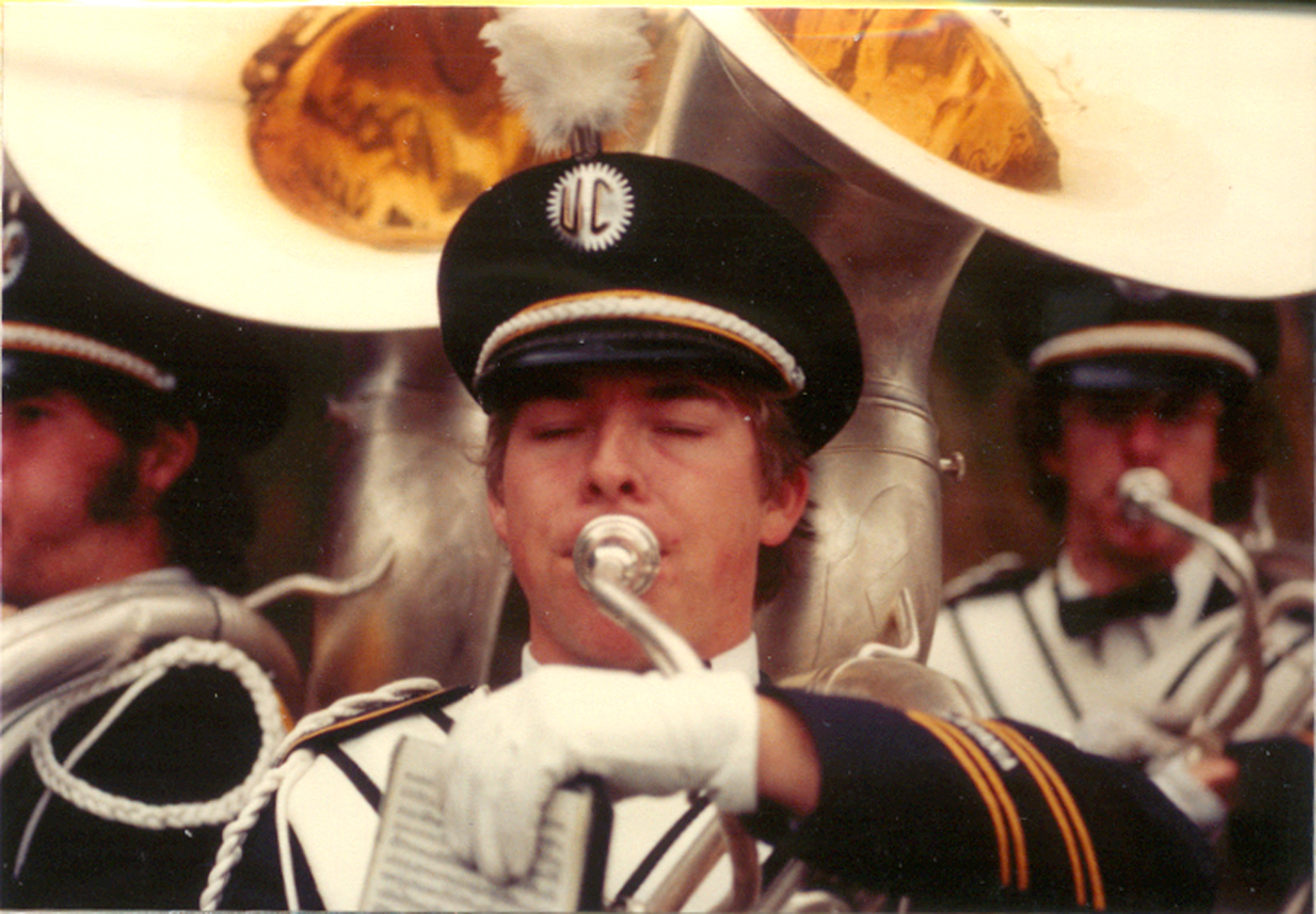
Though today the 11th of September is now most widely known as the anniversary of a gruesome and senseless act of monstrous terrorism, I would like to recall a more personal anniversary that is far more positive and pleasant. It was thirty-four years ago now – Sunday 11 September 1977 – that the Cal Band’s “Class of `77″, as we in the University of California Marching Band style these things, started its first Fall Training Program, better known as “FTP.” This is not truly the day when we joined the Band – that lay a few days in the future after we had passed the audition process – but it was our first day with the Cal Band.

With nearly sixty anxious recruits, the class of `77 was quite a large intake of potential new band members. By the end of FTP there were 53 freshly minted Cal Band members who participated in the traditional Silent Walk, which concludes the formal induction of new Cal Band members. The numbers are significant, for the Cal Band had 127 members during the 1977 season. I do not know the statistics, but I would think that there has rarely been a class of new members who comprised such a large percentage of the Band (42%.) A large percentage of the Class of `77 stayed on through the next four years to receive their prized Cal Band Blankets.

Many years ago I wrote down some recollections from that first FTP I attended. Some old memories fade, but that week of FTP is still clear in my mind. It is no exaggeration at all for me to describe the experience as “life changing.” I arrived at FTP that Sunday morning a very different person from the one who attended Silent Walk seven days later.

My first hurdle was the music audition. Boy, was I nervous! I had been travelling for almost the entire summer and had not touched my horn in about twelve weeks. I flew from LAX to Oakland early on Sunday the 11th of September, the morning that FTP started. This was the first trip that I had ever made alone in my entire eighteen years — in fact, I had never even been in an airplane until three months earlier. I had to make my own way to the dorms where we stayed for FTP (due to the fact that BART did not run on Sundays at that time.) I took a cab and was scandalized at the cost. If memory serves, it came to a whopping $12.00 with tip.) But the driver had been extremely pleasant on the trip, and told me tales of students he had met, mentioned that “the Band up at Berkeley was pretty sharp,” and wished me luck. He also turned off the meter at Channing Circle, despite having two more blocks to drive. I felt that things were off to an auspicious start.

Once I arrived at Deutsch Hall in Unit One where registration was taking place, I was directed to get a horn from the Room Q coordinator — for some reason I seem to recall that Larry Espinosa (Clarinet, `74) was involved — and report to auditions.

The auditions were held in a room at the end of the corridor on the second floor of Deutsch. I remember waiting out in the hall with other anxious freshmen, and I remember being so nervous I could hardly speak since my mouth was so dry. I had not played a tuba since high school graduation twelve weeks or so earlier, and I had not yet even had the chance to run through a few scales, so I was in mortal fear that I would fail and thus have to return home in ignominy. I remember the fellow ahead of me asking if I was nervous, and I assured him that I was. We got to talking and made introductions. He was Scotty Dreisbach (trumpet, `77) and he was also from Southern California (Anaheim.) I discovered that his high school, Magnolia, and mine, the now-defunct Rolling Hills, had competed in the same band competitions in Southern California, and so we began to feel a little bit less alone in this new and unfamiliar world. Scotty told me not to be nervous, since four years of high school tuba playing should make me a competent candidate. I informed him that I hadn’t played a note in three months. Scotty said, “Blow air through the horn.”

“What good will that do?” I demanded.

“It’ll keep you busy.”

Scotty was then called in for his audition, and I grew more and more nervous as I listened. By the time Scotty came out, giving me a thumbs-up gesture, I was a basket case; I was dry-mouthed, shaking, and tongue-tied. Mr. Briggs, the director, invited me to sit down. The first thing he noticed was that my knees were bouncing up and down like springs. He astutely surmised that I was quite nervous, and he spent a few minutes asking about my summer and such small talk in an effort to get me to relax.

I honestly cannot recall just what the audition consisted of. After Mr. Briggs handed me some music my mind is a blank until he finished and told me that “because I want us to march ten basses” the band needed me. I have always thought that smacked of squeaking by, and I wonder whether he saw beyond my wretched audition to perceive a greater ability or if he simply was desperate. Later that evening he told me that he was confident that I would be up to snuff by the end of the week. Whatever the case, I think that it must have been a truly terrible audition, and so those details have mercifully faded from my mind.

I honestly had no idea of just what I was getting myself into. After the audition I had to check in to my dorm room. I was rooming with Dave Lowrey (bass, `76) who was the bass section Teaching Assistant (TA) for the Fall of 1977. Naturally this added somewhat to my apprehension, but Dave was friendly — if somewhat brusque — and I figured it would work out fine. Dave poked his head into the room long enough to introduce himself and then turned to speak with some other TA. At that point and at others that morning the conversation was peppered with “colorful” adjectives. It struck me at the time — though it seems quite silly now — just how much vulgar language was being used in casual conversation; I recall wondering if I really was suited for such a crowd. Of course, sad to say, I soon acclimated. The coarse language was simply one of those “college things,” I guess, and it really wasn’t all that terrible by today’s standards.

At noon we had the “New Men’s” meeting. At that time incoming Freshmen, regardless of gender, were referred to as “New Men.” And bandmembers were collectively “bandsmen.” In 1977 the Band had only passed one full “generation” with its women membership. (That being a school “generation” of four years, since 1973.)

At the New Men’s meeting we were told some basics about the Band and its policies, the rehearsal commitment, and its high standards. Then they played a film of some pregame performances and halftime shows from previous seasons. Watching these remarkable displays of marching prowess and musical mastery, I suddenly felt very uncertain about my future.

I had assumed that marching would be a piece of cake compared to the music audition, most of the college marching bands with which I was familiar performed drills that were, essentially, the same things we did in high school, albeit on a far grander scale. But here I saw a Band of unbelievable, extraordinary speed and skill, playing and marching in drills and routines so complex that it seemed to me it would take months to master any one of them! I was unable to see how I could ever learn to march like that, and certainly not inside of a single week. I was not the only one who was in awe by any means. I think just about the entire crop of New Men were thunderstruck.

After about forty minutes we broke for lunch. I recollect that despite the best efforts of the “Old Men” to mingle, the table I was seated at was composed entirely of New Men. I sat across from Barbara Holliman (mellophone, `77) who was wearing a T-shirt that said “Cello Power.” I was impressed by her confidence that we’d all be able to manage to march like pros by the end of the week.

You see, the end of the week was hugely important, as we had been amply made aware, because the first pregame show and halftime performance (not to mention post-game, which was charted way back then!) were to be the following Saturday for the Cal vs. Air Force game. Thus we did not merely have to survive FTP, we had to succeed. The point had also been stressed that the pregame block would be just 92 bandsmen, and so competition for a place in the block would be intense. In fact, that block size greatly influenced that entire Fall season as we’ll see later.

At 2:00 we started the first field rehearsal. All of the TA’s formed a block and did a remarkable and impressive drill involving the marching fundamentals that we were to cover that first day. I and most of the other New Men were once more in awe, for these exemplars of marching style were also putting out more sound than most 100 piece high school bands (I think that there were about twenty TA’s that year.)

That rehearsal started one of the most intense and demanding three days of my life. I do not mean simply the intensity of FTP which was certainly present throughout that week. Rather I mean the intensity of realizing that one has a personal challenge to face. That first rehearsal was tough, both physically and mentally demanding, and personally nerve-wracking because I had never been very agile or particularly well coordinated. I was not then (and I never really have been) a “quick study” when it comes to choreography and the like. Yet the Cal Band was teaching marching fundamentals that demanded both physical exertion and rapid mastery. We started with one of the Cal Band’s most distinctive marching basics, “high step,” so called because, as the name implies, it involves a crisp, high lift of feet with a rather challenging “toe-point.”  When it is properly executed, it looks deceptively simple, but to leg muscles unused to its requirements, it is a truly demanding first step.  High step would be used through most of our pregame performance. We also learned a variant of high step that was suited to slower pieces which demanded a more stately effect.  This fundamental was called “show high.”  We would be using this toward the conclusion of our pregame show as we marched to America The Beautiful in the “full field spread,” as the band expanded across the whole of the football gridiron. Show high required raising your feet so that your thighs were parallel to the ground.  Because it was a slower maneuver, it seemed at first to be relatively easy.  But legs unused to these fundamentals quickly found the slow and stately pace was actually more ache inducing than high step!  The final marching fundamental I recall learning that afternoon was a “back pivot,” a 180-degree reversing step.  I watched so carefully, but could not seem to get it right.  As I mentioned, I was definitely growing worried, especially because it had been made clear that we had more – much more – to cover in the next two days.

By the time 5:00 rolled around, I was tired and frustrated and more than a little scared. Tired because of a three-hour workout in the warm autumn sunshine, frustrated because I was not picking up the fundamentals rapidly, and scared because I was afraid I would fail to pass the marching audition. Suddenly, even after just one day, I wanted to be in the Cal Band more than I had ever wanted anything in my life. And I knew that it would require more hard work and dedication than anything that I had ever previously been involved in.

I still look back on that Sunday afternoon, walking back to Unit One (a pretty long hike, so plenty of time for reflection,) and I can vividly recall resolving that I would make it. I said to myself that no matter how much work it took, I was going to be a part of the Cal Band and I would learn my fundamentals. I do not know if I then realized it, but it certainly is the Band’s emphasis on its carefully crafted marching fundamentals that made it possible to take a batch of raw recruits and turn them into reasonable marchers inside of five days. And since everything builds from the fundamentals, those amazingly complex drills do become learnable. But whether or not I understood the long-range benefits of the fundamentals, I knew that I had to get them down. And I clearly recall resolving to make it. I really think that this was the first time in my life that I had so clearly aimed at a goal which was — to me at that time — so uncertain. I grew.

When I got back to Deutsch Hall, I found that my sister Anne was waiting for me. She was driving from central Washington down to Southern California, and she stopped to have dinner with me. We ate at the Round Table Pizza on University, and she dropped me back at the dorm just in time to make the evening music rehearsal.

The music rehearsal was held in the Cal Band’s Band Rehearsal Hall, which, given the Cal Band’s propensity to reduce every term to its initials, has always been better-known as BRH.  It seemed an incredibly large and fancy facility to me in those days.  Its multi-tiered layout was perfect for a 120-piece ensemble.  The walls were decorated with the annual formal group photos of the Band, which imparted a sense of the long history and tradition we hoped to soon become a part of.  The hall had been cleaned up and readied for FTP, so the clutter and detritus that accumulates over a Fall season was not yet visible.

Music rehearsal was another intense experience, of course. It seemed that none of the Old Men needed music even though we played for three hours! I was once more unsure that I could ever get to that stage, but as I said, I made up my mind that it must be possible. By the end of the rehearsal my lips were painfully “buzzed,” but I was having a great time playing my horn again. I also liked the fact that we sang as well as played, for I have always loved to sing.  We learned the words to the music we would be playing for the pregame show, and to the campus alma mater, All Hail.  I recall thinking at the time that in four years of high school band I had never properly learned the words to our high school alma mater, yet here, in one evening, I had learned half a dozen school songs.  It was an impressive experience.  I also greatly appreciate the fact that Mr. Briggs gave a short history of each of the songs we were learning. The University of California has a rich treasure trove of school songs, generally simply referred to as Cal Songs, and we had just begun to scratch the surface; throughout the season, we would continue to learn other songs from the abundant resource of Cal Songs, including some truly obscure items.  As I learned of this musical heritage which even then spanned almost nine decades, I realized that this was an organization with a long and cherished history. That appealed to me powerfully: to be a part of a tradition that spanned nearly a century! That was a fine prospect indeed.

I walked back to Unit One with Dave Lowrey, Kip Parent, (bass `75) and two other New Men, Dan Blick, (bass, `77) and Carlos De Los Rios, (bass `77.) Despite the alleged 11:15 lights out, all of the New Men seemed to be up for hours “kicking the walls” to practice high step. I remember being aware that my legs were already quite stiff.

What a week lay ahead!

Monday morning 12 September 1977 was one of the most unsettling moments of my life! As I mentioned, I was rooming with Dave Lowrey, the bass’s TA. Dave had brought a huge and noisy box-fan into the dorm room, and despite my assurance to Dave that I could sleep through anything, the damned fan kept me awake most of that night! The fan was not merely loud, it was in pain! It seemed to be out of balance so that it developed an unpredictable but irritating screeching noise at odd intervals. Whir, whir, whir, whir, screeeeeeeeeeck, whir whir whir… As the week wore on I did manage to sleep through the cacophony — exhaustion is a wonderful sleep aid, after all — but I got little rest that first night. And, for reasons that I have never understood, when the TA’s came to our floor to do the dreaded reveille — rattling door knobs, pounding on doors, and generally making enough noise to wake the dead — they skipped Dave’s and my room!

Yes, much to my consternation and fright, Dave and I slept till about ten minutes of nine! The second field rehearsal was starting in ten minutes! I woke up Dave and we dressed in a fury and ran down to the field. As we passed through the great green gates to Edwards Field, Dave instructed me to walk, as running would call attention to us. I didn’t bother to ask how two guys walking across the field with sousaphones could fail to attract attention, but I walked. I had visions of being drummed out right then and there, since punctuality had been stressed as being especially important for the week, but thankfully no one really seemed to notice, and we were just a few minutes late.

In reflection, I would imagine that our tardiness had indeed been duly noted and that Dave, as a TA, was probably dressed down right smartly by the Drum Major (Bob Smith, clarinet `74.) But since I was a tyro, they did not make mention of it to me. I was grateful for that, for sure! A real down side for me was that I not only had missed breakfast — no big deal — but I had missed the chance to make a bag lunch for the day. By the time dinner rolled around that night I was starving, but I survived.

The morning started off with a review of the previous day’s fundamentals, and the introduction of others. That afternoon we began learning some of the basics of the pregame flows, and each section would march a drill playing its part. It was wonderfully weird to hear a group of mellos, say, just punching out off-beats of Big C and marching down the field.

At music rehearsal that evening we began learning some of the halftime music which was various selections from Star Wars. I was mightily impressed that the Band could get the music from a movie that was still in the theaters! This was definitely a far, far cry from high school!

We had quite a lot of music to learn that week. Pregame consisted of Big C, Sons of California, California Indian Song, Fight for California, America The Beautiful, and The Star Spangled Banner. Post-game included Make Way For The Bear, Fight `Em, Stanfurd Jonah, Lights Out, One More River, and By The Old Pacific’s Rolling Waters. The halftime was various pieces of thematic music for a Star Wars show, but also included the theme from Star Trek, (the TV show; at that time there had been no movie versions!) and, interestingly enough, the theme from the Underdog cartoons. This volume of music was, too, a far cry from high school days.

Tuesday morning started off much better than Monday. Dave and I woke up and had breakfast and arrived on the field in plenty of time. On the way from the dorms, Dave insisted that I stop to buy a pair of gym shorts. I had marched the previous two days in blue jeans, and Dave wisely and correctly felt that shorts would be better. I also bought a bottle of Block Out sunscreen and some chapstick. The marching drills were getting more complex and demanding, and the weather was warming up. The dreaded marching audition was a day and a half away. Those of us not used to spending more than eight hours a day in the sun were already beginning to show the effects: chapped lips and sunburn were pandemic.

I recollect that on that second full day I finally began truly making friends and acquaintances. By some unspoken sense, we New Men had begun to feel that we as a collective group were going to succeed. I know that this memory must be tinted by the reflection of the following years, for our class — despite fierce differences at many points — was definitely characterized by a collective sense of support and stick-to-it-iveness. Yet I remember people both on the field and off insisting that we were all going to make it. I know that some did not, and I admit I have no memory of those people now, but those of us who did make it were many. And in large measure we made it because of the mutual support. Certainly Old Men were encouraging, but it was from the New Men that the most insistent support arose.

In the bass section we had a good number of New Men: Dan Blick, Carlos De Los Rios, Ken Needham, (bass, `77) Dave Reyna, (bass, `77) and me. There were also five Old Men, Jay Huxman, (bass, `76) Kip Parent, Randy Parent, Greg Schoofs, (bass, `77) and Dave Lowrey. So we newbies were one half of this highly visible and musically important section. (Mr. Briggs was very big on the importance of the basses.) We knew that we were both crucial and untrained, and we worked intensely that night to master highstep and kicking the walls. I remember all of us New Men basses being up until at least two o’clock working on this. I also recollect that Ken Needham was among the most fanatical among us, not merely driving himself, but pushing the rest of us too. As I say, we seemed to have quickly developed a sense that we were a team, and we were a team that would succeed. That sense lasted us through the next four or five years, and is one of my most treasured “possessions” from my Cal Band days.

Wednesday’s rehearsal began with Drum Major Bob Smith pointing out that the prominent concrete C on the hillside east of campus had been desecrated; it had been painted (a rather wimpy shade of) red! Horrors! Not, I think, that any of us, New Men or Old, had any doubts that this was an inside job, but we were all duly horrified. And I believe that we New Men also understood that it portended some certain obligation on our part. In fact, it was probably mentioned to us that it would be our duty to repaint it, though I am not certain.

That day’s rehearsal seemed to go on and on and on and on.

Well, the time of the marching audition eventually arrived. With the passing of years it seems that this was held very late in the afternoon with long golden shadows stretching across the bleachers of Edwards, but in reality it took place between 4:00 and 5:30, so it cannot have been quite so picturesque. Yet it ought to have been at least that visually dramatic, for it was that emotionally dramatic.

For those who have never experienced FTP, the significance of this test cannot be completely understood. It is not merely a test, it is a goal that has loomed large for three previous days, and given the intensity of an FTP experience — no phones, no TV, no newspapers — it becomes the only thing. It is huge, intimidating, and necessary.

Every bandmember, new or old, must march 100 yards with a TA at every ten-yard line recording your effort. The marching was done to a bass and snare drum, (Karl Bizjak and the percussion TA, Tom Blair [percussion, `76]) snapping out a cadence that echoed and reechoed off the surrounds like gunshots. In some ways it felt more like a march to an execution than a march to an achievement. Scary. Scary. But it had to be done.

I remember when my turn came. All the Old Men were encouraging. Dave Lowrey gave me a thumbs up as I passed him, and Karl Bizjak whispered loudly, “way to go, Rawman.” (A nickname I never much liked, and which, thankfully, did not catch on!) When I had completed that gauntlet, I set my horn down, and in my exuberant relief that I was through it, alive, I dashed down the track and leapt several low hurdles, a thing that I had never done before. I was, honestly, after three days, forever changed, (though far from a finished product!)

Dinner that evening was an anxious thing, as the letters of acceptance or rejection were to be handed out afterward, prior to our evening music rehearsal Several Old Men tried their best to lighten up the meal with various silly “Knock Knocks.” We had already been introduced to this “art form” but that evening the introductory puns were as outrageous and inane as people could conceive. The concept is simple: just as knock knock jokes rely on unexpected puns for their effect, Cal Band knock knocks use the same premise as a means of  starting a Cal Song.  A typical example might be started with someone shouting to the room,

“Knock, knock!”

“Who’s there?” comes the loud response.

“Oyster!”

“Oyster WHO???”

Then the whole crew would join in singing Fight For California, which opens with the lyrics, “Our sturdy golden bear is watching from the skies.”  Of course the words “Our sturdy” are formed from “Oyster:”  “Oyster dee golden bear …” It is, obviously, incredibly silly and lighthearted.

Yet the forced levity could not mask the fact that after that evening some folks would be gone, and some would remain. And we were all on tenterhooks.

There are those who think that it must have been obvious that the Band would accept all whom it could, but consider this: we knew that the basic block had been decided at less than 100 people, and that the pool of people at FTP was more than 130! We did not have the confidence that the Band could even afford, whether or not desiring, to bring so many New Men aboard. We were scared. Monica Johnstone, (clarinet, `77) summed it up best when she said to a gathering of New Men, “those of us who don’t make it now will come back for re-auditions next week.” For Monica, as for the rest of us who stuck it out, failure was simply no longer an option. I do not mean that we were cocky; I mean to say we were already a committed group.

Well, after dinner in the Unit One dining commons, we gathered to receive our eagerly anticipated/dreaded envelopes. I opened mine with apprehension and discovered — as is plain by now — that I had indeed been welcomed into the Cal Band for the 1977 – 1978 year. Dave Lowrey gave me a hearty handshake and a pat on the back. All of us New Men basses congratulated each other. And then we headed back to BRH for music rehearsal and something called “Big C.”

The “ceremony” of “Big C” has no doubt undergone many evolutionary changes over the years, but in 1977 it was still a cross between hell night and old home week. We New Men were made to walk quietly across the campus to the hills beyond Galey Road. Once at the base of the slopes, we were required to ascend straight up the steep hillside. The long, dry grass was as slick as ice, and with legs aching from three and a half days of marching and drills, it was no mean feat to actually make it up to “The C.”

Once we arrived at the huge concrete initial which adorns our rugged eastern foothills, sensory overload set it. Virtually all of the Old Men were there exhorting and demanding, hollering and screaming, hurling foul epithets, and in general encouraging us Freshmen to paint the C! Large buckets of watery yellow (gold?) paint had been provided, and stubby brooms and worn-out mops were handed to us.

If you have ever tried to accomplish anything with 60 people screaming at you and jostling, and hassling you, you are well aware that it can be a challenge to say the very least. Add to that background the hopelessly inadequate tools that we were given, and you can imagine there was much room for less than positive critiques of our work. Nevertheless, after a surprisingly short number of minutes — yet still an eternally long passage of time, relatively speaking — the defiled C had been restored to its rightful hue. And then, as suddenly as a thunderclap, silence reigned.

What followed was something of an epiphany for me personally, as I was really not too impressed with the hazing part, though I feel that I took it in stride. The reason what followed was such a revelation was that there was suddenly a genuine sense of belonging imparted to those of us who had just survived three and a half tough days and ten minutes of hell. We were accepted into the fold. Cal songs were sung, bawdy chants and cheers were hollered, tales of dubious authenticity and questionable moral value were related. I’ll not go into more detail, though the night is still a vivid memory, because much of the subsequent couple of hours just would not be fitting for the written record. But suffice it to say that when I returned to the dorms that night, I felt that I had indeed been accepted by the Cal Band.

On Thursday we began working on the halftime in earnest. It was really quite a relief after the previous few days, because the halftime show was necessarily kept to a simplified minimum. That is to say, simplified in Cal Band terms. There was a good deal of stand-and-play rather than intense marching drills, and the show was a props extravaganza based upon Star Wars, which was the mega-hit blockbuster of the summer of 1977.

We all appreciated the comparative simplicity of the halftime show because we also had a huge amount of work yet to do on pregame. The pregame that season was charted for 92 bandmembers (actually, in a bit of unusual subterfuge, the charters had inserted four additional marchers into the flow after the script Cal and before the long lines of America The Beautiful so that the full field spread would work properly. As I have mentioned earlier, this small block size gave rise to a fairly intense competition among bandmembers, since we had ended up with 127 people after Wednesday evenings cuts.

The pregame started, of course, with Big C and a flying wedge which would burst out of Memorial Stadium’s North Tunnel at impressive speed. We then transitioned into Sons Of California and a block C, then into California Indian Song and concentric squares. From there we naturally played Fight For California as we formed the traditional script Cal. We jogged off and formed the long lines for America and the full field spread, and concluded with our national anthem. A fairly typical pregame, to be sure, but also a fairly demanding one. We managed a full run-through by late Thursday so that Friday was spent polishing pregame, working on halftime, and learning postgame.

Postgame was not terribly demanding when considered in light of that pregame and halftime, yet it was a charted performance with a block and some pretty complicated flows. But by the end of the week we had gotten a firm enough grasp of our fundamentals that it seemed almost “easy.” We New Men, and myself in particular, had come a long, long way from that Sunday morning just five days and half a lifetime before. I went to sleep that night anxiously and eagerly awaiting my first Cal Band Saturday morning.

I will never forget was my very first marching performance with the Cal Band.  It was Saturday September 17, 1977.  Though it was more than half my lifetime ago, it is a vivid and clear in my mind as if it were last week.  And how could it be otherwise?  Though we newly created band members had been in the Band just six days, we felt as if we had been focussed on this goal for months.

Cal was to play Air Force that day.  It was not then and is not now a major Cal rivalry, and the attendance at the games was expected to be quite low, somewhere between 20,000 and 25,000 fans.  But for those of us who had never performed in Memorial Stadium, the prospect of thousands of people watching us from the seats was fairly impressive.  We had done our final rehearsal of Friday in the great, empty stadium, and it seemed unimaginably vast.  I think that I expected twenty or thirty thousand people would nearly fill the place up!  In any case, it would surely be the largest crowd I had ever performed before, and that was exciting.  And a wee bit scary.  So it seems to me that every new Band member was both eager and anxious for Game Day to begin.

Saturday morning arrived with a bang at 6:30 as the T.A. squad went from floor to floor rousing every one.  We had to get an especially early start that morning because in addition to the logistical hassle that a Band Saturday morning usually is, we were also checking out of the dorms and other such mundane triviata.  Bags were packed, gear was gathered, and everyone’s goods were piled into a large room on the ground floor of Deutsch Hall to be collected after the game was over.  Keys were turned in and names were checked off the lists.  In remarkably short order, the checkout process was wrapped up.

Breakfast was light that morning.  I recall that it consisted of a selection of those tiny boxes of cold cereals, tiny cartons of milk, and tiny cartons of orange juice.  Many of us did not want to risk eating anything at all.  There was fear of developing cramps and such, but I think more than that was simple newbie jitters.  I recall Gerri Rosen (piccolo, `77) advising people to drink the orange juice, though.  The fluid and the nutrition would come in handy.

It was a busy morning.  We walked from Deutsch to BRH where we changed into the standard Saturday Morning Uniform — pants, white shirts, hats, and rehearsal vests — and many folks enjoyed coffee and donuts which were in those days provided by the Band for each Saturday rehearsal.  For those of us in the Bass section, this would be our first rehearsal using the “performance horns,” which were King, satin silver sousaphones, with gold-plated bell interiors.  The King sousaphones had been purchased for the Bicentennial Tour two years earlier.  These were striking horns, and they were kept in nearly flawless condition.  For daily rehearsal we used the older Besson sousaphones.  These were heavier than the Kings, so it was a nice break to use a lighter horn on game day.  The basses walked down to Edwards, footsore and weary after a week of FTP, I would guess, but no one mentioned anything.  The excitement was palpable.

Saturday morning rehearsal started at 8:30 sharp, and lasted for two hours.  We ran pregame first.  That year our tunnel formation lined up in the north end of the track field (naturally!) where there were textured steel plates covering some pits.  The steel plates were thick and painted an ochre red, inappropriately enough.  When someone jumped up and down on them, they made a jangling, clashing  din of cacophony.  And jump up and down one person in particular did.

After we did our walk-through of tunnel flow and into the wedge, drum major Bob Smith told everyone to run back into tunnel formation.  Among the first ones back, if not the very first, was Howard White (trombone, ’75.)  Howard, jumping up and down on those obnoxiously noisy steel plates and making enough noise to drive the seagulls from the bleachers, shouted out, “I’m here!!!  Where is everybody!?!???” That rallying cry became his trademark to the extent that the catch phrase “I’m here! where’s HOWARD?!??!!!” became a signature of that Fall season.  (It even showed up in fortune cookies during Big Game week!)

After running through pregame full-out, we ran halftime.  As I mentioned earlier, the show took its theme from the smash hit of that summer, Star Wars.   Due to the tight schedule of FTP that year, the show was planned as a melodrama with plenty of acting and dancing and such, but relatively minimal marching and maneuvering for most of the Band.  It was also a prop extravaganza.  A golf cart was pressed into service as a sort of shuttle craft for Luke Skywalker and his Wookie sidekick (Jim Hutcherson, [trumpet, `75] and John Soper [trumpet, `75].)  Jim was resplendent in his Skywalker whites, and Soper was looking vaguely ridiculous in a hilariously furry, black gorilla suit.  The golf cart itself sported shiny, aerodynamic-looking, cardboard-and-aluminum-foil side panels.  Exhaust was simulated with a dry-chemical fire extinguisher.

I was impressed by the quality and complexity of these props.  Tom Blair was AdmProp (Assistant Drum Major for props) that Fall.  He and his crew had built a huge box that would be placed in the middle of the halftime formation midway through the show.  This not only would serve as the platform for dancers and for Luke Skywalker’s fight with Darth Vader, it also served as concealment for the various costumed characters who were part of the show; Doug Kern (trombone, `75) played Darth Vader in an enormously over-sized, papier-mâché helmet, Carol Dows (tenor sax, `75) took the role of Princess Leia, complete with prominent buns in her hair.  I will never forget the surreal sense of the absurd I felt when it came time for the platform to be placed on the marching field.  From the drum major’s tower, Bob Smith instructed – as if it were as normal a command as any he’d given that morning – “Prop, hup on three!” The actors inside the giant box simply carried it onto the field, supporting it from the inside.

After some last minute refinements to the halftime show we did one run-through of Post Game, then it was back to the Band Area for lunch.  I was so impressed that the Band provided sandwiches for everyone on Game Day.

It was now 11:00 and we had an hour to eat and change before the Band’s concert on the steps of Sproul Hall on the east side of Sproul Plaza which traditionally signaled the commencement of Game Day festivities on the Berkeley campus.  The Sproul Steps concert would be followed by a sort of parade through campus, with the Band leading a stream of Cal Fans up to California Memorial Stadium.  We in the bass section were told to be quick because we also had to align the bells of our horns before we hit the steps.  It may sound like a simple procedure, but it required that everyone be present and ready so that the alignment would be as uniform as possible.  It was fortunate that the ASUC Store had a large expanse of plate-glass windows which we used as a sort of mirror to help us get the adjustments right.

About 11:40 the Band began to form up on lower Sproul Plaza.  Shouts of “I’m excited!” echoed off the concrete walls.  “I’m excited!” was an understatement.  I was excited, undeniably, but I was also nervous as all get out.  Would I mess something up?  Would I get to my spot in the wedge in time?  Would I be able to play all the music?  And on and on.  I guess I could say that I had butterflies in my stomach.  But they were enormous, paper-kite-sized butterflies.

I was eagerly looking forward to that afternoon.  This would be the first time I had ever been to a college football game, as well as being my first Cal Band performance, and I could look forward to performing for my older brother Bill and my twin brother, Rob (trombone, `78.)  My brothers were driving from Southern California that morning with various goods and items that I had not packed for FTP, but which I would need for the coming quarter.  After attending the game in Berkeley they’d be on their way to take Rob at U.C. Davis where he was enrolled that Fall.

Just before noon, the Band burst up the staircase to Sproul Plaza, charging through the crowd of die-hard Cal fans who gathered there.  We played through several Cal songs and the “Cantina” music from the halftime show.  Then we were off to the stadium.  Along the way we sang traditional song such as Titanic and Salvation Army, maintained strict silence past the libraries, and played out silly jokes such as:

“Hey, Schoofs!  What’s your old man do for a living?”

“Aw, nuthin’!  He’s a cop!”

“Honest!?!??”

“No, Berkeley PD!!!” as we passed a Berkeley city officer.

Once we reached Memorial Stadium, we bass players had to change from our street shoes into the soccer cleats needed for strutting on the grass of the football field.  The cleats had all been put in a large box that was driven up to the stadium in the “Band Van.”  As we all retrieved our cleats I was panicked to discover that I had only a right shoe!  My other cleat was not in the box!!!  Naturally I had visions of trying to strut in black dress shoes and falling flat on my back in front of 20,000 fans.  I was quite distressed, particularly because I was absolutely certain that both cleats had been together (tied together, in fact) when we put them in the box.  I was at a loss for what to do – there would not be time to go back to BRH to look – when Jay Huxman saved the day.  He had had the intelligent (and probably obvious) notion to look in the back of the Band Van!  The missing cleat was found and I would be able to march.

As the time to form up approached, I was growing more and more nervous, and getting that adrenaline rush that anyone who has ever stormed forth from North Tunnel can readily recall.  (To this day when I listen to any recording of the Tunnel Yell, I still experience a trace of that feeling.)  There were Band members throughout the tunnel stretching and limbering up and generally getting ready for the surge of energy needed for tunnel flow.  “Tunnel flow” is conducted with the vast majority of the Band executing a double-quick step that is nearer to a flat-out running pace than a marching step, and truly requires proper warm-up.  The basses, however, bring up the rear of the wedge by strutting out of the tunnel at a pace of six strides per five yards, an impressive feat that demands a degree of physical fitness above and beyond ordinary marching maneuvers.  So North Tunnel was filled with bandmembers in an array of bizarre postures, readying their limbs for the upcoming task.

Then the football team came through the tunnel after their warm ups.  We were cheering them on and many of the players high-fived Band members and otherwise interacted.  I recall the players as seeming impossibly huge, girded in their padding and all; it was hard to believe that many of them were my age.  (Of course it’s almost harder for me to think that none of the Players on Cal’s team this year had even been born when this game took place!)

Suddenly the tunnel grew quiet and the cry of “Stick’s up!” announced that the time had come.  “Pick up your heels!  Turn your corners square!  And TWINKLE!  TWINKLE!!  TWINKLE!!!”  (You must remember that I was in the bass section.  The vast majority of the Band booms out the more understandable, “DRIVE!  DRIVE!!  DRIVE!!!”  The basses technique of flashing our bells as we marched was termed “twinkling,” hence the basses’ alternative wording.)  As I say, the adrenaline surge that hit when tunnel cadence began was almost overwhelming.  As the band exploded out of the tunnel, the basses remained along the walls on each side until we could form our lines for the entry strut.  I was the second from the end in the right-hand line.  Greg Schoofs was behind me.  Despite the electricity of the moment Greg was cool, calm, and collected, and he politely pointed out that I was out of step as we jogged our tunnel pace in place.  I felt painfully embarrassed, naturally, but at least I was corrected before we actually started moving.  As the last of the ranks took off, we basses charged down the tunnel and flew across the grass, strutting into our positions at the back of the wedge.  Though the stadium was indeed far from full, all the same the crowd noise was unlike anything I’d ever experienced to that time.  Nothing like the U$¢ game later that Fall, nor Big Game, when Memorial Stadium was filled to capacity, but still, for someone who had only ever performed for high school football games it was more fuel to that rush.

Pregame was a blast!  By the time we finished the ripple bow which concludes the traditional script Cal, there was a tangible sense of having accomplished a truly great goal.  The fans were applauding and cheering for us.  I was astonished and proud to hear the rooting section bellow out: “Cal Band GREAT!!!”  What a wonderful feeling!  We then moved into the long lines in position for the full field spread in which the Band would be distributed across the entire football field, endzone to endzone and sideline to sideline. Because of the relatively small size of the Block that Fall, the spread was even more widely spaced than usual, and I was very anxious that I might miscount and miss my pivot, but Dave Lowrey was near me in the north half of the field as well, and he helpfully yelled at me “NOW!”  So I did it right.

After we jogged off the field we took our place in the stands.  It was always nice to be in the bass section at the far back of the Band, because we had a really good view of the field from about 20 rows up.  The game was not terribly exciting; Cal was dominating Air Force from the get-go.  I began to yawn and I was sorely tempted to nod off.  The Fall afternoon was warm and pleasant, and sleep had been a scarce commodity that week.

When halftime arrived, we formed up to go onto the field.  Because Air Force had not brought their band, we were treated to an exhibition of falconry as Air Force’s halftime contribution.  It was an impressive display, and those of us along the sideline had an excellent view.  But I would guess that the folks in the stands found it hard to see much of anything.  In 2004 at the Cal/Air Force game, I was intrigued to discover that they still had a trained falcon exhibition, but I did find it awfully difficult to see that falcon against the background of a stadium crowd.

As I said above, the halftime show was somewhat complex logistically, but it was nowhere near as demanding as pregame.  We started off with the theme from Star Trek, with our piccolo section filling in for the TV music’s theramin.  OOooeeeeee-dee-dee-dee-dee-dee …  Albert Locher, (trumpet, `68) the Band’s announcer, intoned the familiar, “Space.  The Final Frontier …”  The first formation was the outline of the starship Enterprise.  We then morphed into the setting for the Cal Band’s rendition of Mos Eisley spaceport and cantina.  Dancers came forth from the prop which had indeed duly hupped on three to arrive in position on time.  Our version of the cantina’s mixture of freakish aliens looked more like bumble bees from Romper Room, but the effect worked.

At some point – and I admit that my recollection is not so precise as I’d like it to be – Darth Vader appeared from the prop and captured Princess Leia.  From the north endzone, Luke Skywalker and Chewbacca zoomed in (well, insofar as a golf cart can be said to have zoomed) to save the day.  Unfortunately, the golf cart apparently ran out of juice well before Luke was at the prop, but Jim emboddied the motto, “Perform and Adapt.” He leaped from the stalled vehicle and dashed onto the field as if it had all been scripted.  Luke and Darth engaged in a duel to the death with Luke getting the worst of it.  As Darth was about to triumph, though, a mysterious voice intoned over the stadium’s PA system: “Use the Force, Luke!”

I thought this was way neat: the bass section represented “The Force.” We surrounded the evil Darth Vader and symbolically smothered him with our bells!  Goodness triumphed, evil was thwarted, and we wrapped it all up with John William’s “Graduation Music” from the film.  Huzzah!  It was truly a simple show by Cal Band standards, but it was effective and the crowd loved it.  The Stunt Comm that year had shown sound judgment in creating a halftime show that could be learned along side a pregame and a postgame all in one week.

Cal’s lead at halftime was maintained throughout the second half, and when the final seconds ticked off the clock, it was California 24, Air Force 14.  What a great bit of good fortune.  The Class of `77’s very first game was a Cal victory!  As we formed up in the south endzone for postgame, I was still buzzing from the adrenaline rush.  We played Palms Of Victory and All Hail and many fans lingered on the field listening to our postgame concert.  In those days, the fans always took to the field after the game was over, and so our contact with our audience was quite direct.

At last it was time to march back to the Band Area.  We formed a block to leave the stadium to “One More River.”  The Band that marched off the field that afternoon represented a truly magnificent accomplishment:  Fifty-three raw recruits had presented themselves at FTP Sunday morning six days and a lifetime before.  The people who left Memorial that afternoon were indeed the Cal Band, an integrated whole, a new chapter in a long and proud tradition.

Such an accomplishment was possible for many reasons.  I think that the determination of everyone involved was important.  But all that determination would have come to naught if it were not for the Band’s long experience in training new recruits, the development and teaching of fundamentals, building upon years of previous experience, improving where needed, and retaining what worked.  Above all, the Band’s sense of its heritage and commitment that was so fully conveyed during the days of FTP was key.  All of these things combined to channel the enthusiasm and determination of the new members into the polished product that is the Cal Band.

In late September of 2005, I was teaching a class in Dallas.  After the class ended on Friday afternoon, I was talking with one of my students, and I discovered that he had graduated from Cal last year.  We spoke about the coming football season, and he mentioned that he’d been there for the dismal 2002 season.  Though I had not yet told him I had been in the Cal Band, he offered: “That year the only reason anyone came to the games was to watch the Band!”  I felt quite proud that such a statement could still be made.  The Cal Band is a heritage worth maintaining, and it is an asset to the University.

We marched down to BRH following the reverse of our route up to the stadium.  As we passed in front of Doe Library, Kip Parent introduced us new men basses to an odd tradition: we picked up our horns in our left hands and carried them raised above our heads until we passed from the front of South Hall.  It looked a bit strange, I would guess, and frankly, after the week we had experienced, it felt terrible!  But in its own way it did look fairly impressive.  My arm was really burning by the time we got to put the horns back on our shoulders.
Detail of a shot of Cal Band Basses beneath Sather Gate after the Cal v Oregon State game, October 1980. Left to right: Joel Buringrud, Jamie Rawson, Alan Barton.

My brothers Rob and Bill met up with us as we passed under Sather Gate, and I gave them directions to Tellefsen Hall, the house on the north side of campus where 44 male members of the Band would live that school year, so they could take my gear up.  Bill told me that he had seen the Cal Band many times (Bill was, alas, a benighted UCLA alumn) and had always been impressed by the halftime shows.  He told me about a show at UCLA in the early `70s where the band had done a dance in the darkened L. A. Coliseum using flashlights.  He said the Cal Band was a top-notch group, and he was pleased and proud that I had made it.  Me too!

When we arrived at BRH there was much rushing and hurrying, because that evening would be a ceremony called “Silent Walk.”  We had to change, get our gear, head home to change into dressy clothes, and be back at the Band Area at 7:00.  Some expressed a concern that we might be in for another “Big C” type ritual, but Ken Needham rightly pointed out that they wouldn’t ask us to dress up for something like that.

Silent Walk was a moving experience.  We were charged with the responsibility of remaining silent so that we could listen, absorb, and contemplate what we were to learn.  We walked in silence through the campus, stopping at various significant sites to listen to a presentation about some aspect of our Band and our campus.  The silence gave the event a feeling of deep solemnity and importance, and the ritual seemed nearly religious in its bearing.  In the coppery light early evening, amid the long, tangential shadows, the campus was a beautiful setting for the Walk.

Later that evening I found out that Rob had walked back to the Band Area after we had set forth on Silent Walk to look for me.  Norman Chong (baritone, `74) was waiting on the bridge for any late Silent Walk participants.  He saw Rob dressed in blue jeans and a casual shirt and said, “Jamie!  You’re supposed to be dressed up!”  He later admitted that it took him a couple of minutes to believe that Rob really was my twin brother!

At each point we learned about the history of the Cal Band, its heritage, its achievements.  We stopped at Sather Gate and learned of the recent history of the Band, and how the Band Area came to be.  At Old Eshelman Hall we heard of the early years of the Band, and learned names Such as Chris Tellefsen and Charles Cushing.  At the Campanile the carilloneur played All Hail as we listened to the presentation there.  At the Greek Theater we learned of the Band’s tradition as the embodiment of The Spirit of Cal, and heard Benjamin Ide Wheeler’s famous quotation:

“This University shall be a glorious old mother around whose hearth you shall love to sit down. Love her. It does a man good to love noble things and to attach his life to noble allegiances. It is a good thing to love the church. It is a good thing to love the state. It is a good thing to love the home. It is good to be loyal to one’s father and mother, and after the same fashion, it is good to be loyal to the University of California, which stands in life for the finest things and the highest ideals. To the University of California, then, cheer for her, it will do your lungs good. Love her, it will do your hearts and lives good.”

We ended the Walk inside California Memorial Stadium where the scoreboards were still lighted up, displaying the score from the afternoon.  The Walk, though not so very lengthy, had been quite a lesson.  The things we learned gave us a sense that we had become a part of something far greater than the sum of its individual components.  We learned about a time when the president of the University had declared the Band “a disgrace,” and about the evolution of the Cal Band that became the Band which has for more than sixty years been an undeniable source of pride for the University and its community.

The Walk concluded with the bestowal of Cal Band pins upon the new Band members.  Dave Lowrey pinned mine on me.  I cannot recall having been so proud of any recognition in my life.  I had made it, and I was a Cal Bandsman.  Rarely have I ever had such a sense of rightness and fittingness.  I was where I was meant to be.

Before the conclusion of the Walk, Dave Pearson (saxophone, `69) spoke on behalf of the Cal Band Alumni Association.  He told how our association of the Band would extend beyond the years at Cal, and would provide us with something which we could be a part of from that evening onward.  He mentioned organized Alumni Band events such as the annual Alumni Band Day, and he mentioned the many informal events and spontaneous gatherings that we would enjoy over the years.  In these thirty-four years since that evening, I must say that he was one hundred percent correct.  Dave concluded his presentation with a statement that also is amply proven:

“Once a Cal Bandsman, always a Cal Bandsman.”

+-+-+-+-+-+-+-+-+-+-+-+-+-+-+-+

Jamie Rawson
Flower Mound, Texas

It is probably wrong to permit any highly developed art, no matter how fatuous, perish from the earth – and which arts are fatuous depends on the point of view. — George S. Patton